


Maculabatis gerrardi (Gray, 1851)
Sharpnose stingray
Lägg till din observation i Fish Watcher
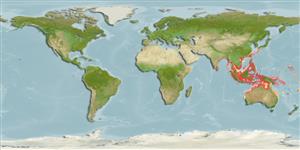
| Native range | All suitable habitat | Point map | Year 2050 |
|
| This map was computer-generated and has not yet been reviewed. |
| Maculabatis gerrardi AquaMaps Data sources: GBIF OBIS |
Ladda upp din foton och Videor
Bilder | Google image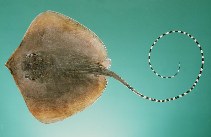 Maculabatis gerrardi
Bild av Randall, J.E.
Bilder | Google image
Bild av Randall, J.E.
Klassificering / Namn Populärnamn | synonymer | Catalog of Fishes(Släkte, Arter) | ITIS | CoL | WoRMS | Cloffa
Elasmobranchii (hajar och rockor) (sharks and rays) > Myliobatiformes (Stingrays) > Dasyatidae (Stingrays) > Urogymninae
Eponymy: Edward Gerrard (1810–1910) worked as an attendant in Gray’s department at the British Museum (1841–1896). [...] (Ref. 128868), visit book page.
More on author: Gray.
Eponymy: Edward Gerrard (1810–1910) worked as an attendant in Gray’s department at the British Museum (1841–1896). [...] (Ref. 128868), visit book page.
More on author: Gray.
Taxonomic Remarks
Distribution to check.
Miljö: miljö / Klimatzon / djupintervall / distributionsområde Ekologi
marina; brackvatten bottenlevande; djupintervall ? - 50 m (Ref. 5578). Tropical
Utbredning Territorier | FAO områden | Ekosystem | Förekomster | Prickkarta | Utplanteringar | Faunafri
Indo-West Pacific: Oman to Indonesia; north to Taiwan.
Längd vid första mognad / Storlek / Vikt / Ålder
Likely confined to the inner continental shelf (Ref. 9840), over sandy and mud bottoms (Ref. 30573). Recorded from coastal waters and river mouths (Ref. 45255). Feeds on bottom crustaceans including shrimp, crabs and small lobsters (Ref. 5578). Ovoviviparous (Ref. 50449). Important food fish, the skin and flesh are dried or used to produce leather for purses and bags (Ref. 9840). Caught in very large quantities in the demersal tangle net, bottom trawl and trammel net fisheries. Utilized for its meat, skin (high value) and cartilage (Ref. 58048). It is parasitised on the dorsal skin surface by the monogeneans Dendromonocotyle citrosa, D. colorni, D. ukuthena (Ref. 124058) and D. lotteri (Ref. 124051).
Livscykel och parningsbeteende Könsmognad | Reproduktion | Lek | Ägg | Fekunditet | Larver
Exhibit ovoviparity (aplacental viviparity), with embryos feeding initially on yolk, then receiving additional nourishment from the mother by indirect absorption of uterine fluid enriched with mucus, fat or protein through specialised structures (Ref. 50449). Distinct pairing with embrace (Ref. 205). Bears 2 young in summer (Ref. 5578). Gives birth to litters of 1-4 pups; born at 18-21 cm WD (Ref.58048).
Huvudreferens
Ladda upp dina referenser | referenser | Koordinator : McEachran, John | Medarbetare
Last, P.R., W.T. White, M.R. de Carvalho, B. Séret, M.F.W. Stehmann and G.J.P. Naylor, 2016. Rays of the world. CSIRO Publishing, Comstock Publishing Associates. i-ix + 1-790. (Ref. 114953)
Status på IUCN:s rödlista (Ref. 130435: Version 2025-2 (Global))
Endangered (EN) (A2d); Date assessed: 06 May 2020
CITES
Not Evaluated
Hot mot människor
Harmless
Mänskliga användningsområden
Fiskeri: kommersiell; sportfisk: ja; Akvarium: Kommersiell
FAO - fiskeri: landningar; Publication: search | FishSource | Havet omkring oss
Ytterligare information
Populationsdynamik
Tillväxtparametrar
Max. åldrar / storlekar
Längd-vikt rel.
Längd-längd rel.
Längd-frekvenser
Massakonvertering
Rekrytering
Abundans
Tillväxtparametrar
Max. åldrar / storlekar
Längd-vikt rel.
Längd-längd rel.
Längd-frekvenser
Massakonvertering
Rekrytering
Abundans
Livscykel
Reproduktion
Könsmognad
Mognad/Gills rel.
Fekunditet
Lek
Lekande aggregat
Ägg
Utveckling av ägg
Larver
Larvdynamik
Reproduktion
Könsmognad
Mognad/Gills rel.
Fekunditet
Lek
Lekande aggregat
Ägg
Utveckling av ägg
Larver
Larvdynamik
Anatomi
Gälyta
Hjärna
Otolit
Gälyta
Hjärna
Otolit
Fysiologi
Kroppssammansättning
Näringsämnen
Syreförbrukning
Typ av simning
Simhastighet
Visuella pigment
Ljud från fisk
Sjukdomar & Parasiter
Toxicitet (LC50)
Kroppssammansättning
Näringsämnen
Syreförbrukning
Typ av simning
Simhastighet
Visuella pigment
Ljud från fisk
Sjukdomar & Parasiter
Toxicitet (LC50)
Människorelaterad
Vattenbrukssystem
Vattenbruksprofiler
Avelslinjer
Ciguatera-fall
Frimärken, mynt, diverse.
Vattenbrukssystem
Vattenbruksprofiler
Avelslinjer
Ciguatera-fall
Frimärken, mynt, diverse.
Verktyg
E-bok | Fälthandbok | Bestämningsnycklar | Längdfördelnings-verktyg | Livshistorie-verktyg | Prickkarta |
Fångst-MSY |
Särskilda rapporter
Kontrollera för underhåll av akvarium | Kontrollera om det finns faktablad om arter | Kontrollera om det finns faktablad om vattenbruk
Ladda ner XML
Internet-källor
AFORO (otoliths) | Aquatic Commons | BHL | Cloffa | Websites from users | Check FishWatcher | CISTI | Catalog of Fishes: Släkte, Arter | DiscoverLife | ECOTOX | FAO - fiskeri: landningar; Publication: search | Faunafri | Fishipedia | Fishtrace | GloBI | Google Books | Google Scholar | Google | IGFA World Record | Nationella databaser | OneZoom | Open Tree of Life | Otolith Atlas of Taiwan Fishes | PubMed | Reef Life Survey | Socotra Atlas | TreeBase | Tree of Life | Wikipedia: Go, sök | World Records Freshwater Fishing | Zoologiskt register
Uppskattningar baserade på modeller
Önskad temperatur (Ref. 123201): 24.7 - 29.1, mean 28.4 °C (based on 1116 cells).
Index för fylogenetisk mångfald (Ref. 82804): PD50 = 0.5020 [Uniqueness, from 0.5 = low to 2.0 = high].
Bayesian length-weight: a=0.01905 (0.01170 - 0.03102), b=3.08 (2.93 - 3.23), in cm total length, based on LWR estimates for this species & (Sub)family-body (Ref. 93245).
Trofisk nivå (Ref. 69278): 3.7 ±0.55 se; based on food items.
Resiliens (Ref. 120179): Mycket låg, lägsta populationsfördubblingstid mer än 14 år (Fec=2).
Näringsämnen (Ref. 124155): Calcium = 12.9 [1.9, 252.0] mg/100g; Iron = 0.63 [0.06, 7.40] mg/100g; Protein = 20.9 [18.3, 23.5] %; Omega3 = 0.122 [0.038, 0.345] g/100g; Selenium = 50.3 [10.3, 257.1] μg/100g; VitaminA = 4.98 [0.44, 49.87] μg/100g; Zinc = 0.725 [0.044, 8.176] mg/100g (wet weight);