>
Clupeiformes (Herrings) >
Clupeidae (Herrings, shads, sardines, menhadens)
Etymology: Potamalosa: Greek, potamos = river + Latin, alausa = a fish cited by Ausonius and Latin, halec = pickle, dealing with the Greek word hals = salt; it is also the old Saxon name for shad = "alli" ; 1591 (Ref. 45335).
Eponymy: This is a toponym referring to Richmond River, New South Wales, Australia, the type locality. (Ref. 128868), visit book page.
More on author: Macleay.
Environment: milieu / climate zone / kisaran kedalaman / distribution range
Ekologi
laut; air tawar; payau pelagic-neritic; katadromus (ruaya dari air tawar ke laut) (Ref. 51243). Temperate; 32°S - 39°S, 139°E - 151°E (Ref. 188)
Oceania: Endemic to southeastern Australia.
Size / Weight / umur
Kematangan: Lm ? range ? - ? cm
Max length : 32.0 cm SL jantan/; (Ref. 44894); common length : 15.0 cm SL jantan/; (Ref. 44894); Umur maksimum dilaporkan: 11 Tahun (Ref. 6996)
deskripsi pendek
Kunci identifiaksi (pengenalan) | Morfologi | Morfometrik
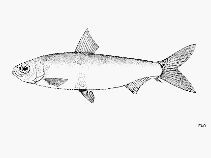
Duri punggung (Keseluruhan (total)) : 0; duri punggung lunak (Keseluruhan (total)) : 12 - 18; Duri dubur: 0; Sirip dubur lunak: 16 - 27. Body fairly elongate, belly keeled, with 16 to 18 + 14 or 15 scutes; about 14 dorsal scutes with low keel from head to dorsal fin origin. Minute or no teeth in jaws; second supra-maxilla slender. Branchiostegal rays 8. Anal fin origin far behind dorsal fin base. Juveniles resemble Hyperlophus, which has a deeper second supra-maxilla, only 4 branchiostegal rays and i 6 pelvic fin rays.
Body shape (shape guide): fusiform / normal; Cross section: compressed.
It occurs in clear, moderately fast-flowing streams, as well as in quiet backwaters, estuaries, and in the sea ( Ref. 5259, 44894). Also found in sluggish lowland rivers (Ref. 44894). A schooling species and appears diadromous. A fast swimming, shoal-forming species. Nothing much is known of its biology, although it may have a catadromous life cycle. Downstream migration to estuaries, presumably for spawning, has been reported in winter months (July-August). Feeds on worms, small crustaceans and insects (Ref. 44894). Breeds in estuaries in July to August. Taken in nets during the spawning season; will also take bait.
Life cycle and mating behavior
Kematangan | Reproduksi, perkembang biakan | Pemijahan | telur-telur | Fecundity | Larva
Whitehead, P.J.P., 1985. FAO Species Catalogue. Vol. 7. Clupeoid fishes of the world (suborder Clupeoidei). An annotated and illustrated catalogue of the herrings, sardines, pilchards, sprats, shads, anchovies and wolf-herrings. FAO Fish. Synop. 125(7/1):1-303. Rome: FAO. (Ref. 188)
Status IUCN Red List (Ref. 130435: Version 2025-1)
ancaman kepada manusia
Harmless
penggunaan manusia
Perikanan: perikanan swasembada
Alat, peralatan
laporan khas
muat turun XML
Sumber internet
Estimates based on models
Phylogenetic diversity index (Acuan
82804): PD
50 = 1.0000 [Uniqueness, from 0.5 = low to 2.0 = high].
Bayesian length-weight: a=0.00525 (0.00331 - 0.00832), b=3.24 (3.10 - 3.38), in cm total length, based on LWR estimates for this species & (Sub)family-body (Ref.
93245).
Trophic level (Acuan
69278): 3.3 ±0.43 se; based on food items.
Daya lenting (Acuan
120179): Rendah, Waktu penggandaan populasi minimum 4.5 - 14 tahun (K=0.13; tmax=11).
Fishing Vulnerability (Ref.
59153): Low to moderate vulnerability (29 of 100).
🛈