


अपना अवलोकन जोड़ें Fish Watcher
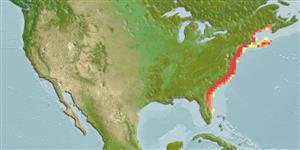
| Native range | All suitable habitat | Point map | Year 2050 |
|
| This map was computer-generated and has not yet been reviewed. |
| Alosa mediocris AquaMaps Data sources: GBIF OBIS |
वर्गीकरण / नाम आम नाम | उपशब्द | Catalog of Fishes(वर्ग, प्रजाति) | ITIS | CoL | WoRMS | Cloffa
> Clupeiformes (Herrings) > Alosidae (Shads and Sardines)
Etymology: Alosa: Latin, alausa = a fish cited by Ausonius and Latin, halec = pickle, dealing with the Greek word hals = salt; it is also the old Saxon name for shad = "alli" ; 1591 (Ref. 45335).
More on author: Mitchill.
Etymology: Alosa: Latin, alausa = a fish cited by Ausonius and Latin, halec = pickle, dealing with the Greek word hals = salt; it is also the old Saxon name for shad = "alli" ; 1591 (Ref. 45335).
More on author: Mitchill.
पर्यावरण: पर्यावरण / जलवायु क्षेत्र / गहराई सीमा / वितरण सीमा पारिस्थितिकी
समुद्री; स्वच्छ जल, अलवण जल; खारा pelagic-neritic; ऐनाढरोमस (Ref. 138280). Temperate; 46°N - 25°N, 82°W - 66°W (Ref. 117467)
वितरण प्रदेशों | ऐफ ऐ ओ क्षेत्र | पारिस्थितिकी प्रणालियों | संयोग | बिन्दु नक्शा | भूमिका | Faunafri
Western Atlantic: along the coast from Maine to the St. John's River, Florida, USA (Ref. 188). Possibly in Campobello Island, New New Brunswick, Canada (Ref. 86798).
प्रथम परिपक्वता पर लंबाई / आकार / वज़न / आयु
परिपक्व अवधि: Lm 32.0 range ? - ? cm
Max length : 60.0 cm SL पुल्लिंग / अलिंग; (Ref. 188); common length : 34.0 cm SL पुल्लिंग / अलिंग; (Ref. 188)
Max length : 60.0 cm SL पुल्लिंग / अलिंग; (Ref. 188); common length : 34.0 cm SL पुल्लिंग / अलिंग; (Ref. 188)
संक्षिप्त वर्णन पहचान कुंजी | आकृति विज्ञान | मौरफोमैटरिक्स
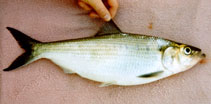
पृष्ठीय रीढ़ (सम्पूर्ण) : 0; पृष्ठीय सौफट रेज़ (सम्पूर्ण) : 15 - 20; गुदा कांटा: 0; ऐनल सौफट रेज़: 19 - 23; जानवरों की रीड़ का जोड़: 53 - 55. Belly with distinct keel of scutes. Lower jaw very prominent, but not rising steeply within mouth; teeth reduced or in upper jaw absent in fishes over 23 cm standard length. A dark spot on shoulder, several obscure dark spots along flank (sometimes missing). Closely resembles A. chrysochloris which has stronger jaw teeth, no shoulder spot and the body depth less than head length (Ref. 188). Silvery, with a dark grayish green back (Ref. 7251).
Body shape (shape guide): fusiform / normal; Cross section: compressed.
Body shape (shape guide): fusiform / normal; Cross section: compressed.
In freshwater habitat, this species occurs in open water of large rivers (Ref. 86798). Schools of adults are found in marine waters, along the coast; also estuaries, tidal rivers and tributaries during late spring and early summer (Ref. 4639). Juveniles tend to leave nursery areas during summer (Ref. 4639). Adults feed on small fishes, also squid, small crabs and other crustaceans, as well as fish eggs. Spawning occurs in tidal freshwater (Patuxent River, Chesapeake Bay in May) (Ref. 188), and return to the sea shortly after (Ref. 4639). Parasites found are nematodes, cestodes and trematodes (Ref. 37032).
जीवन चक्र और संभोग व्यवहार परिपक्व अवधि | पुनरुत्पत्ति | मछलीऔ का अंडे देना | अंडे | उपजाऊपन | लार्वा
मुख्य संदर्भ
अपने संदर्भ अपलोड करें | संदर्भ | संयोजक | सहयोगीयो
Whitehead, P.J.P., 1985. FAO Species Catalogue. Vol. 7. Clupeoid fishes of the world (suborder Clupeoidei). An annotated and illustrated catalogue of the herrings, sardines, pilchards, sprats, shads, anchovies and wolf-herrings. FAO Fish. Synop. 125(7/1):1-303. Rome: FAO. (Ref. 188)
आईयूसीएन रेड लिस्ट स्थिति (Ref. 130435: Version 2025-2 (Global))
Least Concern (LC) ; Date assessed: 14 October 2011
CITES
Not Evaluated
मनुष्यों के लिए ख़तरा
Harmless
मानव उपयोग
मात्स्यिकी: लघु वाणिज्य; आखेट मत्स्य: हां
FAO - मात्स्यिकी: उतरने; Publication: search | FishSource | हमारे चारों ओर समुद्र
अधिक जानकारी
जनसंख्या गतिशीलता
विकास मापदंड
अधिकतम आयु/आकार
लंबाई-वजन संबंध
लंबाई-लंबाई संबंध
लंबाई-आवृत्तियाँ
सामूहिक रूपांतरण
भर्ती
बहुतायत
विकास मापदंड
अधिकतम आयु/आकार
लंबाई-वजन संबंध
लंबाई-लंबाई संबंध
लंबाई-आवृत्तियाँ
सामूहिक रूपांतरण
भर्ती
बहुतायत
जीवन चक्र
पुनरुत्पत्ति
परिपक्व अवधि
परिपक्वता/गिल्स संबंध
उपजाऊपन
मछलीऔ का अंडे देना
स्पॉनिंग एकत्रीकरण
अंडे
अंडे का विकास
लार्वा
लारवल गतिकी
पुनरुत्पत्ति
परिपक्व अवधि
परिपक्वता/गिल्स संबंध
उपजाऊपन
मछलीऔ का अंडे देना
स्पॉनिंग एकत्रीकरण
अंडे
अंडे का विकास
लार्वा
लारवल गतिकी
शरीर रचना
गिल क्षेत्र
दिमाग
ओटोलिथ
गिल क्षेत्र
दिमाग
ओटोलिथ
फिजियोलॉजी
शारीरिक संरचना
पोषक तत्व
प्राणवायु की खपत
तैराकी का प्रकार
तैराकी की गति
दृश्य वर्णक
मछली की आवाज
रोग एवं परजीवी
विषाक्तता (LC50s)
शारीरिक संरचना
पोषक तत्व
प्राणवायु की खपत
तैराकी का प्रकार
तैराकी की गति
दृश्य वर्णक
मछली की आवाज
रोग एवं परजीवी
विषाक्तता (LC50s)
मानव संबंधी
जलकृषि प्रणालियाँ
जलीयकृषि रूपरेखाऐ
खींच
सिगुएटेरा के मामले
टिकट, सिक्के, विविध.
जलकृषि प्रणालियाँ
जलीयकृषि रूपरेखाऐ
खींच
सिगुएटेरा के मामले
टिकट, सिक्के, विविध.
साधन
ई-पुस्तक | कार्यक्षेत्र पथप्रदर्शक | पहचान कुंजी | लंबाई आवृति इंद्रजालिक | जीवन-इतिहास उपकरण | बिन्दु नक्शा |
कैच-एमएसवाई |
विशेष रिपोर्ट
एक्वेरियम के रखरखाव की जांच करें | प्रजातियों के तथ्य पत्रक की जाँच करें | जलीय कृषि तथ्य पत्रक की जाँच करें
XML डाउनलोड करें
सारांश पृष्ठ | बिंदु डेटा | आम नाम | तस्वीरें
इंटरनेट स्रोत
AFORO (otoliths) | Aquatic Commons | BHL | Cloffa | Websites from users | Check FishWatcher | CISTI | Catalog of Fishes: वर्ग, प्रजाति | DiscoverLife | ECOTOX | FAO - मात्स्यिकी: उतरने; Publication: search | Faunafri | Fishipedia | Fishtrace | GloBI | Google Books | Google Scholar | Google | IGFA World Record | OneZoom | Open Tree of Life | Otolith Atlas of Taiwan Fishes | PubMed | Reef Life Survey | Socotra Atlas | TreeBase | Tree of Life | Wikipedia: Go, खोज | World Records Freshwater Fishing | प्राणीशास्त्रीय अभिलेख
मॉडल पर आधारित अनुमान
पसंदीदा तापमान (संदर्भ 123201): 8.4 - 25.5, mean 14 °C (based on 238 cells).
जातिवृति विविधता सूचकांक (संदर्भ 82804): PD50 = 0.5000 [Uniqueness, from 0.5 = low to 2.0 = high].
Bayesian length-weight: a=0.00708 (0.00338 - 0.01484), b=3.08 (2.91 - 3.25), in cm total length, based on LWR estimates for this Genus-body shape (Ref. 93245).
ट्रॉफिक स्तर (संदर्भ 69278): 4.1 ±0.58 se; based on food items.
Generation time: 3.7 ( na - na) years. Estimated as median ln(3)/K based on 1 growth studies.
लौटाव (संदर्भ 120179): माध्यम, न्यूनतम जनसंख्या दुगनी होने का समय 1.4 - 4.4 वर्ष। (K=0.3).
पोषक तत्व (Ref. 124155): Calcium = 11.5 [5.3, 62.2] mg/100g; Iron = 0.599 [0.251, 1.331] mg/100g; Protein = 19.5 [17.0, 22.3] %; Omega3 = 1.42 [0.75, 2.70] g/100g; Selenium = 12.1 [5.9, 24.0] μg/100g; VitaminA = 20.4 [5.1, 78.2] μg/100g; Zinc = 0.266 [0.167, 0.456] mg/100g (wet weight);