>
Clupeiformes (Herrings) >
Dorosomatidae (Gizzard shads and sardinellas)
Etymology: Dorosoma: Greek, doris = lance + Greek, soma = body (Ref. 45335); petenense: Named after the type locality, Lake Peten, Yucatan (Ref. 10294).
Eponymy: This is a toponym referring to Lake Petén, Guatemala, the type locality. (Ref. 128868), visit book page.
More on author: Günther.
Environment: milieu / climate zone / kisaran kedalaman / distribution range
Ekologi
laut; air tawar; payau pelagic-neritic; anadromus (ruaya dari laut ke air tawar) (Ref. 51243); kisaran kedalaman 0 - 15 m (Ref. 39049). Subtropical; 20°C - 30°C (Ref. 115833); 42°N - 15°N, 159°W - 81°W (Ref. 188)
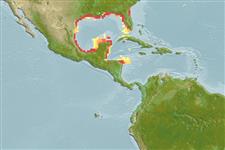
North and Central America: Gulf of Mexico drainage, Mississippi system, from the Ohio River of Kentucky and southern Indiana southwest to Oklahoma, and south to Texas and Florida, also rivers around the Gulf to northern Guatemala; also Belize River, British Honduras. Introduced in Hawaiian waters (Ref. 188) and in Chesapeake Bay tributaries (Ref. 93252).
Length at first maturity / Size / Weight / umur
Kematangan: Lm 5.2, range 5 - 5.5 cm
Max length : 33.0 cm TL jantan/; (Ref. 96339); common length : 10.0 cm SL jantan/; (Ref. 9291); Umur maksimum dilaporkan: 4 Tahun (Ref. 12193)
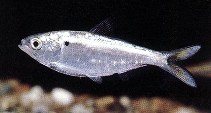
Duri punggung (Keseluruhan (total)) : 0; duri punggung lunak (Keseluruhan (total)) : 11 - 15; Duri dubur: 0; Sirip dubur lunak: 17 - 27; vertebrata, bertulang belakang: 43 - 44. Body moderately deep; belly with 15 to 18 + 8 to 12 scutes. Mouth small. Last dorsal fin ray long, about equal to distance from snout tip to mid-pectoral fin or beyond; anal fin relatively short. Scales relatively large, regularly arranged. A dark spot behind gill opening. Gill rakers fine and numerous (Ref. 188). Body bright silvery, especially on sides, opercles and underparts. Back and upper sides bluish black or dark olivaceous (Ref. 37032).
Body shape (shape guide): fusiform / normal; Cross section: compressed.
Often schooling, occurring mainly in freshwater (in large rivers, reservoirs, lakes, and swamps). Prefer the presence of smooth, steep-sided surfaces such as dams, cement-lined pools and rip rapped streams (Ref. 39049). But adults are also found in brackish or saline water of estuaries and bays (up to 32.3 ppt salinity (Ref. 39050); juveniles to about 15 ppt). Larvae are pelagic probably found only in freshwater (Ref. 39046). Filter-feeders, but not entirely herbivorous since recorded food items include copepods, cladocerans and fish fry. Also feed on organic material of sand and detritus bottoms (Ref. 9114). Breed in the spring and in autumn, in freshwater, near or over plants or other objects. Eggs adhere to aquatic vegetation (Ref. 4639). Caught exclusively in fresh waters and sometimes in mouths of rivers (Ref. 9291). Also Ref. 58302.
Breed in spring and again in autumn, in open waters near or over plants or other objects; eggs slightly adhesive (Ref. 188). Females can produce 5,000 to 20,000 eggs depending upon their size (Ref. 44091).
Whitehead, P.J.P., 1985. FAO Species Catalogue. Vol. 7. Clupeoid fishes of the world (suborder Clupeoidei). An annotated and illustrated catalogue of the herrings, sardines, pilchards, sprats, shads, anchovies and wolf-herrings. FAO Fish. Synop. 125(7/1):1-303. Rome: FAO. (Ref. 188)
Status IUCN Red List (Ref. 130435: Version 2025-1)
ancaman kepada manusia
Harmless
penggunaan manusia
Perikanan: nilai komersial kecil; umpan: usually
Alat, peralatan
laporan khas
muat turun XML
Sumber internet
Estimates based on models
Preferred temperature (Acuan
123201): 23.3 - 28.1, mean 25.5 °C (based on 182 cells).
Phylogenetic diversity index (Acuan
82804): PD
50 = 0.5312 [Uniqueness, from 0.5 = low to 2.0 = high].
Bayesian length-weight: a=0.00891 (0.00545 - 0.01458), b=2.99 (2.85 - 3.13), in cm total length, based on LWR estimates for this species & (Sub)family-body (Ref.
93245).
Trophic level (Acuan
69278): 2.8 ±0.1 se; based on diet studies.
Daya lenting (Acuan
120179): sedang, Waktu penggandaan populasi minimum 1.4 - 4.4 tahun (tm=1-2; tmax=4; Fec=800).
Fishing Vulnerability (Ref.
59153): Low vulnerability (23 of 100).
🛈
Nutrients (Ref.
124155): Calcium = 116 [71, 204] mg/100g; Iron = 1.74 [1.04, 2.98] mg/100g; Protein = 19.5 [18.4, 20.6] %; Omega3 = 0.499 [0.289, 0.845] g/100g; Selenium = 14.5 [7.5, 28.1] μg/100g; VitaminA = 18.6 [7.2, 48.4] μg/100g; Zinc = 1.18 [0.82, 1.68] mg/100g (wet weight);