>
Ophidiiformes (Cusk eels) >
Bythitidae (Livebearing brotulas)
Etymology: Barathronus: Greek, barathron = abyss + ending -ites, that lives there; the Barathron was a deep pit in Athens where criminals were thrown; 1849 +Greek, onos = hake.
Environment: milieu / climate zone / intervalo de profundidade / distribution range
Ecologia
marinhas batidemersal; intervalo de profundidade 386 - 1525 m (Ref. 34024). Deep-water
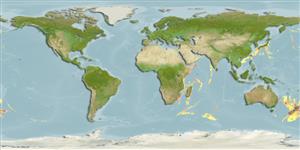
Indo-West Pacific: off South Africa, Madagascar and Mozambique to Japan, the Philippines and Australia.
Tamanho / Peso / Idade
Maturidade: Lm ? range ? - ? cm
Max length : 18.0 cm TL macho/indeterminado; (Ref. 6611)
Descrição breve
Chaves de identificação | Morfologia | Morfometria
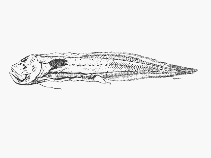
Raios dorsais moles (total) : 75 - 83; Raios anais moles: 55 - 66; Vértebras: 74 - 79. This species is distinguished by the following characters: when preserved, distinct, dark brown pigmentation dorsally between head and dorsal fin and on the sides of the light brown body; fresh specimens when newly caught with dark blue-like pigmentation on the peritoneum and body faintly reddish; D 75-83, A 55-66; vertebrae 74-79; vomer with up to four fangs, dentary with up to five fangs; penis length up to 10% SL, proximally covered by a large dorsal clasper and a smaller ventral clasper protected ventrally by a well-developed fleshy hood; eyes not externally visible in specimens longer than about 14.0 cm SL, while eyes of smaller specimens appear as a narrow, dark ring surrounding lighter tissue (Ref. 128809).
Cross section: compressed.
Rare species (Ref. 34024). Viviparous. Relatively often caught by commercial trawlers for it also occurs on the upper continental slope (Ref. 128809).
Life cycle and mating behavior
Maturidade | Reprodução | Desova | Ovos | Fecundidade | Larvas
Nielsen, J.G., J.J. Pogonoski and S.A. Appleyard, 2019. Aphyonid-clade species of Australia (Teleostei, Bythitidae) with four species new to Australian waters and a new species of Barathronus. Zootaxa 4564(2):554-572. (Ref. 128809)
Categoria na Lista Vermelha da IUCN (Ref. 130435: Version 2025-1)
Ameaça para o homem
Harmless
Utilização humana
Pescarias: sem interesse
Ferramentas
Relatórios especiais
Descarregue XML
Fontes da internet
Estimates based on models
Preferred temperature (Ref.
123201): 2.1 - 9.6, mean 6.8 °C (based on 265 cells).
Phylogenetic diversity index (Ref.
82804): PD
50 = 0.5005 [Uniqueness, from 0.5 = low to 2.0 = high].
Bayesian length-weight: a=0.00447 (0.00172 - 0.01163), b=3.10 (2.87 - 3.33), in cm total length, based on LWR estimates for this (Sub)family-body shape (Ref.
93245).
Nível Trófico (Ref.
69278): 3.4 ±0.5 se; based on size and trophs of closest relatives
Resiliência (Ref.
120179): Elevada, tempo mínimo de duplicação da população menor que 15 meses (Preliminary K or Fecundity.).
Fishing Vulnerability (Ref.
59153): Low vulnerability (10 of 100).
🛈
Nutrients (Ref.
124155): Calcium = 47.3 [26.0, 106.9] mg/100g; Iron = 0.502 [0.248, 1.006] mg/100g; Protein = 15.9 [13.5, 18.3] %; Omega3 = 0.386 [0.182, 0.815] g/100g; Selenium = 19 [7, 46] μg/100g; VitaminA = 17.7 [3.6, 83.0] μg/100g; Zinc = 0.517 [0.337, 0.789] mg/100g (wet weight);