Environment: milieu / climate zone / profondeur / distribution range
Écologie
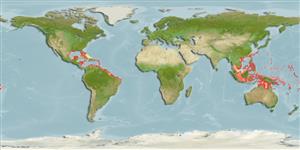
marin; saumâtre démersal; pH range: 0.0 - 10.4; amphidrome (Ref. 51243); profondeur 0 - 50 m (Ref. 13325). Subtropical; 11°C - 34°C (Ref. 127853); 29°N - 17°S
Western Atlantic: Cape Cod (USA), Bermuda, and northern Gulf of Mexico to southern Brazil. Questionable occurrence records in the China (Ref. 52360), Taiwan (47843), and Vietnam (Ref. 9706, 46452).
Length at first maturity / Taille / Poids / Âge
Maturité: Lm ? range ? - ? cm
Max length : 100.0 cm TL mâle / non sexé; (Ref. 26340); common length : 60.0 cm TL mâle / non sexé; (Ref. 3718); poids max. publié: 10.1 kg (Ref. 4699)
Description synthétique
Clés d'identification | Morphologie | Morphométrie
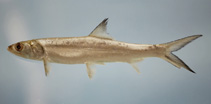
Épines dorsales (Total) : 0; Rayons mous dorsaux (Total) : 25 - 29; Épines anales: 0; Rayons mous anaux: 16 - 19; Vertèbres: 73 - 85. Scales small, more than 100 in lateral line. Gular plate narrow (Ref. 26938). Silvery overall, with bluish on upper surface (Ref. 7251). Branchiostegal rays: 26-33 (Ref. 4639).
Body shape (shape guide): elongated; Cross section: compressed.
Occur in shallow neritic areas, over muddy bottoms (Ref. 5217). Also found in brackish estuaries and juveniles are common in lagoons and hyper-saline bays (Ref. 5217). Form large schools close to the shore (Ref. 9987). Feed mainly on crustaceans and small fishes. Spawn in the open sea (Ref. 5217). Larval development is represented by profound changes in body form accompanied by 2 periods of length increase, interspaced by a period of length decrease (Ref. 4639). Noted for their habit of skipping along the surface of the water and for jumping after being hooked (Ref. 5521). Marketed fresh, salted and frozen but considered a second rate food fish (Ref. 3718). Rhynchobothrium bulbifer found in the viscera of the adult (Ref. 37032).
Spawns offshore, the larvae drifting towards the coast where they shelter and grow (Ref. 9987). Leptocephalus larvae are found in salinities as low as 0.0+ to 0.8 ppt (Ref. 75142).
Robins, C.R. and G.C. Ray, 1986. A field guide to Atlantic coast fishes of North America. Houghton Mifflin Company, Boston, U.S.A. 354 p. (Ref. 7251)
Statut dans la liste rouge de l'IUCN (Ref. 130435: Version 2025-1)
Menace pour l'homme
Harmless
Utilisations par l'homme
Pêcheries: intérêt commercial mineur; pêche sportive: oui; appât: usually
Outils
Articles particuliers
Télécharger en XML
Sources Internet
Estimates based on models
Preferred temperature (Réf.
123201): 25 - 29.1, mean 28 °C (based on 1142 cells).
Phylogenetic diversity index (Réf.
82804): PD
50 = 0.5176 [Uniqueness, from 0.5 = low to 2.0 = high].
Bayesian length-weight: a=0.00617 (0.00458 - 0.00831), b=2.94 (2.86 - 3.02), in cm total length, based on LWR estimates for this species (Ref.
93245).
Niveau trophique (Réf.
69278): 3.5 ±0.3 se; based on diet studies.
Résilience (Réf.
120179): Milieu, temps minimum de doublement de population : 1,4 à 4,4 années (K=0.22-0.3; tm=2).
Fishing Vulnerability (Ref.
59153): High vulnerability (60 of 100).
🛈
Climate Vulnerability (Ref.
125649): Very high vulnerability (88 of 100).
🛈
Nutrients (Ref.
124155): Calcium = 22.2 [10.7, 44.5] mg/100g; Iron = 0.569 [0.300, 0.970] mg/100g; Protein = 17.7 [15.5, 20.7] %; Omega3 = 0.15 [0.08, 0.27] g/100g; Selenium = 20.8 [10.2, 44.4] μg/100g; VitaminA = 34.3 [11.0, 111.0] μg/100g; Zinc = 0.654 [0.437, 1.015] mg/100g (wet weight); based on
nutrient studies.