This website uses cookies to enhance your browsing experience and ensure the functionality of our site. For more detailed information about the types of cookies we use and how we protect your privacy, please visit our Privacy Information page.
×
Cookie Settings
This website uses different types of cookies to enhance your experience. Please select your preferences below:
> Eupercaria/misc (Various families in series Eupercaria) > Lethrinidae (Emperors or scavengers) > Lethrininae
Etymology: Lethrinus:Greek, lethrinia, a fish pertaining to genus Pagellus. More on author: Valenciennes.
Umwelt: Milieu / Klimazone / Tiefenbereich / Verbreitungsgebiet Ökologie
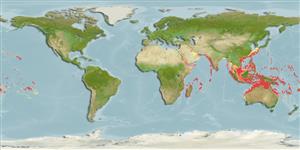
Indo-West Pacific: Red Sea and East Africa to Samoa and Polynesia, north to the Ryukyu Islands; south to Australia.
Länge bei der ersten Reifung / Größe / Gewicht / Alter
Geschlechtsreife: Lm?, range 34 - ? cm Max length : 100.0 cm TL Männchen/unbestimmt; (Ref. 2295); common length : 70.0 cm TL Männchen/unbestimmt; (Ref. 2295); max. veröff. Gewicht: 14.0 kg (Ref. 9710)
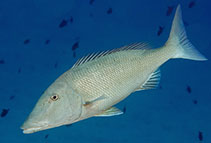
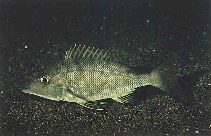
Rückenflossenstacheln (insgesamt) : 10; Rückenflossenweichstrahlen (insgesamt) : 9; Afterflossenstacheln: 3; Afterflossenweichstrahlen: 8. This species is distinguished by the following characters: body moderately slender, its depth 2.9-3.4 times in standard length; head length 1.1-1.3 times in body depth, 2.4-2.9 times in SL, dorsal profile near eye nearly straight or with small bump; snout length about 1.7-2.2 times in HL, measured without the lip the snout is 0.6-0.8 times in cheek height, its dorsal profile slightly concave, snout angle relative to upper jaw between 40° and 50°; interorbital space convex to flat; posterior nostril a longitudinal oblong opening, closer to orbit than anterior nostril; eye situated close to or not close to dorsal profile, its length 3.4-6.2 times in HL; cheek height 3 to 3.8 times in HL; lateral teeth in jaws conical; outer surface of maxilla smooth; D X, 9 with the 3rd or 4th dorsal-fin spine the longest, its length 2.4-2.8 times in body depth; A III,8 with the first soft ray usually the longest, its length almost equal to or slightly shorter than length of base of soft-rayed portion of anal fin and 1.3-1.7 times in length of entire anal-fin base; pectoral-fin rays 13; pelvic-fin membranes between rays closest to body with dense melanophores; cheek without scales; 46-48 lateral-line scales; 5 ½ scale rows between lateral line and base of middle dorsal-fin spines; usually 16-17 scale rows in transverse series between origin of anal fin and lateral line; 15 rows in lower series of scales around caudal peduncle; 6-9 scales in supratemporal patch; inner surface of pectoral-fin base without scales; posterior angle of operculum fully scaly. Colour of body grey, lighter ventrally, often with scattered irregular dark blotches; snout with wavy dark streaks, upper jaw, especially near corner of mouth sometimes edged behind with red (Ref. 114226). Body shape (shape guide): fusiform / normal; Cross section: oval.
Largest and the longest-snouted lethrinid (Ref. 37816). Found in sandy coastal areas, lagoons, and reef slopes (Ref. 30573). Juveniles are found in shallow sandy areas. Often occurs in large schools. Adults deep along coastal slopes and drop-offs, usually solitary (Ref. 48635). Very active and swims fast (Ref. 90102). Feeds mainly on fish, crustaceans, and cephalopods. In Palau, it spawns throughout the year on the first few days of the lunar month along the edges of reefs. Large individuals often ciguatoxic in New Caledonia and possibly elsewhere in Oceania (Ref. 9775). Caught mostly with handline and traps, occasionally by trawls and gill nets (Ref. 68703). Ref. 48635 reports maximum depth of occurrence.
Carpenter, K.E. and G.R. Allen, 1989. FAO Species Catalogue. Vol. 9. Emperor fishes and large-eye breams of the world (family Lethrinidae). An annotated and illustrated catalogue of lethrinid species known to date. FAO Fish. Synop. 125(9):118 p. Rome: FAO. (Ref. 2295)
IUCN Rote Liste Status (Ref. 130435: Version 2025-2 (Global))