Environment: milieu / climate zone / пределы глубины / distribution range
экология
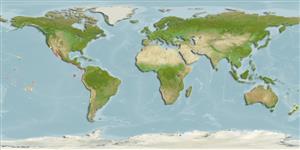
морской донно-пелагический; пределы глубины 0 - 50 m (Ref. 9283). Subtropical; 34°N - 18°S, 118°W - 70°W
Eastern Pacific: Redondo Beach in southern California, USA to Peru; rare north of Baja California, Mexico.
Size / Вес / Возраст
половая зрелость: Lm ? range ? - ? cm
Max length : 40.0 cm TL самец/пол неопределен; (Ref. 55763); common length : 24.0 cm FL самец/пол неопределен; (Ref. 9283)
Краткое описание
определительные ключи | морфология | морфометрия
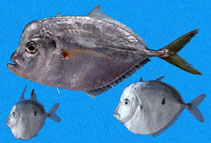
Body very short, deep, and compressed; lower branch of first gill arch with 30 to 35 gill rakers; dorsal fin with 8 spines followed by another spine and 21 to 24 soft rays (VIII1, 21-24); anterior lobe of second dorsal and anal fins not elongated in adults; anterior dorsal spines prolonged in juveniles; body scaleless; lateral line scutes very weak and poorly differentiated; body silvery to gold with metallic blue highlights; juveniles silvery, with a dark oval stain on the straight part of the lateral line (ref. 55763).
Body shape (shape guide): short and / or deep.
Adults are found in coastal waters up to at least 50 m depth (Ref. 9283). They generally form schools near the bottom (Ref. 9283). Juveniles are encountered near the surface (Ref. 9283). They feed on small fishes and crustaceans (Ref. 9283). Marketed fresh and salted or dried (Ref. 9283).
Life cycle and mating behavior
половая зрелость | размножение | нерест | икра | Fecundity | личинки
Eschmeyer, W.N., E.S. Herald and H. Hammann, 1983. A field guide to Pacific coast fishes of North America. Boston (MA, USA): Houghton Mifflin Company. xii+336 p. (Ref. 2850)
Статус Красного Списка МСОП (Ref. 130435: Version 2025-1)
Угроза для людей
Harmless
Использование человеком
рыболовство: не имеет хозяйственного значения
дополнительная информация
инструменты
Специальные отчеты
Скачать в формате XML
ресурсы в Интернет
Estimates based on models
Preferred temperature (ссылка
123201): 20.5 - 28.4, mean 25.1 °C (based on 68 cells).
Phylogenetic diversity index (ссылка
82804): PD
50 = 0.5078 [Uniqueness, from 0.5 = low to 2.0 = high].
Bayesian length-weight: a=0.01622 (0.01061 - 0.02479), b=2.83 (2.71 - 2.95), in cm total length, based on LWR estimates for this species & (Sub)family-body (Ref.
93245).
Trophic level (ссылка
69278): 4.3 ±0.5 se; based on diet studies.
устойчивость к внешним воздействиям (ссылка
120179): высокий, минимальное время удвоения популяции до 15 месяцев (Preliminary K or Fecundity.).
Fishing Vulnerability (Ref.
59153): Low to moderate vulnerability (30 of 100).
🛈
Nutrients (Ref.
124155): Calcium = 78.7 [38.4, 176.8] mg/100g; Iron = 1.24 [0.61, 2.65] mg/100g; Protein = 17.8 [15.7, 20.2] %; Omega3 = 0.296 [0.153, 0.593] g/100g; Selenium = 25.7 [11.0, 58.5] μg/100g; VitaminA = 17.2 [4.4, 65.3] μg/100g; Zinc = 0.553 [0.352, 0.864] mg/100g (wet weight);