>
Gadiformes (Cods) >
Moridae (Morid cods)
Etymology: Pseudophycis: Greek, pseudes = false + Greek, phykon = seaweed; because of the habit of living among them (Ref. 45335).
Eponymy: Bacchus was the Roman god of wine. Forster used a variant spelling of the name. (Ref. 128868), visit book page.
More on author: Forster.
Environment: milieu / climate zone / Mức độ sâu / distribution range
Sinh thái học
Biển; Thuộc về nước lợ gần đáy; Mức độ sâu 26 - 700 m (Ref. 58489), usually 200 - 300 m (Ref. 54741). Subtropical; 33°S - 50°S, 137°E - 177°E (Ref. 54741)
Southwest Pacific: New Zealand and around Australia, at least from Sydney to Adelaide, and around Tasmania. Often confused with Pseudophycis barbata (Ref.9563).
Length at first maturity / Bộ gần gũi / Khối lượng (Trọng lượng) / Age
Chín muồi sinh dục: Lm 52.0, range 45 - 55 cm
Max length : 90.0 cm TL con đực/không giới tính; (Ref. 1371); common length : 55.0 cm TL con đực/không giới tính; (Ref. 9258)
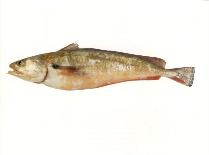
Các tia vây lưng cứng (tổng cộng) : 0; Tia cứng vây hậu môn: 0. Nostrils anterior to eye by about one-third of snout length. Pyloric caeca 6 to 8. Color reddish pink becoming paler ventrally, vertical fins with dark margins; a dark black blotch on the pectoral fin base.
Body shape (shape guide): fusiform / normal; Cross section: oval.
Found usually on soft muddy or sandy bottoms. Also on rocky bottoms, in estuaries, bays and continental shelf (Ref. 9563). In New Zealand, most abundant in 200 to 300 m along the edge of the continental shelf. May be found at depths exceeding 700 m (Ref. 9258). Feeds primarily on fishes, cephalopods, crabs and other crustaceans. Utilized as frozen fillets as well as fish blocks; eaten steamed, fried, microwaved and baked (Ref. 9988).
Life cycle and mating behavior
Chín muồi sinh dục | Sự tái sinh sản | Đẻ trứng | Các trứng | Sự sinh sản | Ấu trùng
Cohen, D.M., T. Inada, T. Iwamoto and N. Scialabba, 1990. FAO species catalogue. Vol. 10. Gadiform fishes of the world (Order Gadiformes). An annotated and illustrated catalogue of cods, hakes, grenadiers and other gadiform fishes known to date. FAO Fish. Synop. 125(10). Rome: FAO. 442 p. (Ref. 1371)
IUCN Red List Status (Ref. 130435: Version 2025-1)
Threat to humans
Harmless
Human uses
Các nghề cá: tính thương mại cao; cá để chơi: đúng
Các công cụ
Special reports
Download XML
Các nguồn internet
Estimates based on models
Preferred temperature (Tài liệu tham khảo
123201): 7.9 - 13.5, mean 11 °C (based on 43 cells).
Phylogenetic diversity index (Tài liệu tham khảo
82804): PD
50 = 0.6250 [Uniqueness, from 0.5 = low to 2.0 = high].
Bayesian length-weight: a=0.00589 (0.00301 - 0.01154), b=3.12 (2.94 - 3.30), in cm total length, based on LWR estimates for this species & (Sub)family-body (Ref.
93245).
Mức dinh dưỡng (Tài liệu tham khảo
69278): 3.9 ±0.6 se; based on diet studies.
Thích nghi nhanh (Tài liệu tham khảo
120179): Trung bình, thời gian nhân đôi của chủng quần tối thiểu là 1.4 - 4.4 năm (K=0.4(?); tm=4; Fec~1million).
Prior r = 0.42, 95% CL = 0.27 - 0.62, Based on 5 data-limited stock assessments.
Fishing Vulnerability (Ref.
59153): Low to moderate vulnerability (35 of 100).
🛈
Climate Vulnerability (Ref.
125649): High to very high vulnerability (71 of 100).
🛈
Nutrients (Ref.
124155): Calcium = 56.8 [23.8, 116.8] mg/100g; Iron = 1.16 [0.65, 2.15] mg/100g; Protein = 19.6 [17.4, 21.5] %; Omega3 = 0.412 [0.214, 0.763] g/100g; Selenium = 47.5 [24.4, 100.0] μg/100g; VitaminA = 8.47 [2.69, 27.87] μg/100g; Zinc = 0.562 [0.389, 0.809] mg/100g (wet weight); based on
nutrient studies.