


Malapterurus electricus (Gmelin, 1789)
Electric catfish
Uploaden van uw Foto's en video's
Afbeeldingen | Postzegels, munten, diversen. | Google afbeelding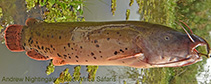 Malapterurus electricus
Afbeelding van Nightingale, A.
Afbeeldingen | Postzegels, munten, diversen. | Google afbeelding
Afbeelding van Nightingale, A.
Classificatie / Namen Lokale namen | Synoniemen | Catalog of Fishes(Genus, Soort(en)) | ITIS | CoL | WoRMS | Cloffa
> Siluriformes (Catfishes) > Malapteruridae (Electric catfishes)
Etymology: Malapterurus: Greek, mala = a lot of + Greek, pteron = fin + Greek, oura = tail (Ref. 45335); electricus: The electric discharging capacity of this electric catfish is described by the specific epithet (Ref. 44050).
More on author: Gmelin.
Etymology: Malapterurus: Greek, mala = a lot of + Greek, pteron = fin + Greek, oura = tail (Ref. 45335); electricus: The electric discharging capacity of this electric catfish is described by the specific epithet (Ref. 44050).
More on author: Gmelin.
Milieu: milieu / Klimaatzone / Diepte / verspreidingsgebied Ecologie
; zoet water benthopelagisch; pH range: 7.0 - 8.0; dH range: ? - 20; potamodroom (Ref. 51243). Tropical; 23°C - 30°C (Ref. 1672); 35°N - 30°S
Verspreiding Gebieden | FAO regio's | Ecosystemen | Voorkomen | Verspreidingskaart | Introducties | Faunafri
Africa: typical Sudanian distribution; in much of the Nile system (exclusive of Lake Victoria), Lake Turkana, Lake Chad and Senegal basins, throughout the Niger system and smaller southward flowing basins in west Africa, from Bandama through Volta rivers in Ivory Coast and Ghana (Ref. 44050). Absent from Congo basin; reports from Congo basin refer to any of the other species in this system (see Ref. 44050 for details).
Grootte / Gewicht / Leeftijd
Maturiteit: Lm ? range ? - ? cm
Max length : 122 cm SL mannelijk / geslacht onbekend; (Ref. 3850); max. gepubliceerd gewicht: 20.0 kg (Ref. 3799); max. gerapporteerde leeftijd: 10 Jaren (Ref. 7248)
Max length : 122 cm SL mannelijk / geslacht onbekend; (Ref. 3850); max. gepubliceerd gewicht: 20.0 kg (Ref. 3799); max. gerapporteerde leeftijd: 10 Jaren (Ref. 7248)
Korte beschrijving Determinatiesleutels | Morfologie | Morfometrie
Dorsale stekels (totaal) : 0; Dorsale zachte stralen (totaal) : 0; Anale stekels: 0; Anale zachte stralen: 9 - 11; Wervels: 38 - 41. Diagnosis: tooth patches narrow; pectoral fin placed near body mid-depth; 7-8 branched caudal fin rays (Ref. 44050). 9-11 anal-fin rays, usually 10-11; 38-41 total vertebrae, usually 39-41 (Ref. 57130). Caudal saddle and bar pattern not present in adults (Ref. 57130), poorly developed in all ages (Ref. 44050). Flank and dorsum in adults and young marked with large blotches (some up to 4-5 times eye diameter); caudal fin of adults generally same color as flank ground color or slightly darker, larger specimens usually with spots or blotches in caudal fin (Ref. 44050, 57130).
Body shape (shape guide): fusiform / normal; Cross section: circular.
Body shape (shape guide): fusiform / normal; Cross section: circular.
Occur among rocks or roots. Favors sluggish or standing water. Active at night, feeding mainly on fish stunned by electric shocks. Described as a nocturnal piscivore that breeds during periods of high water; rarely feeds on molluscs (Ref. 44050). The electric organ, capable of discharging 300-400 V, is derived from pectoral muscle and surrounds almost the entire body. It is used both for prey capture and defense. Electric organ discharge (EOD) is intermittent and the amplitude increases with size of the fish (Ref. 10011). Responds immediately to cyclic light changes, exhibiting maximum EOD activity shortly after sunset and lowest activity just after sunrise (Ref. 10798). Its EOD duration decreased from 1.5 to 0.3 ms in response to increased temperature from 15 to 30°C (Ref. 10838). Adults form pairs and breed in excavated cavities or holes (Ref. 7248). Maximum size in Lake Chad reported as 1125mm SL, but most museum specimens much smaller (maximum 400mm SL, Nile River)(Ref. 57130).
Levenscyclus en paargedrag Maturiteit | Voortplanting | Paaien | Eieren | Fecunditeit | Larven
It is assumed that the male tends the clutch. Others report that the male takes the eggs into his mouth. It is also unknown how the fry is immune to the electric shocks by the parents (Ref. 1672).
Hoofdreferentie
Upload uw referenties | Referenties | Coördinator | Medewerkers
Roberts, T.R., 2000. A review of the African electric catfish family Malapteruridae, with descriptions of new species. Occas. Pap. Ichthyol. 1:1-15. (Ref. 34006)
Status op de Rode Lijst van het IUCN (Ref. 130435: Version 2025-2 (Global))
Niet bedreigd (LC) ; Date assessed: 04 March 2025
CITES
Not Evaluated
Gevaar voor de mens
Other (Ref. 4967)
Gebruik door de mens
Visserij: visserij voor eigen gebruik; sportvis: ja
FAO - Publication: search | FishSource |
Meer informatie
Trofische ecologie
Voedsel (prooien)
Dieetsamenstelling
Voedselconsumptie
Voedselrantsoenen
Predatoren
Voedsel (prooien)
Dieetsamenstelling
Voedselconsumptie
Voedselrantsoenen
Predatoren
Populatiedynamica
Groeiparameters
Max. leeftijden / maten
Lengte-gewicht rel.
Lengte-lengte rel.
Lengtefrequenties
Massaconversie
Rekrutering
Abundantie
Groeiparameters
Max. leeftijden / maten
Lengte-gewicht rel.
Lengte-lengte rel.
Lengtefrequenties
Massaconversie
Rekrutering
Abundantie
Levenscyclus
Voortplanting
Maturiteit
Rijpheid/kieuwen rel.
Fecunditeit
Paaien
Paaibestanden
Eieren
Ontwikkeling van de eieren
Larven
Larvale populatiedynamiek
Voortplanting
Maturiteit
Rijpheid/kieuwen rel.
Fecunditeit
Paaien
Paaibestanden
Eieren
Ontwikkeling van de eieren
Larven
Larvale populatiedynamiek
Anatomie
Kieuwoppervlak
Hersenen
Otoliet
Kieuwoppervlak
Hersenen
Otoliet
Fysiologie
Lichaamssamenstelling
Voedingsstoffen
Zuurstofverbruik
Type zwemmen
Zwemsnelheid
Visuele pigmenten
Vis geluid
Ziekten en parasieten
Toxiciteit (LC50)
Lichaamssamenstelling
Voedingsstoffen
Zuurstofverbruik
Type zwemmen
Zwemsnelheid
Visuele pigmenten
Vis geluid
Ziekten en parasieten
Toxiciteit (LC50)
Menselijk gerelateerd
Aquacultuursystemen
Aquacultuurprofielen
Kweeklijnen
Ciguatera gevallen
Postzegels, munten, diversen.
Aquacultuursystemen
Aquacultuurprofielen
Kweeklijnen
Ciguatera gevallen
Postzegels, munten, diversen.
Tools
Biologische quiz | E-boek | Veldgids | Determinatiesleutels | Lengtefrequentie Tool | Levenscyclus tool | Verspreidingskaart |
Vangst-MSY |
Speciale rapporten
Bekijk gegevens voor het houden in een aquarium | Bekijk Fact Sheets voor de soort | Bekijk Aquacultuur Fact Sheets
Download XML
Internetbronnen
AFORO (otoliths) | Exoten/Invasieve soorten database | Aquatic Commons | BHL | Cloffa | Websites from users | Bekijk FishWatcher | CISTI | Catalog of Fishes: Genus, Soort(en) | DiscoverLife | ECOTOX | FAO - Publication: search | Faunafri | Fishipedia | Fishtrace | GloBI | Google Books | Google Scholar | Google | IGFA World Record | OneZoom | Open Tree of Life | Otolith Atlas of Taiwan Fishes | PubMed | Reef Life Survey | Socotra Atlas | TreeBase | Tree of Life | Wikipedia: ga naar, zoek | World Records Freshwater Fishing | Zoological Record
Schattingen op basis van modellen
Fylogenetische diversiteitsindex (Ref. 82804): PD50 = 0.5000 [Uniqueness, from 0.5 = low to 2.0 = high].
Bayesian length-weight: a=0.01202 (0.00883 - 0.01637), b=2.95 (2.86 - 3.04), in cm total length, based on LWR estimates for this species (Ref. 93245).
Trofisch niveau (Ref. 69278): 2.9 ±0.38 se; based on food items.
Weerstandsvermogen (Ref. 120179): laag, minimale populatieverdubbelingstijd 4,5-14 jaar (tmax=10; Fec < 1,000).
Voedingsstoffen (Ref. 124155): Calcium = 48.9 [27.2, 92.2] mg/100g; Iron = 1.14 [0.65, 2.02] mg/100g; Protein = 16.4 [15.2, 17.6] %; Omega3 = 0.382 [0.141, 1.050] g/100g; Selenium = 119 [46, 264] μg/100g; VitaminA = 34.3 [11.4, 99.9] μg/100g; Zinc = 1.24 [0.82, 1.79] mg/100g (wet weight);