This website uses cookies to enhance your browsing experience and ensure the functionality of our site. For more detailed information about the types of cookies we use and how we protect your privacy, please visit our Privacy Information page.
×
Cookie Settings
This website uses different types of cookies to enhance your experience. Please select your preferences below:
> Gobiiformes (Gobies) > Gobiidae (Gobies) > Gobiinae
Etymology: Trimma:Greek, trimma, -atos = something crushed (Ref. 45335). Eponymy: Dr Stefan Meiring Naudé (1904–1985) was a South African physicist who was Professor of Physics at Stellenbosch University (1934–1946). [...] (Ref. 128868), visit book page. More on author: Smith.
Entorno: milieu / zona climática / rango de profundidad / gama de distribución Ecología
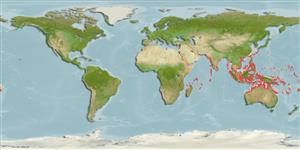
marino asociado a arrecife; rango de profundidad 3 - 30 m (Ref. 1602), usually 3 - 30 m (Ref. 27115). Tropical; 22°C - 26°C (Ref. 27115); 30°N - 22°S
Espinas dorsales (total) : 7; Radios blandos dorsales (total) : 7 - 8; Espinas anales: 1; Radios blandos anales: 7 - 9. Diagnosis: a frontal ridge behind the orbits that slopes steeply into a wide interorbital trench
anteromedially, and into postorbital trenches laterally; posterior nasal opening separate from eye; second spine of first dorsal fin elongate, third spine occasionally elongate; fifth pelvic fin ray branched once dichotomously; body color orange-red with seven dorsolateral white spots
between posterodorsal margin of the peduncle and origin of first dorsal, and with four ventrolateral spots between posteroventral margin of peduncle and origin of last anal ray; facial pattern uniform dusky orange-grey colour under orbit, with an orange vertical blotch, edged in melanophores on vertical limb of the preopercle resembling a club; conspicuous bar of melanophores extending vertically across posterior margin of pectoral base (Ref. 57688). Body shape (shape guide): fusiform / normal.
Occurs in lagoons and seaward reefs; on rubble and reef rock (Ref. 1602); also over coral patches interspaced with fine sandy bottoms, occasionally form small schools (Ref. 37688). Feeds on copepods, ostracods, and radiolarians (Ref. 1602).
Ciclo vital y comportamiento de apareamiento Madurez | Reproducción | Puesta | Huevos | Fecundidad | Larva
Dinámica de la población Coeficiente del crecimiento para Edades / tallas máximas Longitud-peso rel. Longitud-longitud rel. Longitud-frecuencias Conversión de masas Reclutamiento Abundancia
Ciclo de vida Reproducción Madurez Madurez/Gills rel. Fecundidad Puesta Agregaciones de desove Huevos Desarrollo de los huevos Larva Dinámica larvaria
Fisiología Composición corporal Nutrientes Consumo del oxígeno Tipo de natación Velocidad de natación Pigmentos visuales Sonido de peces Enfermedades y parásitos Toxicidad (CL50)
Temperatura preferida (Referencia 123201): 25.3 - 29, mean 28 °C (based on 1090 cells).
Índice de diversidad filogenética (Referencia 82804): PD50 = 0.5000 [Uniqueness, from 0.5 = low to 2.0 = high].
Bayesian length-weight: a=0.01023 (0.00477 - 0.02194), b=3.01 (2.83 - 3.19), in cm total length, based on LWR estimates for this (Sub)family-body shape (Ref. 93245).
Nivel trófico (Referencia 69278): 3.3 ±0.42 se; based on food items.
Resiliencia (Referencia 120179): Alto, población duplicada en un tiempo mínimo inferior a 15 meses (Preliminary K or Fecundity.).
Vulnerabilidad pesquera (Ref. 59153): Low vulnerability (10 of 100). 🛈