Environment: milieu / climate zone / kisaran kedalaman / distribution range
Ekologi
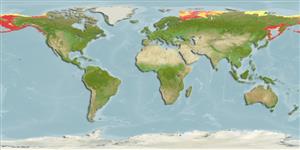
laut; air tawar; payau pelagic-neritic; anadromus (ruaya dari laut ke air tawar) (Ref. 51243); kisaran kedalaman 0 - 290 m (Ref. 50550). Polar; 77°N - 39°N, 35°E - 123°W
North Pacific and Arctic: Wonsan, North Korea and the Sea of Okhotsk to Barkley Sound, British Columbia, north to the Bering Sea and the Arctic (Ref. 6793). Estuaries and coastal waters of European and Siberian shores of Arctic ocean from White Sea to Chukota in eastern Siberia (Ref. 59043).
Length at first maturity / Size / Weight / umur
Kematangan: Lm 15.0, range 14 - 16 cm
Max length : 34.0 cm SL jantan/; (Ref. 59043); common length : 14.9 cm TL jantan/; (Ref. 12193); Berat maksimum terpublikasi: 119.00 g (Ref. 56483); Umur maksimum dilaporkan: 11 Tahun (Ref. 59043)
deskripsi pendek
Kunci identifiaksi (pengenalan) | Morfologi | Morfometrik
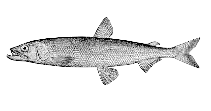
Duri punggung (Keseluruhan (total)) : 0; duri punggung lunak (Keseluruhan (total)) : 8 - 11; Duri dubur: 0; Sirip dubur lunak: 12 - 16; vertebrata, bertulang belakang: 63 - 68. Adipose small, sickle shaped (Ref. 6885). Olive green above, shading to silvery below, a bright clearly bounded longitudinal silvery band, becoming dark in preserved specimens; speckled with black on top of head, chin and upper part of body, more plentifully along mid-dorsal line (Ref. 6885).
Body shape (shape guide): elongated; Cross section: compressed.
Inhabits brackish water of estuaries, lagoons, coastal shallows and bays, and fresh water in lowland and piedmont rivers (Ref. 59043). A schooling species that inhabits lakes or inshore coastal waters (Ref. 1998). Pelagic at the sea where it occurs at 4-8 m depth (Ref. 59043). In the spring, it leaves the sea or the lake and ascends freshwater streams to spawn. Some remain in fresh water throughout their lives (Ref. 1998); those that enter the sea stay within 8 to 10 km of the shore and probably do not stray far along the coast from the estuary (Ref. 28996). Spawns in rapids, in clear water, over stone-gravel bottom and at depth of 0.2-0.5 m (Ref. 59043). Possibly found up to 425 m depth (Ref. 6793). Young-of-the-year feed mostly on copepods and cladocerans, also rotifers, eggs and algae; adults feed on small crustaceans, fishes and shellfish, also squid, worms, and various insects (Ref. 27547). Feeding virtually ceases during spawning (Ref. 27547). Females grow faster, get bigger and live longer than males (Ref. 27547). Highly esteemed as a food fish ever since white men came to North America (Ref. 27547). Flesh is firm and tasty (Ref. 27547).
Rainbow smelt usually return to natal streams to spawn but degree of homing varies from one population to another and may be genetically controlled (Ref. 11226, 30367). Movement into the streams begins when water temperatures reach 2° to 4°C or higher. The upstream run is generally short, at most a few km (Ref. 11226, 28996). Movement to spawning grounds are usually made at night. Males reach spawning grounds an hour or so before the females. Spawning is initiated, at least in part, by the presence of the proper sex ratio in the group, which has been indicated to be no more than four males to one female (Ref. 30366, 30374). The spawning group crowd together and move upstream. Body contact between a male and female brings about a release of sperm and eggs. Only a few eggs are extruded at each spawning act (Ref. 30366), so that the act is repeated over several hours each night for several nights until all eggs are extruded. After each evening's activities, most drift downstream to the larger body of water whence they came to the spawning grounds. Some, mostly males, may remain in the spawning stream during the day. Many spawned-out fish, especially males, die after spawning, but those that survive will spawn again the following year (Ref. 27547). Lake shore spawners on the other hand move inshore in small schools and swim about over rather restricted areas, apparently without any distinct pairing. The composition of the schools change constantly, for individual fish apparently engage in spawning activities for only 15 to 30 minutes at a time, then leave the school (Ref. 30374, 30376).
Mecklenburg, K.C., P.R. Møller and D. Steinke, 2011. Biodiversity of the Arctic marine fishes: taxonomy and zoogeography. Marine Biodiversity 41(1):109-140. (Ref. 86838)
Status IUCN Red List (Ref. 130435: Version 2025-1)
ancaman kepada manusia
Harmless
penggunaan manusia
Perikanan: komersial; Ikan buruan: ya
Alat, peralatan
laporan khas
muat turun XML
Sumber internet
Estimates based on models
Preferred temperature (Acuan
123201): -1.6 - 4.8, mean -0.4 °C (based on 2071 cells).
Phylogenetic diversity index (Acuan
82804): PD
50 = 0.5625 [Uniqueness, from 0.5 = low to 2.0 = high].
Bayesian length-weight: a=0.00407 (0.00255 - 0.00651), b=3.23 (3.09 - 3.37), in cm total length, based on LWR estimates for this species & (Sub)family-body (Ref.
93245).
Trophic level (Acuan
69278): 4.2 ±0.0 se; based on diet studies.
Generation time: 9.2 ( na - na) years. Estimated as median ln(3)/K based on 1
growth studies.
Daya lenting (Acuan
120179): sedang, Waktu penggandaan populasi minimum 1.4 - 4.4 tahun (tm=2-3; tmax=7; Fec=1,700).
Fishing Vulnerability (Ref.
59153): High vulnerability (60 of 100).
🛈