>
Cichliformes (Cichlids, convict blennies) >
Cichlidae (Cichlids) > Pseudocrenilabrinae
Etymology: Nimbochromis: Latin, nimbus = stormy, rainy + Greek, chromis, a fish, perhaps a perch; it has dark clouded melanic blotches on the body (Ref. 45335); livingstonii: Named after Dr. David Livingstone, famous explorer of the African continent. During one of his expeditions, the first fishes from Lake Malawi/Nyasa were collected for scientific studies (Ref. 55922).
Eponymy: David Livingstone (1813–1873) was a Scottish doctor and missionary, and undoubtedly the most famous African explorer of all time. [...] (Ref. 128868), visit book page.
More on author: Günther.
Environment: milieu / climate zone / rango de profundidad / distribution range
Ecología
; agua dulce demersal; pH range: 8.0 - 8.0; dH range: 9 - 19; no migratorio; rango de profundidad 0 - 114 m (Ref. 55922), usually ? - 78 m (Ref. 55922). Tropical; 25°C - 28°C (Ref. 30491); 9°S - 15°S
Africa: widespread occurrence in Lake Malawi, upper Shire River and Lake Malombe.
Tamaño / Peso / Age
Madurez: Lm ? range ? - ? cm
Max length : 25.0 cm TL macho / no sexado; (Ref. 5595); 20.0 cm TL (female)
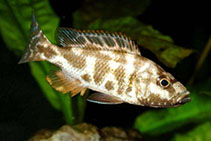
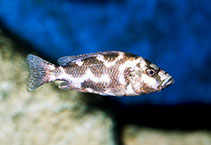
Espinas dorsales (total) : 15 - 16; Radios blandos dorsales (total) : 10 - 11; Espinas anales: 3; Radios blandos anales: 9 - 10. Diagnosis: unique color pattern with 4 conspicuous dark bars radiating from the eye; body silvery, yellowish or blue with a highly contrasting black blotched pattern with anastomosing horizontal and vertical components; faint spots on the pectoral fins; no speckles on head and body; head length 34.0-37.0% of standard length; body depth 32.9-38.3% of standard length; dorsal fin base 49.6-53.7% of standard length; lower jaw 37.5-46.2% head length; head width 40.8-47.0% head length (Ref. 55922).
Occurs in all kinds of habitats but is more common in vegetated areas of sheltered bays (Ref. 5595). Prefers soft, muddy bottoms but is also seen in purely rocky environments (Ref. 5595, 55922). Feeds on fish (Ref. 5595). Has been observed to mimic as dead and then feed on small fish that get close (Ref. 3817, 13371, 55922). Is usually solitary and territorial (Ref. 3817).
Life cycle and mating behavior
Madurez | Reproducción | Puesta | Huevos | Fecundidad | Larva
Female takes brood into her mouth and takes care of the young.
Maréchal, C., 1991. Nimbochromis. p. 296-299. In J. Daget, J.-P. Gosse, G.G. Teugels and D.F.E. Thys van den Audenaerde (eds.) Check-list of the freshwater fishes of Africa (CLOFFA). ISNB, Brussels; MRAC, Tervuren; and ORSTOM, Paris. Vol. 4. (Ref. 4989)
IUCN Red List Status (Ref. 130435: Version 2025-1)
Threat to humans
Harmless
Human uses
Pesquerías: comercial; Acuario: Comercial
Herramientas
Special reports
Download XML
Fuentes de Internet
Estimates based on models
Phylogenetic diversity index (Referencia
82804): PD
50 = 0.5312 [Uniqueness, from 0.5 = low to 2.0 = high].
Bayesian length-weight: a=0.01445 (0.00674 - 0.03099), b=2.99 (2.82 - 3.16), in cm total length, based on LWR estimates for this (Sub)family-body shape (Ref.
93245).
Nivel trófico (Referencia
69278): 4.2 ±0.73 se; based on food items.
Resiliencia (Referencia
120179): Medio, población duplicada en un tiempo mínimo de 1.4-4.4 años (Fec<1000).
Fishing Vulnerability (Ref.
59153): Low vulnerability (15 of 100).
🛈