


Luciobarbus capito (Güldenstädt, 1773)
Bulatmai barbel
Uploaden van uw Foto's en video's
Afbeeldingen | Google afbeelding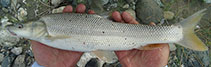 Luciobarbus capito
Afbeelding van Kaya, C.
Afbeeldingen | Google afbeelding
Afbeelding van Kaya, C.
Classificatie / Namen Lokale namen | Synoniemen | Catalog of Fishes(Genus, Soort(en)) | ITIS | CoL | WoRMS | Cloffa
Milieu: milieu / Klimaatzone / Diepte / verspreidingsgebied Ecologie
; zoet water; brak water benthopelagisch; anadroom (Ref. 59043). Temperate
Verspreiding Gebieden | FAO regio's | Ecosystemen | Voorkomen | Verspreidingskaart | Introducties | Faunafri
Europe and Asia: Caspian basin, from Volga southward to Atrek (Iran); Aral basin in Amu Darya, Syr Darya and Chu drainages.
Grootte / Gewicht / Leeftijd
Maturiteit: Lm ? range ? - ? cm
Max length : 105 cm TL mannelijk / geslacht onbekend; (Ref. 1441); common length : 65.0 cm TL mannelijk / geslacht onbekend; (Ref. 1441); max. gepubliceerd gewicht: 15.0 kg (Ref. 59043)
Max length : 105 cm TL mannelijk / geslacht onbekend; (Ref. 1441); common length : 65.0 cm TL mannelijk / geslacht onbekend; (Ref. 1441); max. gepubliceerd gewicht: 15.0 kg (Ref. 59043)
Korte beschrijving Determinatiesleutels | Morfologie | Morfometrie
Dorsale stekels (totaal) : 4; Dorsale zachte stralen (totaal) : 8; Anale stekels: 2; Anale zachte stralen: 5. Diagnosed from other species of Barbus and Luciobarbus in Caspian Se basin by having the following characters: predorsal length longer than postdorsal length; dorsal fin with 8½ branched rays; 12-18 gill rakers; back between head and dorsal origin laterally compressed, forming a keel; lateral line with 52-72 (usually 60-66) scales; and lower lip thin, without median lobe or pad (Ref. 59043).
Body shape (shape guide): elongated.
Body shape (shape guide): elongated.
Adults occur in the sea, mostly close to shores and forages also in estuaries. They are semi-anadromous and non-anadromous, rarely landlocked in reservoirs. Adults and juveniles feed on invertebrates, algae, detritus, plant material, and small fishes, while larvae prey on zooplankton and small benthic invertebrates. Spawn in lowland streams and rivers on sand-gravel bottom, usually in strong current. Undertake migration to uppermost tributaries of rivers. Non-anadromous populations begin to migrate during late summer-autumn and spawn following spring, but some enter rivers in early spring and spawn same year. Migration by non-anadromous populations takes place just before spawning to upper stretches of tributaries or spawn in lakes and reservoirs on sand to mud bottom (Ref. 59043).
Levenscyclus en paargedrag Maturiteit | Voortplanting | Paaien | Eieren | Fecunditeit | Larven
Hoofdreferentie
Upload uw referenties | Referenties | Coördinator | Medewerkers
Kottelat, M. and J. Freyhof, 2007. Handbook of European freshwater fishes. Publications Kottelat, Cornol and Freyhof, Berlin. 646 pp. (Ref. 59043)
Status op de Rode Lijst van het IUCN (Ref. 130435: Version 2025-2 (Global))
Kwetsbaar (VU) (A2acd); Date assessed: 02 August 2022
CITES
Not Evaluated
Gevaar voor de mens
Harmless
Gebruik door de mens
FAO - Publication: search | FishSource |
Meer informatie
Trofische ecologie
Voedsel (prooien)
Dieetsamenstelling
Voedselconsumptie
Voedselrantsoenen
Predatoren
Voedsel (prooien)
Dieetsamenstelling
Voedselconsumptie
Voedselrantsoenen
Predatoren
Populatiedynamica
Groeiparameters
Max. leeftijden / maten
Lengte-gewicht rel.
Lengte-lengte rel.
Lengtefrequenties
Massaconversie
Rekrutering
Abundantie
Groeiparameters
Max. leeftijden / maten
Lengte-gewicht rel.
Lengte-lengte rel.
Lengtefrequenties
Massaconversie
Rekrutering
Abundantie
Levenscyclus
Voortplanting
Maturiteit
Rijpheid/kieuwen rel.
Fecunditeit
Paaien
Paaibestanden
Eieren
Ontwikkeling van de eieren
Larven
Larvale populatiedynamiek
Voortplanting
Maturiteit
Rijpheid/kieuwen rel.
Fecunditeit
Paaien
Paaibestanden
Eieren
Ontwikkeling van de eieren
Larven
Larvale populatiedynamiek
Anatomie
Kieuwoppervlak
Hersenen
Otoliet
Kieuwoppervlak
Hersenen
Otoliet
Fysiologie
Lichaamssamenstelling
Voedingsstoffen
Zuurstofverbruik
Type zwemmen
Zwemsnelheid
Visuele pigmenten
Vis geluid
Ziekten en parasieten
Toxiciteit (LC50)
Lichaamssamenstelling
Voedingsstoffen
Zuurstofverbruik
Type zwemmen
Zwemsnelheid
Visuele pigmenten
Vis geluid
Ziekten en parasieten
Toxiciteit (LC50)
Genetica
genoom
Genetica
Heterozygositeit
Erfelijkheid
Genetische diversiteit
genoom
Genetica
Heterozygositeit
Erfelijkheid
Genetische diversiteit
Menselijk gerelateerd
Aquacultuursystemen
Aquacultuurprofielen
Kweeklijnen
Ciguatera gevallen
Postzegels, munten, diversen.
Aquacultuursystemen
Aquacultuurprofielen
Kweeklijnen
Ciguatera gevallen
Postzegels, munten, diversen.
Tools
Speciale rapporten
Bekijk gegevens voor het houden in een aquarium | Bekijk Fact Sheets voor de soort | Bekijk Aquacultuur Fact Sheets
Download XML
Internetbronnen
AFORO (otoliths) | Aquatic Commons | BHL | Cloffa | Websites from users | Bekijk FishWatcher | CISTI | Catalog of Fishes: Genus, Soort(en) | DiscoverLife | ECOTOX | FAO - Publication: search | Faunafri | Fishipedia | Fishtrace | GloBI | Google Books | Google Scholar | Google | IGFA World Record | Nationale databanken | OneZoom | Open Tree of Life | Otolith Atlas of Taiwan Fishes | PubMed | Reef Life Survey | Socotra Atlas | TreeBase | Tree of Life | Wikipedia: ga naar, zoek | World Records Freshwater Fishing | Zoological Record
Schattingen op basis van modellen
Fylogenetische diversiteitsindex (Ref. 82804): PD50 = 0.5000 [Uniqueness, from 0.5 = low to 2.0 = high].
Bayesian length-weight: a=0.00617 (0.00304 - 0.01252), b=3.06 (2.89 - 3.23), in cm total length, based on LWR estimates for this Genus-body shape (Ref. 93245).
Trofisch niveau (Ref. 69278): 2.8 ±0.3 se; based on size and trophs of closest relatives
Weerstandsvermogen (Ref. 120179): laag, minimale populatieverdubbelingstijd 4,5-14 jaar (tm=3-7; Fec=15,000-125,000).