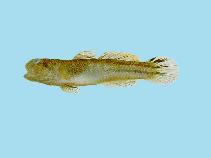
>
Gobiiformes (Gobies) >
Gobiidae (Gobies) > Gobionellinae
Etymology: Mugilogobius: Latin, mugil, -ilis = grey mullet + Latin, gobius = gidgeon (Ref. 45335).
Eponymy: Kakichi Abe, of Tokyo, was a former student of the senior author at Stanford University. He accompanied the authors in their travels throughout southern Japan, to the ‘great advantage’ of their work. (Ref. 128868), visit book page.
More on authors: Jordan & Snyder.
Environment: milieu / climate zone / intervalo de profundidade / distribution range
Ecologia
marinhas; estuarina demersal. Subtropical; 38°N - 22°N
Northwest Pacific: South-central to southern Japan, Hong Kong, Korea; Viet Nam, Taiwan, and Fukien Province in China.
Tamanho / Peso / Idade
Maturidade: Lm ? range ? - ? cm
Max length : 4.1 cm SL macho/indeterminado; (Ref. 43716)
Descrição breve
Chaves de identificação | Morfologia | Morfometria
Espinhos dorsais (total) : 6 - 8; Raios dorsais moles (total) : 7 - 9; Espinhos anais: 1; Raios anais moles: 7 - 9; Vértebras: 26 - 27.
Body shape (shape guide): elongated.
Facultative air-breathing in the genus (Ref. 126274); Inhabits sandy and muddy bottoms of estuaries and coastal freshwater streams not far from the stream mouth; probably fresh water tolerant (Ref. 43716).
Life cycle and mating behavior
Maturidade | Reprodução | Desova | Ovos | Fecundidade | Larvas
Larson, H.K., 2001. A revision of the gobiid fish genus Mugilogobius (Teleostei: Gobioidei), and its systematic placement. Rec. West. Aust. Mus. (Suppl. No. 62):1-233. (Ref. 43716)
Categoria na Lista Vermelha da IUCN (Ref. 130435: Version 2025-1)
Ameaça para o homem
Harmless
Utilização humana
Ferramentas
Relatórios especiais
Descarregue XML
Fontes da internet
Estimates based on models
Phylogenetic diversity index (Ref.
82804): PD
50 = 0.5000 [Uniqueness, from 0.5 = low to 2.0 = high].
Bayesian length-weight: a=0.00851 (0.00495 - 0.01463), b=3.06 (2.91 - 3.21), in cm total length, based on LWR estimates for this species & (Sub)family-body (Ref.
93245).
Nível Trófico (Ref.
69278): 3.4 ±0.3 se; based on size and trophs of closest relatives
Resiliência (Ref.
120179): Elevada, tempo mínimo de duplicação da população menor que 15 meses (Preliminary K or Fecundity.).
Fishing Vulnerability (Ref.
59153): Low vulnerability (10 of 100).
🛈