>
Cichliformes (Cichlids, convict blennies) >
Cichlidae (Cichlids) > Pseudocrenilabrinae
Etymology: Abactochromis: Name from Latin 'abactus' meaning driven away, banished, expelled; and 'chromis' which is widely used as a root in generic names of cichlids. The name alludes to the solitary, wandering, apparently non-territorial habits of living individuals, and the removal of this species from Melanochromis which it has mistakenly remained for 75 years.
More on author: Trewavas.
Environment: milieu / Zona climática / intervalo de profundidade / distribution range
Ecologia
; Água doce demersal; pH range: 7.0 - 8.5; dH range: 10 - 15; intervalo de profundidade 0 - 30 m (Ref. 85491). Tropical; 23°C - 26°C (Ref. 1672); 11°S - 14°S
Africa: Lake Malawi (Ref. 85491).
Tamanho / Peso / Idade
Maturidade: Lm ? range ? - ? cm
Max length : 11.5 cm SL macho/indeterminado; (Ref. 85491)
Descrição suscinta
Chaves de identificação | Morfologia | Morfometria
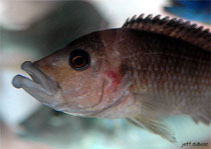
Espinhos dorsais (total) : 15 - 17; Espinhos anais: 3; Vértebras: 28 - 29. This species is distinguished from all other mbuna genera by the following characters: strongly hypertrophied , papillose, medially lobate lips; large head at least 40% SL in > 5 cm SL individuals; premaxillary pedicel (ascending process) >35% HL. Other non-mbuna haplochromine species endemic to Lake Malawi resemble this species in having enlarged and often lobate lips, but all can be distinguished as follows: Placidochromis milomo with total vertebrae 30-31 (vs. 28-29 in Abactochromis), segmented anal-fin rays 9-10 (vs. 7-8), broad, black vertical bars below the dorsal-fin base 4 (vs. 6-7 narrow subdorsal bars when distinct), reaches at least 19 cm SL (vs. ca. 12 cm); Otopharynx pachycheilus with longer pectoral fin 38-44% SL (vs. 19-27), shorter premaxillary pedicel 24-35% HL (vs. 36-46), color pattern of three lateral spots (vs. vertical bars with no lateral spots), depth range of 78-135 m (vs. 0-30 m); Cheilochromis euchilus total vertebrae 30-31, head and jaws not laterally compressed (vs. distinctly compressed), 2-3- horizontal stripes (vs. narrow bars with no horizontal stripes); Chilotilapia rhoadesii total vertebrae 31, thickened lips with no median lobes (vs. strongly lobate medially), adult teeth for crushing gastropod molluscs - robust with crowns shaped like grains of wheat, blunt, recurved and grooved on the outer surface (vs. oral dentition not similarly specialized), head and jaws not laterally compressed (vs. compressed), 2-3 horizontal stripes (vs. narrow bars with no horizontal stripes); Eclectochromis spp. with total vertebrae 30, segmented dorsal-fin rays 10-11 (vs. 7-9), thickened lips with no median lobes, some submolariform posteromedian pharyngeal teeth (vs. posteromedian teeth slightly enlarged by their crowns laterally compressed), color pattern of vertical bars alternating with dark spots along dorsum (vs. bars only); Lichnochromis acuticeps total vertebrae 32, thickened lips with no median lobes, with oblique stripe from nape to base of caudal fin (vs. no oblique stripe) (Ref. 85491).
Body shape (shape guide): short and / or deep.
Found over rocky substrate (Ref. 6307).
Ciclo de vida ou comportamento de acasalamento
Maturidade | Reprodução | Desova | Ovos | Fecundidade | Larvas
Oliver, M.K. and M.E. Arnegard, 2010. A new genus for Melanochromis labrosus, a problematic Lake Malawi cichlid with hypertrophied lips (Teleostei: Cichlidae). Ichthyol. Explor. Freshwat. 21(3):209-232. (Ref. 85491)
Status na Lista Vermelha da UICN (Ref. 130435: Version 2025-1)
Ameaça para os humanos
Harmless
Uso pelos humanos
Pescarias: espécies comerciais; Aquário: Espécies comerciais
Ferramentas
Relatórios especiais
Baixar XML
Fontes da internet
Estimates based on models
Índice de diversidade filogenética (Ref.
82804): PD
50 = 1.0000 [Uniqueness, from 0.5 = low to 2.0 = high].
Bayesian length-weight: a=0.01862 (0.00830 - 0.04177), b=3.01 (2.82 - 3.20), in cm total length, based on LWR estimates for this (Sub)family-body shape (Ref.
93245).
Nível Trófico (Ref.
69278): 3.4 ±0.4 se; based on size and trophs of closest relatives
Resiliência (Ref.
120179): Elevada, tempo mínimo de duplicação da população menor que 15 meses (Preliminary K or Fecundity.).
Fishing Vulnerability (Ref.
59153): Low vulnerability (10 of 100).
🛈