-

- Über diese Seite
- Sprachen
- Rückmeldungen der Nutzer
- Zitat
- Uploads
-
Verwandte Arten
- Arten in
Pelmatolapia - Arten in
Cichlidae - - Klassifizierung -
- Pseudocrenilabrinae
- Cichlidae
- Cichliformes
- Teleostei
- Chordata
- Animalia
- Arten in
-



Pelmatolapia mariae (Boulenger, 1899)
Spotted tilapia
Hochladen Photos und videos
Bilder | Google Bild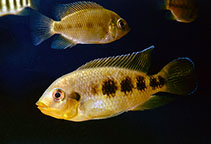 Pelmatolapia mariae
Photo von Muséum-Aquarium de Nancy/D. Terver
Bilder | Google Bild
Photo von Muséum-Aquarium de Nancy/D. Terver
Klassifizierung / Names Namen | Synonyme | Catalog of Fishes(Gattung, Arten) | ITIS | CoL | WoRMS | Cloffa
> Cichliformes (Cichlids, convict blennies) > Cichlidae (Cichlids) > Pseudocrenilabrinae
Eponymy: Mary Henrietta Kingsley (1862–1900) was an ethnographic and scientific writer and explorer. [...] (Ref. 128868), visit book page.
More on author: Boulenger.
Eponymy: Mary Henrietta Kingsley (1862–1900) was an ethnographic and scientific writer and explorer. [...] (Ref. 128868), visit book page.
More on author: Boulenger.
Umwelt: Milieu / Klimazone / Tiefenbereich / Verbreitungsgebiet Ökologie
; süßwasser; brackwasser demersal; pH range: 6.0 - 8.0; dH range: 5 - 19. Tropical; 20°C - 25°C (Ref. 1672); 9°N - 2°N, 9°W - 11°E (Ref. 55202)
Verbreitung Territorien | FAO Gebiete | Ökosysteme | Vorkommen | Punkt Karte | Einführungen | Faunafri
Africa: coastal lagoons and lower river courses from the Tabou River (Côte d'Ivoire) to the Kribi River (Cameroon), but absent from the area between the Pra River (Ghana) and Benin (Ref. 53405). Also recorded from the lower Ntem, Cameroon (81260).
Größe / Gewicht / Alter
Geschlechtsreife: Lm ? range ? - ? cm
Max length : 32.3 cm SL Männchen/unbestimmt; (Ref. 81260); common length : 17.5 cm TL Männchen/unbestimmt; (Ref. 12193); max. veröff. Gewicht: 1.4 kg (Ref. 40637)
Max length : 32.3 cm SL Männchen/unbestimmt; (Ref. 81260); common length : 17.5 cm TL Männchen/unbestimmt; (Ref. 12193); max. veröff. Gewicht: 1.4 kg (Ref. 40637)
Kurzbeschreibung Bestimmungsschlüssel | Morphologie | Morphometrie
Rückenflossenstacheln (insgesamt) : 15 - 17; Rückenflossenweichstrahlen (insgesamt) : 13 - 15; Afterflossenstacheln: 3; Afterflossenweichstrahlen: 10 - 11. Diagnosis: body rather elevated (body depth 46.9-51.6% SL) (Ref. 53405). Head profile rounded (Ref. 81260). Outer teeth on jaws bicuspid (Ref. 53405), gracile (Ref. 81260) and spatulated (Ref. 53405, 81260). Lower pharyngeal jaw teeth relatively small and narrow near posterior border of bone, forming an almost felt-like covering (Ref. 81260). Micro-gillrakers present; adults (> 150 mm) with a series of dark blotches in the middle of the flanks (sometimes body entirely blackish) (Ref. 53405, 81260). Juveniles with 7-9 large vertical bands (Ref. 53405). Ventral scales with central red spot; 12 or more rakers on lower limb of first gill arch (Ref. 81260).
Body shape (shape guide): fusiform / normal.
Body shape (shape guide): fusiform / normal.
Live in still or flowing waters in rocky or mud-bottom areas (Ref. 44894). Occur in warm springs and mud-bottomed to sand-bottomed canals (Ref. 5723). Clearly prefers a herbivorous diet, including algae, higher plants and parts of cassava, but also accepts insects and shrimps (along with their eggs) (Ref. 52307). Consume plant matter. Reache sexual maturity at 10-15 centimeters length. Parents prepare nest site on logs, leaves and other debris. Prolific species (Ref. 52307). The eggs (600-3300 per female) are guarded by the parents and hatch in 1-3 days. Larvae need 6-8 additional days to develop before they can swim freely (Ref. 52307). Parental care of the brood continues until the fish are about (1.5 cm, Ref. 52307) 2.5-3.0 centimeters (Ref. 44894). Occurs in mixed groups composed of individuals of varying size/age, along with individuals of other species (Ref. 52307). Pair-bonding, open (Ref. 52307) substrate brooder (Ref. 52307, 81260) with both parents guarding the brood (Ref. 52307). Maximum size was recorded at 39.4 cm TL (Ref. 40637).
Lebenszyklus und Paarungsverhalten Geschlechtsreife | Fortpflanzung | Ablaichen | Eier | Fruchtbarkeit | Larven
Produces up to 2000 eggs.
Hauptreferenz
Laden Sie Ihre Referenzen hoch | Referenzen | Koordinator : Kullander, Sven O. | Partner
Dunz, A.R. and U.K. Schliewen, 2013. Molecular phylogeny and revised classification of the haplotilapiine cichlid fishes formerly referred to as "Tilapia". Mol. Phylogenet. Evol. 68(1):64-80. (Ref. 93285)
IUCN Rote Liste Status (Ref. 130435: Version 2025-2)
nicht bedroht (LC) ; Date assessed: 16 October 2019
CITES
Not Evaluated
Bedrohung für Menschen
Harmless
Nutzung durch Menschen
Sportfisch: ja; Aquarium: Kommerziell
FAO - Publication: search | FishSource |
Mehr Information
Trophische Ökologie
Lebensmittel (Beutetiere)
Nahrungszusammensetzung
Nahrungsaufnahme
Lebensmittelrationen
Räuber
Lebensmittel (Beutetiere)
Nahrungszusammensetzung
Nahrungsaufnahme
Lebensmittelrationen
Räuber
Ökologie
Ökologie
Ökologie
Populationsdynamik
Wachstumsparameter
Max. Alter/Größen
Länge-Gewicht-Rel.
Länge-Länge-Verhältnis.
Längenhäufigkeiten
Massenkonvertierung
Rekrutierung
Dichte
Wachstumsparameter
Max. Alter/Größen
Länge-Gewicht-Rel.
Länge-Länge-Verhältnis.
Längenhäufigkeiten
Massenkonvertierung
Rekrutierung
Dichte
Lebenszyklus
Fortpflanzung
Geschlechtsreife
Reifung/Kiemen rel.
Fruchtbarkeit
Ablaichen
Laichaggregationen
Eier
Eientwicklung
Larven
Larven Pop.Dyn.
Fortpflanzung
Geschlechtsreife
Reifung/Kiemen rel.
Fruchtbarkeit
Ablaichen
Laichaggregationen
Eier
Eientwicklung
Larven
Larven Pop.Dyn.
Anatomie
Kiemenoberfläche
Gehirn
Otolith
Kiemenoberfläche
Gehirn
Otolith
Physiologie
Körperliche Zusammensetzung
Nährstoffe
Sauerstoffverbrauch
Schwimmart
Schwimmgeschwindigkeit
Visuelle Pigmente
Fischgeräusche
Krankheiten und Parasiten
Toxizität (LC50s)
Körperliche Zusammensetzung
Nährstoffe
Sauerstoffverbrauch
Schwimmart
Schwimmgeschwindigkeit
Visuelle Pigmente
Fischgeräusche
Krankheiten und Parasiten
Toxizität (LC50s)
Menschenbezogen
Aquakultur-Systeme
Aquakultur Profile
Zuchtlinien
Ciguatera-Fälle
Briefmarken, Münzen, Verschiedenes.
Aquakultur-Systeme
Aquakultur Profile
Zuchtlinien
Ciguatera-Fälle
Briefmarken, Münzen, Verschiedenes.
Tools
E-Book | Feldführer | Bestimmungsschlüssel | Längenhäufigkeits Tool | Lebensdaten Tool | Punkt Karte |
Catch-MSY |
Zusatzinformationen
Download XML
Zusammenfassung | Punktdaten | Namen | Photos
Internet Quellen
AFORO (otoliths) | Alien/Invasive Species database | Aquatic Commons | BHL | Cloffa | Websites from users | FishWatcher Einträge suchen | CISTI | Catalog of Fishes: Gattung, Arten | DiscoverLife | ECOTOX | FAO - Publication: search | Faunafri | Fishipedia | Fishtrace | GloBI | Google Books | Google Scholar | Google | IGFA World Record | OneZoom | Open Tree of Life | Otolith Atlas of Taiwan Fishes | Öffentliche Aquarien | PubMed | Reef Life Survey | Socotra Atlas | TreeBase | Tree of Life | Wikipedia: Gehe zu, Suchen | World Records Freshwater Fishing | Zoologischer Rekord
Schätzungen auf der Grundlage von Modellen
Phylogenetischer Diversitätsindex (Ref. 82804): PD50 = 0.7500 [Uniqueness, from 0.5 = low to 2.0 = high].
Bayesian length-weight: a=0.01585 (0.01360 - 0.01847), b=3.00 (2.96 - 3.04), in cm total length, based on LWR estimates for this species (Ref. 93245).
Trophische Ebene (Ref. 69278): 3.5 ±0.5 se; based on size and trophs of closest relatives
Generation time: 2.4 ( na - na) years. Estimated as median ln(3)/K based on 1 growth studies.
Widerstandsfähigkeit (Ref. 120179): mittel, Verdopplung der Population dauert 1,4 - 4,4 Jahre. (Fec = 2,000).
Nährstoffe (Ref. 124155): Calcium = 195 [105, 334] mg/100g; Iron = 1.41 [0.84, 2.69] mg/100g; Protein = 18.6 [17.1, 20.0] %; Omega3 = 0.247 [0.139, 0.509] g/100g; Selenium = 47.5 [28.7, 82.9] μg/100g; VitaminA = 15.7 [4.6, 38.4] μg/100g; Zinc = 1.8 [1.3, 2.7] mg/100g (wet weight);