


Adicionar sua observação em Fish Watcher
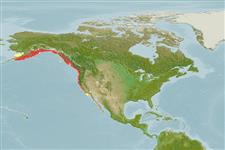
| Native range | All suitable habitat | Point map | Year 2050 |
|
| This map was computer-generated and has not yet been reviewed. |
| Hypomesus pretiosus AquaMaps Data sources: GBIF OBIS |
Carregue seu(sua) Fotos e vídeos
Fotos | vídeos | Imagem do Google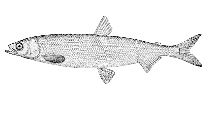 Hypomesus pretiosus
Foto de Bull. U.S. Bur. Fish.
Fotos | vídeos | Imagem do Google
Foto de Bull. U.S. Bur. Fish.
Classificação / Nomes Nomes comuns | Sinônimos | Catalog of Fishes(Gênero, Espécies) | ITIS | CoL | WoRMS | Cloffa
> Osmeriformes (Freshwater smelts) > Osmeridae (Smelts)
Etymology: Hypomesus: Greek, hypo = under + Greek,mesos = a half (Ref. 45335).
More on author: Girard.
Etymology: Hypomesus: Greek, hypo = under + Greek,mesos = a half (Ref. 45335).
More on author: Girard.
Meio ambiente: milieu / Zona climática / intervalo de profundidade / faixa de distribuição Ecologia
marinhas; estuarina bentopelágico; diadromous (Ref. 138280). Temperate; 61°N - 33°N, 163°W - 117°W
Distribuição Territórios | Áreas da FAO | Ecossistemas | Ocorrências | Mapa de pontos | Introduções | Faunafri
Eastern Pacific: Prince William Sound, Gulf of Alaska to Long Beach, southern California, USA. Reports from the western Pacific are misidentifications of Hypomesus japonicus.
Comprimento de primeira maturação / Tamanho / Peso / Idade
Maturidade: Lm ?, range 9 - ? cm
Max length : 30.5 cm TL macho/indeterminado; (Ref. 6885); common length : 15.0 cm TL macho/indeterminado; (Ref. 12193); idade máx. registrada: 5 anos (Ref. 72502)
Max length : 30.5 cm TL macho/indeterminado; (Ref. 6885); common length : 15.0 cm TL macho/indeterminado; (Ref. 12193); idade máx. registrada: 5 anos (Ref. 72502)
Descrição suscinta Chaves de identificação | Morfologia | Morfometria
Espinhos dorsais (total) : 0; Raios dorsais (total) : 9 - 11; Espinhos anais: 0; Raios anais : 12 - 17; Vértebras: 64 - 67. Vomer small, without posterior process; periphery of glossohyal bone with single row of blunt teeth, a few teeth located irregularly at center of distal region; base of adipose fin less than 20% of head length; eye small; adipose eyelid well developed (Ref. 33312). Distinguished by its midlateral scale count of 66 to 73 and the presence of 4 to 7 pyloric caeca (Ref. 27547). Lateral line short and incomplete, reaching about to tip of pectorals (Ref. 27547). Adipose sickle-shaped; pectorals small; pelvic fins originating behind or below dorsal origin (Ref. 6885). Light olive green to brownish on back, sides and belly silvery and iridescent with a bright reflecting band along the side in living specimens; males show more golden hues than females during spawning season (Ref. 6885). Branchiostegal rays: 7-8 (Ref. 35792).
Body shape (shape guide): elongated.
Body shape (shape guide): elongated.
Individuals 3.5 cm may ascend rivers, presumably returning to the sea shortly after (Ref. 27547). Presumably young move offshore and reappear inshore as mature adults (Ref. 27547). At sea, they feed on small crustaceans, worms and jellyfish, as well as larval fishes (Ref. 6885, 10276). Females reach age 3, males age 2 (Ref. 27547). Oviparous, with demersal eggs and planktonic larvae (Ref. 35792). Eggs are laid on beaches with heavy surf action (Ref. 33312).
Ciclo de vida ou comportamento de acasalamento Maturidade | Reprodução | Desova | Ovos | Fecundidade | Larvas
Schools approach the beach to spawn, usually with the females appearing a few days before the males. At spawning, large numbers of males mill about near the edge of the surf. When a female is seen, numbers of males pursue her and try to get into spawning position. If she swims to deeper water, the males desert her. 1 to 5 males swim parallel to and slightly behind a ripe female. The males press against the female and as they reach water 2.5 to 5 cm deep, the fish bend and vibrate, releasing eggs and sperm, then retreat to deeper water. The spawning act may be repeated on several successive waves. Wave action buries the eggs, usually to a depth of 2.5 to10 cm but sometimes to as deep as 30 cm (Ref. 27547).
Referência principal
Carregar suas referências | Referências | Coordenador | Colaboradores
Saruwatari, T., J.A. López and T.W. Pietsch, 1997. A revision of the ormerid genus Hypomesus Gill (Teleostei: Salmoniformes), with a description of a new species from the southern Kuril Islands. Species Diversity 2:59-82. (Ref. 33312)
CITES
Not Evaluated
Ameaça para os humanos
Harmless
Uso pelos humanos
Pescarias: espécies comerciais; peixe esportivo: sim
FAO - pescarias: desembarques; Publication: search | FishSource | Sea Around Us
Mais informação
Ecologia Trófica
Itens alimentares (presas)
Composição da dieta
Consumo alimentar
Rações alimentares
Predadores
Itens alimentares (presas)
Composição da dieta
Consumo alimentar
Rações alimentares
Predadores
Dinâmica populacional
Parâmetros de crescimento
Idade máxima / tamanhos
Relação comprimento-peso.
Relação comprimento-comprimento.
Frequências de comprimento
Conversão de massa
Recrutamento
Abundância
Parâmetros de crescimento
Idade máxima / tamanhos
Relação comprimento-peso.
Relação comprimento-comprimento.
Frequências de comprimento
Conversão de massa
Recrutamento
Abundância
Ciclo de vida
Reprodução
Maturidade
Maturidade/Rel. das guelras
Fecundidade
Desova
Agregações de desova
Ovos
Desenvolvimento dos ovos
Larvas
Dinâmica larval
Reprodução
Maturidade
Maturidade/Rel. das guelras
Fecundidade
Desova
Agregações de desova
Ovos
Desenvolvimento dos ovos
Larvas
Dinâmica larval
Anatomia
Área branquial
Cérebro
Otólito
Área branquial
Cérebro
Otólito
Fisiologia
Composição corporal
Nutrientes
Consumo de oxigênio
Tipo de natação
Velocidade de natação
Pigmentos visuais
Som de peixe
Doenças e Parasitas
Toxicidade (LC50s)
Composição corporal
Nutrientes
Consumo de oxigênio
Tipo de natação
Velocidade de natação
Pigmentos visuais
Som de peixe
Doenças e Parasitas
Toxicidade (LC50s)
Relacionado a humanos
Sistemas de aquicultura
Perfis para aquacultura
Estirpes
Casos de Ciguatera
Selos, moedas, diversos.
Sistemas de aquicultura
Perfis para aquacultura
Estirpes
Casos de Ciguatera
Selos, moedas, diversos.
Ferramentas
Livro eletrônico | Guia de campo | Ferramenta auxiliar de frequências de comprimento | Ferramenta sobre a história de vida | Mapa de pontos |
Catch-MSY |
Relatórios especiais
Checar Manutenção em Aquário | Checar Planilhas de Fatos sobre as Espécies | Checar Planilhas de Fatos sobre Aquicultura
Baixar XML
Fontes da internet
AFORO (otoliths) | Aquatic Commons | BHL | Cloffa | Websites from users | Checar Observador de Peixes (FishWatcher) | CISTI | Catalog of Fishes: Gênero, Espécies | DiscoverLife | ECOTOX | FAO - pescarias: desembarques; Publication: search | Faunafri | Fishipedia | Fishtrace | GloBI | Google Books | Google Scholar | Google | IGFA World Record | OneZoom | Open Tree of Life | Otolith Atlas of Taiwan Fishes | PubMed | Reef Life Survey | Socotra Atlas | TreeBase | Árvore da vida | Wikipedia: Ir para, procura | World Records Freshwater Fishing | Registro zoológico
Estimativas baseadas em modelos
Temperatura preferida (Ref. 123201): 7.5 - 11.8, mean 8.6 °C (based on 58 cells).
Índice de diversidade filogenética (Ref. 82804): PD50 = 0.5313 [Uniqueness, from 0.5 = low to 2.0 = high].
Bayesian length-weight: a=0.00363 (0.00177 - 0.00744), b=3.17 (2.99 - 3.35), in cm total length, based on LWR estimates for this (Sub)family-body shape (Ref. 93245).
Nível Trófico (Ref. 69278): 3.4 ±0.41 se; based on food items.
Resiliência (Ref. 120179): médio(a), tempo mínimo de duplicação da população 1,4 - 4,4 anos (tm=1-2; tmax=5; Fec=1,320).
Nutrientes (Ref. 124155): Calcium = 54.4 [24.8, 135.3] mg/100g; Iron = 0.415 [0.193, 1.044] mg/100g; Protein = 16.9 [13.6, 19.8] %; Omega3 = 0.633 [0.287, 1.428] g/100g; Selenium = 12.8 [5.8, 26.6] μg/100g; VitaminA = 29.8 [11.0, 84.9] μg/100g; Zinc = 0.771 [0.517, 1.176] mg/100g (wet weight); based on nutrient studies.