


Acipenser fulvescens Rafinesque, 1817
Lake sturgeon
Uploaden van uw Foto's en video's
Afbeeldingen | video's | Google afbeelding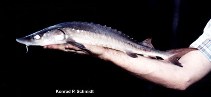 Acipenser fulvescens
Afbeelding van The Native Fish Conservancy
Afbeeldingen | video's | Google afbeelding
Afbeelding van The Native Fish Conservancy
Classificatie / Namen Lokale namen | Synoniemen | Catalog of Fishes(Genus, Soort(en)) | ITIS | CoL | WoRMS | Cloffa
> Acipenseriformes (Sturgeons and paddlefishes) > Acipenseridae (Sturgeons)
Etymology: Acipenser: Latin, acipenser = sturgeon, 1853 (Ref. 45335).
More on author: Rafinesque.
Etymology: Acipenser: Latin, acipenser = sturgeon, 1853 (Ref. 45335).
More on author: Rafinesque.
Milieu: milieu / Klimaatzone / Diepte / verspreidingsgebied Ecologie
; zoet water; brak water demersaal; potamodroom (Ref. 116361); diepte 5 - 9 m (Ref. 117245). Temperate; 60°N - 30°N, 100°W - 71°W
Verspreiding Gebieden | FAO regio's | Ecosystemen | Voorkomen | Verspreidingskaart | Introducties | Faunafri
North America: St. Lawrence-Great Lakes, Hudson Bay, and Mississippi River basins.
Lengte bij maturiteit / Grootte / Gewicht / Leeftijd
Maturiteit: Lm 99.7, range 90 - 120 cm
Max length : 274 cm TL mannelijk / geslacht onbekend; (Ref. 5723); common length : 97.5 cm TL mannelijk / geslacht onbekend; (Ref. 12193); max. gepubliceerd gewicht: 125.0 kg (Ref. 3672); max. gerapporteerde leeftijd: 152 Jaren (Ref. 72475)
Max length : 274 cm TL mannelijk / geslacht onbekend; (Ref. 5723); common length : 97.5 cm TL mannelijk / geslacht onbekend; (Ref. 12193); max. gepubliceerd gewicht: 125.0 kg (Ref. 3672); max. gerapporteerde leeftijd: 152 Jaren (Ref. 72475)
Korte beschrijving Determinatiesleutels | Morfologie | Morfometrie
Single row of preanal shields. Soft area on the top of the head absent and black viscera. Large blotches present on anterior half of upper surface of snout and on back. Lower surface whitish (Ref. 37032). Anal fin origin behind dorsal fin origin; scutes on back and along side same color as skin (Ref. 86798).
Body shape (shape guide): elongated.
Body shape (shape guide): elongated.
Adults inhabit bottom of lakes and large rivers (Ref. 10294), usually in 5-9 m depth, over mud, sand, and gravel. Occasionally enters brackish water. A specimen caught in 1952 was reputed to have been 152 years old (Ref. 6866). Search for food, with the aid of the sensory ability of the barbels, by constantly moving close to the substrate. Omnivorous, virtually anything edible that enters the mouth is sucked up and consumed. The food is worked or pulled in the mouth, often partly ejected and sucked in again (Ref. 1998). Spawning sites are rocky and boulder filled areas along the outside bend of rivers (Ref. 41542). In the 1800s, it was extensively exploited for oil to fire boilers on steamboats, animal feed and fertilizer. Later is was high-valued as smoked, caviar and isinglass (Ref. 117245). In 1951, Canada, 2,000 lbs. of caviar were made from the eggs (Ref. 37032). It continous to be an important source of food for Indigenous people in North America (Ref. 117245). Threatened due to over harvesting, habitat loss and pollution (Ref. 58490).
Levenscyclus en paargedrag Maturiteit | Voortplanting | Paaien | Eieren | Fecunditeit | Larven
Spawning sites are rocky and boulder filled areas along the outside bend of rivers (Ref. 41542).
Hoofdreferentie
Upload uw referenties | Referenties | Coördinator | Medewerkers
Page, L.M. and B.M. Burr, 1991. A field guide to freshwater fishes of North America north of Mexico. Houghton Mifflin Company, Boston. 432 p. (Ref. 5723)
Status op de Rode Lijst van het IUCN (Ref. 130435: Version 2025-2 (Global))
Bedreigd (EN) (A2bcd); Date assessed: 14 September 2019
Gevaar voor de mens
Harmless
Gebruik door de mens
Visserij: commercieel; Aquacultuur: experimenteel; sportvis: ja; Aquarium: Publieke aquaria
FAO - visserij: soortsprofiel; Publication: search | FishSource |
Meer informatie
Trofische ecologie
Voedsel (prooien)
Dieetsamenstelling
Voedselconsumptie
Voedselrantsoenen
Predatoren
Voedsel (prooien)
Dieetsamenstelling
Voedselconsumptie
Voedselrantsoenen
Predatoren
Populatiedynamica
Groeiparameters
Max. leeftijden / maten
Lengte-gewicht rel.
Lengte-lengte rel.
Lengtefrequenties
Massaconversie
Rekrutering
Abundantie
Groeiparameters
Max. leeftijden / maten
Lengte-gewicht rel.
Lengte-lengte rel.
Lengtefrequenties
Massaconversie
Rekrutering
Abundantie
Levenscyclus
Voortplanting
Maturiteit
Rijpheid/kieuwen rel.
Fecunditeit
Paaien
Paaibestanden
Eieren
Ontwikkeling van de eieren
Larven
Larvale populatiedynamiek
Voortplanting
Maturiteit
Rijpheid/kieuwen rel.
Fecunditeit
Paaien
Paaibestanden
Eieren
Ontwikkeling van de eieren
Larven
Larvale populatiedynamiek
Anatomie
Kieuwoppervlak
Hersenen
Otoliet
Kieuwoppervlak
Hersenen
Otoliet
Fysiologie
Lichaamssamenstelling
Voedingsstoffen
Zuurstofverbruik
Type zwemmen
Zwemsnelheid
Visuele pigmenten
Vis geluid
Ziekten en parasieten
Toxiciteit (LC50)
Lichaamssamenstelling
Voedingsstoffen
Zuurstofverbruik
Type zwemmen
Zwemsnelheid
Visuele pigmenten
Vis geluid
Ziekten en parasieten
Toxiciteit (LC50)
Menselijk gerelateerd
Aquacultuursystemen
Aquacultuurprofielen
Kweeklijnen
Ciguatera gevallen
Postzegels, munten, diversen.
Aquacultuursystemen
Aquacultuurprofielen
Kweeklijnen
Ciguatera gevallen
Postzegels, munten, diversen.
Tools
E-boek | Veldgids | Determinatiesleutels | Lengtefrequentie Tool | Levenscyclus tool | Verspreidingskaart |
Vangst-MSY |
Speciale rapporten
Bekijk gegevens voor het houden in een aquarium | Bekijk Fact Sheets voor de soort | Bekijk Aquacultuur Fact Sheets
Download XML
Internetbronnen
AFORO (otoliths) | Exoten/Invasieve soorten database | Aquatic Commons | BHL | Cloffa | Websites from users | Bekijk FishWatcher | CISTI | Catalog of Fishes: Genus, Soort(en) | DiscoverLife | ECOTOX | FAO - visserij: soortsprofiel; Publication: search | Faunafri | Fishipedia | Fishtrace | GloBI | Google Books | Google Scholar | Google | IGFA World Record | OneZoom | Open Tree of Life | Otolith Atlas of Taiwan Fishes | PubMed | Reef Life Survey | Socotra Atlas | TreeBase | Tree of Life | Wikipedia: ga naar, zoek | World Records Freshwater Fishing | Zoological Record
Schattingen op basis van modellen
Fylogenetische diversiteitsindex (Ref. 82804): PD50 = 0.5000 [Uniqueness, from 0.5 = low to 2.0 = high].
Bayesian length-weight: a=0.00269 (0.00214 - 0.00339), b=3.18 (3.13 - 3.23), in cm total length, based on LWR estimates for this species (Ref. 93245).
Trofisch niveau (Ref. 69278): 3.3 ±0.49 se; based on food items.
Weerstandsvermogen (Ref. 120179): Zeer laag, minimale populatieverdubbelingstijd meer dan 14 jaar (tm=16-26; tmax=152; K=0.04; Fec=50,000).