This website uses cookies to enhance your browsing experience and ensure the functionality of our site. For more detailed information about the types of cookies we use and how we protect your privacy, please visit our Privacy Information page.
×
Cookie Settings
This website uses different types of cookies to enhance your experience. Please select your preferences below:
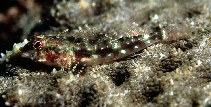
Épines dorsales (Total) : 15 - 17; Rayons mous dorsaux (Total) : 10 - 12; Épines anales: 1; Rayons mous anaux: 19 - 21; Vertèbres: 35 - 36. Dorsal fins III + XII-XIV + 10-12 (usually III + XIII + 10-11); anal fin I, 19-21 (usually 20); pectoral fins usually 15-17 (usually 16: 2, 7, 7). Lateral line continuous, tubed scales 21-27, ending below anterior part of third dorsal fin; total lateral scales 38-40 (37-41, from Clark). Nape, belly, and bases of first dorsal and anal fins scaleless; caudal fin with 1 or 2 rows of scales at base. Pelvic-fin rays bound together by membrane for half the length of shorter ray, longer ray reaches vent. First dorsal fin, triangular, originates over posterior margin of preopercle, in males first spine about as long as longest spine of second dorsal fin, but shorter in females; first two spines close to each other. Mouth large; maxilla reaches vertical through posterior border of pupil; orbital cirrus very small; dentary pores 3 + 1 + 3; head length 3.0-3.5 in SL (Ref. 88983). Body shape (shape guide): elongated.
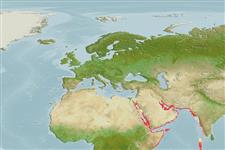
Found usually solitary on corals and rocks in lagoons and bays from 0.5-12 m or deeper (Ref. 88983).
Cycle de vie et comportement reproducteur Maturité | Reproduction | Frai | Œufs | Fécondité | Larves
Holleman, W. and S.V. Bogorodsky, 2012. A review of the blennioid fish family Tripterygiidae (Perciformes) in the Red Sea, with description of Enneapterygius qirmiz, and reinstatement of Enneapterygius altipinnis Clark, 1980. Zootaxa 3152:36-60. (Ref. 88983)
Statut dans la liste rouge de l'IUCN (Ref. 130435: Version 2025-2 (Global))
Cycle de vie Reproduction Maturité Maturité/épines rel. Fécondité Frai Agrégats de frai Œufs Développement de l'œuf Larves Dynamique des populations larvaires
Physiologie Composition corporelle Nutriments Consommation d'oxygène Type de natation Vitesse de nage Pigments visuels Son de poisson Maladies et parasites Toxicité (CL50)
Température préférée (Réf. 123201): 25 - 29.2, mean 27.5 °C (based on 503 cells).
Indice de diversité phylogénétique (Réf. 82804): PD50 = 0.5000 [Uniqueness, from 0.5 = low to 2.0 = high].
Bayesian length-weight: a=0.00617 (0.00290 - 0.01310), b=3.04 (2.86 - 3.22), in cm total length, based on LWR estimates for this (Sub)family-body shape (Ref. 93245).
Niveau trophique (Réf. 69278): 3.1 ±0.3 se; based on size and trophs of closest relatives
Résilience (Réf. 120179): Haut, temps minimum de doublement de population inférieur à 15 mois (Preliminary K or Fecundity.).
Vulnérabilité de la pêche (Ref. 59153): Low vulnerability (10 of 100). 🛈