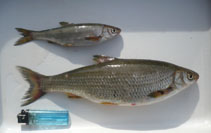
Klassifizierung / Names
Namen | Synonyme | Catalog of Fishes(Gattung, Arten) | ITIS | CoL | WoRMS | Cloffa
>
Cypriniformes (Carps) >
Leuciscidae (Minnows) > Leuciscinae
Etymology: Chondrostoma: Greek, chondros = cartilage + Greek, stoma = mouth (Ref. 45335). Name referring to the characteristic horny layer on the lower lip (Ref. 57917).
Eponymy: Dr Rudolf Kner (1810–1869) was an Austrian zoologist specialising in ichthyology. [...] (Ref. 128868), visit book page.
More on author: Heckel.
Environment: milieu / climate zone / Tiefenbereich / distribution range
Ökologie
; süßwasser benthopelagisch. Subtropical; 45°N - 42°N, 15°E - 18°E
Europe: Neretva drainage in Croatia and Bosnia Herzegovina.
Size / Gewicht / Alter
Geschlechtsreife: Lm ? range ? - ? cm
Max length : 29.4 cm TL Männchen/unbestimmt; (Ref. 91127); max. veröff. Alter: 8 Jahre (Ref. 126005)
Kurzbeschreibung
Bestimmungsschlüssel | Morphologie | Morphometrie
Diagnosed from its congeners in Western Balkans and Adriatic basin by having the following characters: scales on lateral line 50-59; mouth arched and lower lip with thin cornified sheath; ½ 7-8/1/5 scales in transverse row between dorsal-fin and pelvic-fin origins; dorsal fin with 8-9½ branched rays; and 19-24 gill rakers (Ref. 59043).
Body shape (shape guide): fusiform / normal.
Inhabits streams with clear water and lakes (Ref. 59043). Occurs in water bodies on low plains, with little current. Threatened by habitat destruction (Ref. 26100).
Life cycle and mating behavior
Geschlechtsreife | Fortpflanzung | Ablaichen | Eier | Fecundity | Larven
Kottelat, M. and J. Freyhof, 2007. Handbook of European freshwater fishes. Publications Kottelat, Cornol and Freyhof, Berlin. 646 pp. (Ref. 59043)
IUCN Rote Liste Status (Ref. 130435: Version 2025-1)
Bedrohung für Menschen
Harmless
Nutzung durch Menschen
Fischereien: kleinfischerei
Tools
Zusatzinformationen
Download XML
Internet Quellen
Estimates based on models
Phylogenetic diversity index (Ref.
82804): PD
50 = 0.5000 [Uniqueness, from 0.5 = low to 2.0 = high].
Bayesian length-weight: a=0.00575 (0.00339 - 0.00976), b=3.13 (2.99 - 3.27), in cm total length, based on LWR estimates for this species & (Sub)family-body (Ref.
93245).
Trophic level (Ref.
69278): 2.5 ±0.1 se; based on size and trophs of closest relatives
Widerstandsfähigkeit (Ref.
120179): mittel, Verdopplung der Population dauert 1,4 - 4,4 Jahre. (tmax=7.5; Fecundity = 2000-16,000).
Fishing Vulnerability (Ref.
59153): Low vulnerability (19 of 100).
🛈