>
Salmoniformes (Salmons) >
Salmonidae (Salmonids) > Coregoninae
Etymology: Coregonus: Greek, kore = pupils of the eye + Greek, gonia = angle (Ref. 45335).
More on author: Gmelin.
Environment: milieu / climate zone / rango de profundidad / distribution range
Ecología
marino; agua dulce; salobre demersal; anadromo (Ref. 51243). Polar; 71°N - 44°N, 5°W - 133°W
Arctic Ocean basin, from Finland (lapland) to eastern Siberia, Alaska, and Canada eastward to Mackenzie drainage. Belongs to Coregonus clupeaformis complex (Ref. 27547).
Length at first maturity / Tamaño / Peso / Age
Madurez: Lm ?, range 17 - ? cm
Max length : 50.0 cm SL macho / no sexado; (Ref. 59043); common length : 32.8 cm TL macho / no sexado; (Ref. 12193); edad máxima reportada: 14 años (Ref. 12193)
Short description
Claves de identificación | Morfología | Morfometría
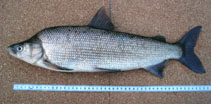
Espinas dorsales (total) : 0; Radios blandos dorsales (total) : 11 - 13; Espinas anales: 0; Radios blandos anales: 10 - 14; Vértebra: 58 - 63. Distinguished by the gill rakers that are longer than 20% of the interorbital width, 19 to 25 gill rakers (with modal counts of 22 or 23), and a pronounced hump behind the head in adults (Ref. 27547). Adipose fin well developed, often larger in males; axillary process present in pelvic fins (Ref. 27547). Dark brown to midnight blue above fading to silver on sides and wide beneath; no parr marks in young (Ref. 27547).
Body shape (shape guide): fusiform / normal.
Inhabits coastal waters near shore (Ref. 5723), lower reaches of rivers with slow current, large lakes with tributaries, floodplain lakes, deltas and estuaries, brackish waters (Ref. 59043). Migrates up to more than 1,200 km inland for spawning (Ref. 5723). Overwinters near river mouths (Ref. 5723). There are non-migratory freshwater populations. Adults feed mostly on mollusks, crustaceans and chironomid larvae (Ref. 28219).
Upstream spawning migrations may be extensive but some populations seldom venture far upstream and still others may never go to sea at all (Ref. 593). Mature adults migrate upstream as early as June to spawn in October. It is assumed that the young hatch in late winter and spring, subsequently moving downstream, to return as mature adults 4 to 6 years later (Ref. 27547).
Kottelat, M., 1997. European freshwater fishes. An heuristic checklist of the freshwater fishes of Europe (exclusive of former USSR), with an introduction for non-systematists and comments on nomenclature and conservation. Biologia, Bratislava, 52/Suppl. 5:1-271. (Ref. 13696)
IUCN Red List Status (Ref. 130435: Version 2025-1)
Threat to humans
Harmless
Human uses
Pesquerías: comercial; Acuicultura: comercial
Herramientas
Special reports
Download XML
Fuentes de Internet
Estimates based on models
Phylogenetic diversity index (Referencia
82804): PD
50 = 0.5000 [Uniqueness, from 0.5 = low to 2.0 = high].
Bayesian length-weight: a=0.00550 (0.00333 - 0.00907), b=3.24 (3.10 - 3.38), in cm total length, based on LWR estimates for this species & Genus-body shape (Ref.
93245).
Nivel trófico (Referencia
69278): 3.3 ±0.2 se; based on diet studies.
Resiliencia (Referencia
120179): Bajo, población duplicada en un tiempo mínimo de 4.5-14 años (tm=3-14; tmax=14; Fec=8,000).
Fishing Vulnerability (Ref.
59153): Moderate to high vulnerability (52 of 100).
🛈
Nutrients (Ref.
124155): Calcium = 18.6 [9.7, 36.6] mg/100g; Iron = 0.418 [0.228, 0.771] mg/100g; Protein = 17.7 [16.6, 18.9] %; Omega3 = 0.619 [0.246, 1.731] g/100g; Selenium = 13.8 [5.7, 34.9] μg/100g; VitaminA = 7.09 [1.42, 38.51] μg/100g; Zinc = 0.481 [0.357, 0.661] mg/100g (wet weight);