


muatnaik fotos/gambar dan video
Gambar | imej Google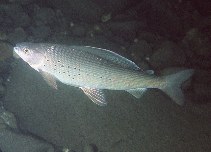 Thymallus arcticus
foto/gambar oleh Keeley, E.R.
Gambar | imej Google
foto/gambar oleh Keeley, E.R.
klasifikasi / Nama Nama-nama umum | Sinonim (persamaan) | Catalog of Fishes(Marga, Jenis) | ITIS | CoL | WoRMS | Cloffa
> Salmoniformes (Salmons) > Salmonidae (Salmonids) > Thymallinae
Etymology: Thymallus: Greek, thymallos, -ou = a kind of fish similar to salmon (Ref. 45335); arcticus: arcticus meaning of the arctic (Ref. 1998).
More on author: Pallas.
Etymology: Thymallus: Greek, thymallos, -ou = a kind of fish similar to salmon (Ref. 45335); arcticus: arcticus meaning of the arctic (Ref. 1998).
More on author: Pallas.
Lingkungan: lingkungan / zona iklim / kisaran kedalaman / jangkauan distribusi Ekologi
; air tawar bentopelagis; potamodromous (Ref. 126106); kisaran kedalaman 30 - ? m (Ref. 5723). Temperate; 71°N - 44°N
Penyebaran Wilayah | Daerah-daerah FAO | Ekosistem | Kemunculan | peta titik | Introduksi | Faunafri
North America: widespread in Arctic drainages from Hudson Bay, Canada to Alaska and in Arctic and Pacific drainages to central Alberta and British Columbia in Canada; upper Missouri River drainage in Montana, USA. Formerly in Great Lakes basin in Michigan, USA (Ref. 5723). Arctic Ocean basin in Siberia from Ob to Yenisei drainages and in Europe in some tributaries of Pechora (Usa, Kosyu, Kozhim), Korotaikha and Kara (Ref. 59043).
Panjang pada saat jatuh tempo pertama / Ukuran / Berat / umur
Kematangan: Lm 24.5, range 23 - 26 cm
Max length : 76.0 cm TL jantan/; (Ref. 5723); common length : 34.3 cm TL jantan/; (Ref. 12193); Berat maksimum terpublikasi: 3.8 kg (Ref. 40637); Umur maksimum dilaporkan: 18 Tahun (Ref. 33969)
Max length : 76.0 cm TL jantan/; (Ref. 5723); common length : 34.3 cm TL jantan/; (Ref. 12193); Berat maksimum terpublikasi: 3.8 kg (Ref. 40637); Umur maksimum dilaporkan: 18 Tahun (Ref. 33969)
deskripsi pendek Kunci identifiaksi (pengenalan) | Morfologi | Morfometrik
Duri punggung (Keseluruhan (total)) : 0; duri punggung lunak (Keseluruhan (total)) : 17 - 25; Duri dubur: 0; Sirip dubur lunak: 11 - 15; vertebrata, bertulang belakang: 58 - 62. Distinguished by its greatly enlarged dorsal fin and its small mouth, which has fine teeth on both jaws (Ref. 27547). Dorsal greatly enlarged in adults (especially males), reaching adipose fin when depressed, but is shorter in females; pelvic fins rather long, reach anal fin in adult males, but not in females; lower lobe of caudal often longer than upper (Ref. 27547). A strikingly colored fish, the dorsal surface is dark purple, or blue black to blue gray, the sides gray to dark blue with pinkish iridescence, the ventral surface gray to white (Ref. 1998). Scattered dark spots on sides, these being more numerous on the young; a dark longitudinal stripe along lower sides between pectoral and pelvic fins; dorsal fin dark with narrow purple edge (rows of reddish to orange or purple to green spots on body of fin); pelvic fins dark with irregular diagonal orange-yellow stripes; adipose, dorsal, anal, caudal and pectorals dusky to dark (Ref. 27547).
Body shape (shape guide): fusiform / normal; Cross section: compressed.
Body shape (shape guide): fusiform / normal; Cross section: compressed.
Adults inhabit open water of clear, cold, medium to large rivers and lakes. They enter rocky creeks to spawn (Ref. 5723). They occur in piedmont and montane cold streams, rivers and lakes with high oxygen concentrations (Ref. 59043). They form schools in moderate numbers (Ref. 9988). Young feed on zooplankton with a gradual shift to immature insects; adults feed mainly on surface insects but also take in fishes, fish eggs, lemmings, and planktonic crustaceans (Ref. 1998). Spawning takes place in montane streams with heavy current on shallows with rock-gravel bottom (Ref. 59043). Utilized fresh and can be fried, broiled, boiled, and baked (Ref. 9988).
Siklus hidup dan perilaku kawin Kematangan | Reproduksi, perkembang biakan | Pemijahan | telur-telur | Fekunditas | Larva
Spawning adults move into tributaries and males establish territories. At spawning, the male follows a female, courting her with displays of his dorsal fin. He then drifts over beside her and curves his extended dorsal fin over the female. The pair vibrates and release eggs and milt. No redd is constructed, but the vibrations of the tails during the spawning act stirs up the substrate and produce a slight depression (Ref. 28876, 28879, 28880, 28881, 28882). A female may spawn only once, or several times in different areas (Ref. 1998). After spawning, adults establish summer territories in pools generally farther upstream from the spawning site, majority moving downstream in mid-September (Ref. 28885, 28886).
rujukan utama
Unggah referensi Anda | Acuan | Koordinator | mitra
McClanes, A.J. (ed.), 1974. Field guide to freshwater fishes of North America. Holt, Rinehart and Winston, New York. 212 p. (Ref. 3221)
Status IUCN Red List (Ref. 130435: Version 2025-2 (Global))
kurang bimbang (LC) ; Date assessed: 01 January 2008
CITES
Not Evaluated
ancaman kepada manusia
Harmless
penggunaan manusia
Perikanan: nilai komersial kecil; Ikan buruan: ya
FAO - Publication: search | FishSource |
informasi lanjut
Dinamika populasi
Parameter pertumbuhan
Maks. usia / ukuran
Panjang-berat rel.
Panjang-panjang rel.
ukuran frekuensi
Konversi massa
pemulihan
Kelimpahan
Parameter pertumbuhan
Maks. usia / ukuran
Panjang-berat rel.
Panjang-panjang rel.
ukuran frekuensi
Konversi massa
pemulihan
Kelimpahan
Siklus hidup
Reproduksi, perkembang biakan
Kematangan
Kedewasaan / insang rel.
Fekunditas
Pemijahan
Agregasi pemijahan
telur-telur
pekembangan telor
Larva
Dinamika larva
Reproduksi, perkembang biakan
Kematangan
Kedewasaan / insang rel.
Fekunditas
Pemijahan
Agregasi pemijahan
telur-telur
pekembangan telor
Larva
Dinamika larva
Anatomi
Area insang
Otak
Otolith
Area insang
Otak
Otolith
Fisiologi
Komposisi tubuh
Nutrisi
Konsumsi oksigen
Jenis renang
Kecepatan berenang
Pigmen visual
Suara ikan
Penyakit & Parasit
Toksisitas (LC50)
Komposisi tubuh
Nutrisi
Konsumsi oksigen
Jenis renang
Kecepatan berenang
Pigmen visual
Suara ikan
Penyakit & Parasit
Toksisitas (LC50)
Yang berhubungan dengan manusia
Sistem akuakultur
profil budidaya air
Strain
Kasus Ciguatera
Perangko, koin, dll.
Sistem akuakultur
profil budidaya air
Strain
Kasus Ciguatera
Perangko, koin, dll.
Alat, peralatan
Kuis organik | E-book | Penuntun lapangan | Kunci identifiaksi (pengenalan) | tanda freqkuenci panjang | peringkat sejarah hidup | peta titik |
Tangkap-MSY |
laporan khas
muat turun XML
Sumber internet
AFORO (otoliths) | Alien/Invasive Species database | Aquatic Commons | BHL | Cloffa | Websites from users | semak peneliti ikan | CISTI | Catalog of Fishes: Marga, Jenis | DiscoverLife | ECOTOX | FAO - Publication: search | Faunafri | Fishipedia | Fishtrace | GloBI | Google Books | Google Scholar | Google | IGFA World Record | OneZoom | Open Tree of Life | Otolith Atlas of Taiwan Fishes | PubMed | Reef Life Survey | Socotra Atlas | TreeBase | Tree of Life | Wikipedia: pergi, Cari | World Records Freshwater Fishing | Catatan Zoologi
Estimasi berdasarkan model
Indeks keanekaragaman filogenetik (Acuan 82804): PD50 = 0.5000 [Uniqueness, from 0.5 = low to 2.0 = high].
Bayesian length-weight: a=0.00813 (0.00578 - 0.01143), b=3.09 (3.00 - 3.18), in cm total length, based on LWR estimates for this species (Ref. 93245).
Tingkat Trofik (Acuan 69278): 3.3 ±0.2 se; based on diet studies.
Generation time: 7.3 (5.5 - 9.2) years. Estimated as median ln(3)/K based on 10 growth studies.
Daya lenting (Acuan 120179): sedang, Waktu penggandaan populasi minimum 1.4 - 4.4 tahun (K=0.10-0.23; tm=2-6; tmax=18; Fec=416).
Nutrisi (Ref. 124155): Calcium = 30.1 [7.9, 61.1] mg/100g; Iron = 0.678 [0.213, 1.553] mg/100g; Protein = 18.6 [16.8, 20.3] %; Omega3 = 1.91 [0.63, 6.48] g/100g; Selenium = 59.2 [22.5, 181.7] μg/100g; VitaminA = 23.2 [6.6, 69.7] μg/100g; Zinc = 0.709 [0.384, 1.339] mg/100g (wet weight); based on nutrient studies.