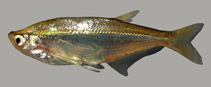
Klassifizierung / Names
Namen | Synonyme | Catalog of Fishes(Gattung, Arten) | ITIS | CoL | WoRMS | Cloffa
>
Cypriniformes (Carps) >
Xenocyprididae (East Asian minnows)
Etymology: Parachela: Greek, para = the side of, near + see under Chela.
Eponymy: Williamina Wemyss Meyer de Schauensee née Wentz (d: 1905) was the wife of Academy of Natural Sciences (Philadelphia) ornithologist Rudolphe Meyer de Schauensee. [...] (Ref. 128868), visit book page.
More on author: Fowler.
Environment: milieu / climate zone / Tiefenbereich / distribution range
Ökologie
; süßwasser benthopelagisch. Tropical
Asia: Mekong basin from northern Thailand downstream to the Great Lake, Cambodia (Ref. 12693) and Chao Phraya basin (Ref. 26336).
Size / Gewicht / Alter
Geschlechtsreife: Lm ? range ? - ? cm
Max length : 12.0 cm SL Männchen/unbestimmt; (Ref. 30857)
Pectoral fin extending behind tips of pelvic fin; 34-35 branched anal-fin rays; no dark pigment outlining canal on anterior lateral-line scales; 22-26 gill rakers on 1st arch (Ref. 12693).
Body shape (shape guide): fusiform / normal.
Inhabits medium to large-sized rivers with fast current and relatively clear water (Ref. 12693). Used to make prahoc (Ref. 12693).
Life cycle and mating behavior
Geschlechtsreife | Fortpflanzung | Ablaichen | Eier | Fecundity | Larven
Rainboth, W.J., 1996. Fishes of the Cambodian Mekong. FAO species identification field guide for fishery purposes. FAO, Rome, 265 p. (Ref. 12693)
IUCN Rote Liste Status (Ref. 130435: Version 2025-1)
Bedrohung für Menschen
Harmless
Nutzung durch Menschen
Fischereien: kleinfischerei
Tools
Zusatzinformationen
Download XML
Internet Quellen
Estimates based on models
Phylogenetic diversity index (Ref.
82804): PD
50 = 0.5078 [Uniqueness, from 0.5 = low to 2.0 = high].
Bayesian length-weight: a=0.00871 (0.00412 - 0.01842), b=3.09 (2.92 - 3.26), in cm total length, based on LWR estimates for this (Sub)family-body shape (Ref.
93245).
Trophic level (Ref.
69278): 3.4 ±0.4 se; based on size and trophs of closest relatives
Widerstandsfähigkeit (Ref.
120179): hoch, Verdopplung der Population dauert weniger als 15 Monate. (Preliminary K or Fecundity.).
Fishing Vulnerability (Ref.
59153): Low vulnerability (10 of 100).
🛈