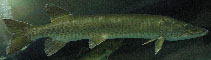
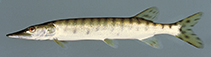
分類 / Names
共通名の | 類義語 | Catalog of Fishes(部類, 種) | ITIS | CoL | WoRMS | Cloffa
>
Esociformes (Pikes and mudminnows) >
Esocidae (Pikes)
Etymology: Esox: From Greek, isox and also related with the Celtic root, eog, ehawc = salmon (Ref. 45335); masquinongy: Stemmed from an Ojibwa (Chippewa) Indian name for this fish (Ref. 10294).
More on author: Mitchill.
Environment: milieu / climate zone / 深さの範囲 / distribution range
生態学
; 新鮮な水 底生の; 移住性ではない. Temperate; 53°N - 30°N
North America: Native to St. Lawrence River - Great Lakes, Hudson Bay (Red River), and Mississippi River basins. Introduced elsewhere in the USA. Native populations are protected in portions of Tennessee and Ohio.
Length at first maturity / サイズ / 重さ / 年齢
成熟: Lm 77.0 range ? - ? cm
Max length : 183 cm TL オス/雌雄の選別がない; (Ref. 5723); common length : 95.0 cm TL オス/雌雄の選別がない; (Ref. 12193); 最大公表体重: 31.8 kg (Ref. 3549); 最大記録サイズ: 30 年 (Ref. 26373)
Lives in clear vegetated lakes, quiet pools and backwaters of creeks and small to large rivers (Ref. 205, 10294). Solitary, lurking hunter on other fishes as well as on ducklings, muskrats, and snakes. Oviparous, spawn in spring as the ice melts (Ref. 205).
Life cycle and mating behavior
成熟 | 繁殖 | 放精 | 卵 | 生産力 | 幼生
Some experts believe that some form of copulation happens during breeding of this species. The female turns on her side to expose her abdomen to the male who then swims against her in a forceful movement. Aftewards, the female takes a rest and deposits her eggs in the sand. This whole activity is presumably repeated one more time (Ref. 205). Other experts believe otherwise, that only a simple and simultaneous discharge of gametes happens during breeding (Ref. 205).
Crossman, E.J., 1996. Taxonomy and distribution. p. 1-11. In J.F. Craig (ed.) Pike biology and exploration. Chapman and Hall, London. 298 p. (Ref. 26373)
IUCNのレッドリストの状況は (Ref. 130435: Version 2025-1)
Human uses
水産業: 商業; 水産養殖: 商業; ゲームフィッシュ: はい; 水族館・水槽: 公共の水族館
用具
特記事項
XMLをダウンロードして下さい
インターネットの情報源
Estimates based on models
Phylogenetic diversity index (参照
82804): PD
50 = 0.5157 [Uniqueness, from 0.5 = low to 2.0 = high].
Bayesian length-weight: a=0.00490 (0.00372 - 0.00645), b=3.08 (3.02 - 3.14), in cm total length, based on LWR estimates for this species (Ref.
93245).
栄養段階 (参照
69278): 4.5 ±0.3 se; based on diet studies.
Generation time: 6.4 (5.5 - 7.1) years. Estimated as median ln(3)/K based on 25
growth studies.
回復力 (参照
120179): 低い, 4.5年~14年の倍増期間の最小個体群 (K=0.07-0.15; tmax=30).
Fishing Vulnerability (Ref.
59153): High to very high vulnerability (67 of 100).
🛈