>
Gobiiformes (Gobies) >
Gobiidae (Gobies) > Gobionellinae
Etymology: Pseudogobius: Greek, pseudes = false + Latin, gobius = gudgeon (Ref. 45335); avicennia: Named after the genus Avicennia, reflecting the species' association with this mangrove.
More on author: Herre.
Environment: milieu / Zona climática / intervalo de profundidade / distribution range
Ecologia
; Água doce; estuarina bentopelágico; intervalo de profundidade 0 - 2 m (Ref. 126575). Tropical
Western Pacific: Thailand, Malaysia, Singapore, Brunei and Indonesia (west of the Lydekker’s Line).
Tamanho / Peso / Idade
Maturidade: Lm ? range ? - ? cm
Max length : 3.6 cm SL macho/indeterminado; (Ref. 126575)
Descrição suscinta
Chaves de identificação | Morfologia | Morfometria
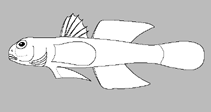
Espinhos dorsais (total) : 7; Raios dorsais (total) : 7; Espinhos anais: 1; Raios anais : 7. This moderate-sized species is distinguished by the following characters: D2 I,7; A I,7; pectoral rays 14-17; segmented caudal rays 6 in 9/7 pattern; lateral scales 25-28; transverse scale count 6-8½; predorsal scales 8-10; opercle has 2-4 rows of cycloid scales, no scales on cheek; shoulder girdle is smooth; tongue is short and mostly fused to floor of mouth; in both sexes teeth are similar although males have 2-3 curved symphyseal canines behind anterior tooth rows, the upper jaw teeth in two rows, teeth in outer row pointed, bluntly rounded to flattened, small, closely spaced, evenly sized, ofthe no teeth from side of jaw; a sexually dimorphic species, with adult males possessing inflated cheeks and nape, have more prominent eyes, a strongly curved suborbital, larger jaws and relatively plain dark body colour. Colouration: body yellowish brown with five dark brown blotches along side and distinctive yellow-edged black spot on upper part of the caudal fin in both sexes (Ref. 126575).
Cross section: compressed.
Facultative air-breathing in the genus (Ref. 126274); Occurs in mangroves and lower estuaries of rivers and streams and is nearly always associated with mangroves (associated with the mangrove Avicennia) (Ref. 126575).
Ciclo de vida ou comportamento de acasalamento
Maturidade | Reprodução | Desova | Ovos | Fecundidade | Larvas
Larson, H.K. and M.P. Hammer, 2021. A revision of the gobiid fish genus Pseudogobius (Teleostei, Gobiidae, Tridentigerinae), with description of seven new species from Australia and South-east Asia. Zootaxa 4961(1):1-85. (Ref. 126575)
Status na Lista Vermelha da UICN (Ref. 130435: Version 2025-1)
Ameaça para os humanos
Harmless
Uso pelos humanos
Ferramentas
Relatórios especiais
Baixar XML
Fontes da internet
Estimates based on models
Índice de diversidade filogenética (Ref.
82804): PD
50 = 0.5000 [Uniqueness, from 0.5 = low to 2.0 = high].
Bayesian length-weight: a=0.01000 (0.00353 - 0.02836), b=3.08 (2.84 - 3.33), in cm total length, based on LWR estimates for this (Sub)family-body shape (Ref.
93245).
Nível Trófico (Ref.
69278): 3.2 ±0.5 se; based on size and trophs of closest relatives
Resiliência (Ref.
120179): Elevada, tempo mínimo de duplicação da população menor que 15 meses (Preliminary K or Fecundity.).
Fishing Vulnerability (Ref.
59153): Low vulnerability (10 of 100).
🛈