


Carasobarbus exulatus (Banister & Clarke, 1977)
分類 / 名稱 俗名 | 同種異名 | Catalog of Fishes(屬, 種) | ITIS | CoL | WoRMS | Cloffa
Teleostei > Cypriniformes (Carps) 鯉形目 (Carps) > Cyprinidae (Minnows or carps) 鯉科 (Minnows or carps) > Torinae
Etymology: Carasobarbus: Latinization of , karass, karausche, European crucian carp + Latin, barbus = barbel (Ref. 45335); exulatus: The specific name is derived from the Latin for banished and refers to the isolation of its habitats (Ref. 113720).
Etymology: Carasobarbus: Latinization of , karass, karausche, European crucian carp + Latin, barbus = barbel (Ref. 45335); exulatus: The specific name is derived from the Latin for banished and refers to the isolation of its habitats (Ref. 113720).
環境: 環境 / 氣候帶 / 深度上下限 / 配送範圍 生態學
; 淡水 底中水層性. 熱帶
分布 領土 | FAO區域 | 生態系 | 發現紀錄 | 分布圖 | 簡介 | Faunafri
Asia: Wadi Hadramaut and Wadi Maran, Yemen (Ref. 113720).
亞洲: 已知只來自哈德拉毛河流域,葉門了。
亞洲: 已知只來自哈德拉毛河流域,葉門了。
大小 / 重量 / 年齡
簡短描述 檢索表 | 型態特徵 | 形態測量圖
背棘 (總數) : 0; 背的軟條 (總數) : 11 - 14; 臀棘: 0; 臀鰭軟條: 8 - 9; 脊椎骨: 37 - 39. Diagnosis: The mouth of this species has a more ventral position than that of the other Carasobarbus species, being almost inferior (Ref. 57642). It is the only species of the genus Carasobarbus in which both pairs of barbels are always present, the barbels of the anterior pair being often very short, but not quite rudimentary (Ref. 57642). Carasobarbus exulatus differs from all congeners, except C. fritschii and C. harterti in modally having 9 instead of 10 branched dorsal-fin rays; it differs from C. fritschii and C. harterti in modally having 12 scales around the least circumference of the caudal peduncle vs. 16 and in having 24-32 scales on the lateral line vs. 30-39 and 31-38 respectively (Ref. 94477).
Body shape (shape guide): fusiform / normal; Cross section: compressed.
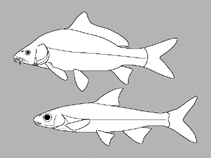
D 4, 7-9; 一 3/6; L. Latvia 的貨幣單位。 24-28. 這種的嘴巴超過它的同類有一個更多的腹位置,幾乎下方。 身體的上面輪廓是中凸的, 下面的幾乎水平; 在這敬意, exulatus 是類似 canis 的更多。 在鱗片上的陷紋是平行的; 唇平滑的; 背鰭的最後不分枝鰭條鈣化了,而且它的後緣相當細鋸齒狀的或平滑的。 C. exulatus 時常是兩者的對觸鬚是永遠有的本屬的唯一的種,前面對的觸鬚非常短, 但是不完全不發達的.(參考文獻 57642)
Body shape (shape guide): fusiform / normal; Cross section: compressed.
D 4, 7-9; 一 3/6; L. Latvia 的貨幣單位。 24-28. 這種的嘴巴超過它的同類有一個更多的腹位置,幾乎下方。 身體的上面輪廓是中凸的, 下面的幾乎水平; 在這敬意, exulatus 是類似 canis 的更多。 在鱗片上的陷紋是平行的; 唇平滑的; 背鰭的最後不分枝鰭條鈣化了,而且它的後緣相當細鋸齒狀的或平滑的。 C. exulatus 時常是兩者的對觸鬚是永遠有的本屬的唯一的種,前面對的觸鬚非常短, 但是不完全不發達的.(參考文獻 57642)
生命週期和交配行為 成熟度 | 繁殖 | 產卵場 | 卵 | 孕卵數 | 仔魚
亞洲: 已知只來自哈德拉毛河流域,葉門了。
主要參考資料
上傳您的推薦信 | 參考文獻 | 合作者 | 合作者
Banister, K.E. and M.A. Clarke, 1977. The freshwater fishes of the Arabian peninsula. J. Oman Stud. Spec. Rep. 1:111-154. (Ref. 113720)
CITES
Not Evaluated
對人類具威脅
無害處的
人類使用
漁業: 沒有興趣
FAO - Publication: search | FishSource |
更多資訊
營養生態學
食物項目(獵物)
食性組成
食物消耗量
食物配給
捕食者
食物項目(獵物)
食性組成
食物消耗量
食物配給
捕食者
生態學
生態學
生態學
人口動態
成長參數
最大年齡/尺寸
長度重量比
長度關係
長度-頻率
質量轉換
入添量
豐度
成長參數
最大年齡/尺寸
長度重量比
長度關係
長度-頻率
質量轉換
入添量
豐度
解剖學
鰓區
腦部
耳石
鰓區
腦部
耳石
生理學
身體成分
營養素
耗氧量
游泳類型
游泳速度
視覺色素
魚聲
疾病與寄生蟲
毒性 (LC50s)
身體成分
營養素
耗氧量
游泳類型
游泳速度
視覺色素
魚聲
疾病與寄生蟲
毒性 (LC50s)
遺傳學
基因組
遺傳學
異種性
遺傳率
遺傳多樣性
基因組
遺傳學
異種性
遺傳率
遺傳多樣性
工具
特別的報告
下載 XML
網路資源
AFORO (otoliths) | Aquatic Commons | BHL | Cloffa | Websites from users | 檢查 FishWatcher | CISTI | Catalog of Fishes: 屬, 種 | DiscoverLife | ECOTOX | FAO - Publication: search | Faunafri | Fishipedia | Fishtrace | GloBI | Google Books | Google Scholar | Google | IGFA World Record | OneZoom | Open Tree of Life | Otolith Atlas of Taiwan Fishes | PubMed | Reef Life Survey | Socotra Atlas | TreeBase | 樹狀分類階層 | Wikipedia: 去, 搜尋 | World Records Freshwater Fishing | 動物學的記錄
基於模型的估計
系統發育多樣性指數 (參考文獻 82804): PD50 = 0.5001 [Uniqueness, from 0.5 = low to 2.0 = high].
Bayesian length-weight: a=0.00955 (0.00430 - 0.02123), b=3.02 (2.83 - 3.21), in cm total length, based on LWR estimates for this (Sub)family-body shape (Ref. 93245).
營養階層 (參考文獻 69278): 3.0 ±0.4 se; based on size and trophs of closest relatives
回復力 (參考文獻 120179): 中等的, 族群倍增時間最少 1.4 - 4.4年 (Assuming Fec < 10,000).