>
Ophidiiformes (Cusk eels) >
Dinematichthyidae (Viviparous brotula)
Etymology: Gunterichthys: Because of Albert C. L. G. Günther, German ichthyologist, 1830-1914 (Ref. 45335).
Eponymy: Dr Gordon Gunter (1909–1998) was a marine biologist. [...] (Ref. 128868), visit book page.
Environment: milieu / Klimaatzone / Diepte / distribution range
Ecologie
marien; brak water demersaal; diepte 0 - 9 m (Ref. 34024). Subtropical; - 24°N
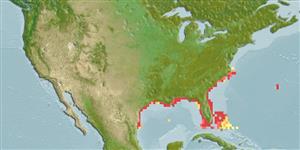
Western Atlantic: northern Gulf of Mexico.
Grootte / Gewicht / Leeftijd
Maturiteit: Lm ? range ? - ? cm
Max length : 7.5 cm TL mannelijk / geslacht onbekend; (Ref. 7251)
Korte beschrijving
Determinatiesleutels | Morfologie | Morfometrie
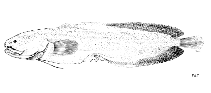
Dorsale zachte stralen (totaal) : 60 - 71; Anale zachte stralen: 41 - 52; Wervels: 38 - 40. Diagnosis: Blunt snout; small distinct eyes, 1.4-1.9% SL in adults; head naked, body covered with imbricate scales; interorbital in adults 5.6-7.7% SL; posterior infraorbital pores 2; rays in dorsal fin 60-71, anal 41-52, caudal 12-15; otolith with fused colliculi; sulcus small; 1 pair of pseudoclaspers with 2 almost equally long supporters (Ref. 55786).
Burrows in soft mud bottoms at shallow depths (0.7-6 m) of quiet lagoons, backwaters and saline parts of estuaries (Ref. 7251, 55786). Reported to give birth to very few, about 15 mm long juveniles in each clutch; one female found to have four 5-8 mm long embryos and has a 3.2 mm bivalve in the intestine (Ref. 55786). Probably common where it occurs (Ref. 34024).
Levenscyclus en paargedrag
Maturiteit | Voortplanting | Paaien | Eieren | Fecunditeit | Larven
Nielsen, J.G., D.M. Cohen, D.F. Markle and C.R. Robins, 1999. Ophidiiform fishes of the world (Order Ophidiiformes). An annotated and illustrated catalogue of pearlfishes, cusk-eels, brotulas and other ophidiiform fishes known to date. FAO Fish. Synop. 125(18):178p. Rome: FAO. (Ref. 34024)
Status op de Rode Lijst van het IUCN (Ref. 130435: Version 2025-1)
Gevaar voor de mens
Harmless
Gebruik door de mens
Visserij: van geen belang
Tools
Speciale rapporten
Download XML
Internetbronnen
Estimates based on models
Preferred temperature (Ref.
123201): 23.3 - 26.8, mean 24.6 °C (based on 124 cells).
Fylogenetische diversiteitsindex (Ref.
82804): PD
50 = 0.6250 [Uniqueness, from 0.5 = low to 2.0 = high].
Bayesian length-weight: a=0.00389 (0.00180 - 0.00842), b=3.12 (2.94 - 3.30), in cm total length, based on all LWR estimates for this body shape (Ref.
93245).
Trofisch niveau (Ref.
69278): 3.3 ±0.5 se; based on size and trophs of closest relatives
Weerstandsvermogen (Ref.
120179): laag, minimale populatieverdubbelingstijd 4,5-14 jaar (Assuming Fec < 100).
Fishing Vulnerability (Ref.
59153): Low vulnerability (10 of 100).
🛈