>
Lampriformes (Velifers, tube-eyes and ribbonfishes) >
Trachipteridae (Ribbonfishes)
Etymology: Trachipterus: Greek, trachys, -eia, -ys = rough + Greek, pteron = wing, fin (Ref. 45335).
More on author: Kner.
Environment: milieu / Klimaatzone / Diepte / distribution range
Ecologie
marien pelagic-oceanic; oceanodroom (Ref. 51243); diepte 0 - 900 m (Ref. 36610). Subtropical; 60°N -
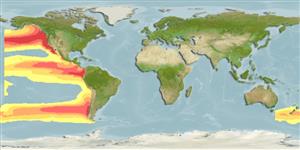
Eastern Pacific: Alaska to Chile.
Grootte / Gewicht / Leeftijd
Maturiteit: Lm ? range ? - ? cm
Max length : 183 cm TL mannelijk / geslacht onbekend; (Ref. 2850)
Korte beschrijving
Determinatiesleutels | Morfologie | Morfometrie
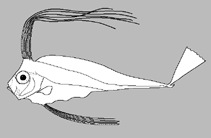
Dorsale stekels (totaal) : 0; Dorsale zachte stralen (totaal) : 165 - 184; Anale stekels: 0; Anale zachte stralen: 0; Wervels: 90 - 94. First 5 rays of dorsal fin greatly elongated in young becoming reduced with age, otherwise rather higher in center, extending almost to caudal and ends abruptly (Ref. 6885); caudal fin highly asymmetric, dorsal lobe becomes well developed in juveniles with 7-8 rays directed upward at an angle of 45° to body axis, and eventually with growth is much reduced; ventral lobe elongate in young specimens becoming reduced to 5-6 spines directed backward from the caudal base in older individuals; anal fin absent; pectorals small, rounded; pelvic fins elongate in young and juveniles, reduced to base in larger individuals (Ref. 6885). Juveniles iridescent silvery with a series of about 4 dark blotches spaced above lateral line canal; upright and pelvic fins carmine red; larger individuals rather very silvery and greener with light spots, around scales; posterior end of dorsal fin darker (Ref. 6885).
Body shape (shape guide): eel-like.
Oceanic (Ref. 2850). Also found near shore, but large adults sometimes feed on the bottom (Ref. 2850). Small individuals feed on copepods, annelid worms, and fish larvae; larger individuals feed on copepods, euphausiids, small pelagic fishes, young rockfishes, squid, and Octopoda (Ref. 6885). Oviparous, with planktonic eggs and larvae (Ref. 36610).
Levenscyclus en paargedrag
Maturiteit | Voortplanting | Paaien | Eieren | Fecunditeit | Larven
Eschmeyer, W.N., E.S. Herald and H. Hammann, 1983. A field guide to Pacific coast fishes of North America. Boston (MA, USA): Houghton Mifflin Company. xii+336 p. (Ref. 2850)
Status op de Rode Lijst van het IUCN (Ref. 130435: Version 2025-1)
Gevaar voor de mens
Harmless
Gebruik door de mens
Tools
Speciale rapporten
Download XML
Internetbronnen
Estimates based on models
Preferred temperature (Ref.
123201): 5.9 - 10.4, mean 7.7 °C (based on 77 cells).
Fylogenetische diversiteitsindex (Ref.
82804): PD
50 = 0.5166 [Uniqueness, from 0.5 = low to 2.0 = high].
Bayesian length-weight: a=0.00102 (0.00046 - 0.00225), b=3.06 (2.88 - 3.24), in cm total length, based on all LWR estimates for this body shape (Ref.
93245).
Trofisch niveau (Ref.
69278): 3.9 ±0.48 se; based on food items.
Weerstandsvermogen (Ref.
120179): laag, minimale populatieverdubbelingstijd 4,5-14 jaar (Assuming tmax>10).
Fishing Vulnerability (Ref.
59153): Very high vulnerability (90 of 100).
🛈