>
Syngnathiformes (Pipefishes and seahorses) >
Syngnathidae (Pipefishes and seahorses) > Syngnathinae
Etymology: Hippocampus: Greek, ippos = horse + Greek,kampe = curvature (Ref. 45335).
Eponymy: Earl Desmond Reid (1885–1960) was Assistant Curator, Division of Fishes at the Smithsonian (United States National Museum, USNM) where Isaac Ginsburg also worked. [...] (Ref. 128868), visit book page.
More on author: Ginsburg.
Environment: milieu / climate zone / rango de profundidad / distribution range
Ecología
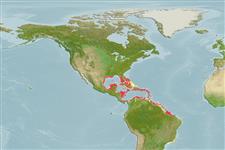
marino; salobre asociado a arrecife; no migratorio; rango de profundidad 0 - 60 m (Ref. 30915). Subtropical; 29°N - 25°S, 133°W - 40°W (Ref. 57010)
Western Atlantic: USA (North Carolina) to Brazil; the Caribbean Sea.
Length at first maturity / Tamaño / Peso / Age
Madurez: Lm 8.0 range ? - ? cm
Max length : 17.5 cm OT macho / no sexado; (Ref. 30915)
Espinas dorsales (total) : 0; Radios blandos dorsales (total) : 16 - 19.
Body shape (shape guide): other; Cross section: angular.
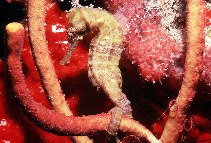
Uncommon in most areas, but may be locally common in certain places. Usually attached to gorgonians or seagrasses but may occur in floating Sargassum or swimming freely in midwater (Ref. 9710). Ovoviviparous (Ref. 205). The male carries the eggs in a brood pouch which is found under the tail (Ref. 205). Has been reared in captivity (Ref. 35409). Length type refers to Height (= from top of coronet to the tip of straightened tail). Maximum depth reported taken from Ref. 128812.
Breeding season more than 8 months in laboratory; egg diameter 1.2 mm; gestation period 2 weeks, depending on water temperature; young approximately 7 mm at birth; pair-bonded in wild (Ref. 30915). Monogamous mating is observed as both obligate and genetic (Ref. 52884).
Lourie, S.A., R.A. Pollom and S.J. Foster, 2016. A global revision of the seahorses Hippocampus Rafinesque 1810 (Actinopterygii: Syngnathiformes): taxonomy and biogeography with recommendations for further research. Zootaxa 4146(1):1-66. (Ref. 115213)
IUCN Red List Status (Ref. 130435: Version 2025-1)
Threat to humans
Harmless
Human uses
Pesquerías: escaso valor comercial
Herramientas
Special reports
Download XML
Fuentes de Internet
Estimates based on models
Preferred temperature (Referencia
123201): 24 - 28, mean 26.7 °C (based on 164 cells).
Phylogenetic diversity index (Referencia
82804): PD
50 = 0.5000 [Uniqueness, from 0.5 = low to 2.0 = high].
Bayesian length-weight: a=0.00447 (0.00175 - 0.01142), b=2.99 (2.77 - 3.21), in cm total length, based on LWR estimates for this (Sub)family-body shape (Ref.
93245).
Nivel trófico (Referencia
69278): 3.4 ±0.5 se; based on size and trophs of closest relatives
Generation time: 1.0 ( na - na) years. Estimated as median ln(3)/K based on 2
growth studies.
Resiliencia (Referencia
120179): Medio, población duplicada en un tiempo mínimo de 1.4-4.4 años (Assuming annual Fec<1000).
Fishing Vulnerability (Ref.
59153): Low vulnerability (12 of 100).
🛈
Nutrients (Ref.
124155): Calcium = 70.1 [33.4, 185.4] mg/100g; Iron = 0.894 [0.451, 1.624] mg/100g; Protein = 18.9 [17.7, 20.1] %; Omega3 = 0.203 [0.104, 0.388] g/100g; Selenium = 18.4 [7.4, 43.5] μg/100g; VitaminA = 35.5 [9.6, 134.4] μg/100g; Zinc = 1.29 [0.78, 2.04] mg/100g (wet weight);