


Rachycentron canadum (Linnaeus, 1766)
Cobia
Beobachtung melden im Fish Watcher
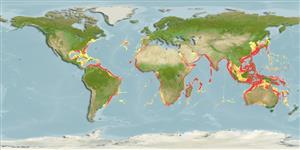
| Native range | All suitable habitat | Point map | Year 2050 |
|
| This map was computer-generated and has not yet been reviewed. |
| Rachycentron canadum AquaMaps Data sources: GBIF OBIS |
Hochladen Photos und videos
Bilder | videos | Briefmarken, Münzen, Verschiedenes. | Google Bild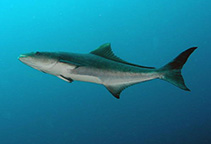 Rachycentron canadum
Photo von Cox, C.D.
Bilder | videos | Briefmarken, Münzen, Verschiedenes. | Google Bild
Photo von Cox, C.D.
Klassifizierung / Names Namen | Synonyme | Catalog of Fishes(Gattung, Arten) | ITIS | CoL | WoRMS | Cloffa
> Carangiformes (Jacks) > Rachycentridae (Cobia)
Etymology: Rachycentron: Greek, rhachis, -ios = spine + Greek, kentron = sting (Ref. 45335).
More on author: Linnaeus.
Etymology: Rachycentron: Greek, rhachis, -ios = spine + Greek, kentron = sting (Ref. 45335).
More on author: Linnaeus.
Umwelt: Milieu / Klimazone / Tiefenbereich / Verbreitungsgebiet Ökologie
seewasser; brackwasser riff-verbunden; ozeanodrom (Ref. 51243); tiefenbereich 0 - 1200 m (Ref. 9739). Subtropical; 17°C - 32°C (Ref. 12459); 47°N - 37°S, 98°W - 166°E (Ref. 12459)
Verbreitung Territorien | FAO Gebiete | Ökosysteme | Vorkommen | Punkt Karte | Einführungen | Faunafri
Worldwide in tropical and subtropical waters, but absent in the eastern Pacific (Ref. 9739, 33390) and the Pacific Plate, except marginally (Ref. 10948). Western Atlantic: Canada (Ref. 5951) to Bermuda and Massachusetts, USA to Argentina (Ref. 7251), including the Gulf of Mexico (Ref. 9626) and entire Caribbean (Ref. 26938). Eastern Atlantic: Morocco to South Africa. Indo-West Pacific: East Africa (Ref. 2871, 5213, 6644, 30573) and Hokkaido, Japan to Australia.
Länge bei der ersten Reifung / Größe / Gewicht / Alter
Geschlechtsreife: Lm ?, range 43 - ? cm
Max length : 200 cm TL Männchen/unbestimmt; (Ref. 10790); common length : 110 cm TL Männchen/unbestimmt; (Ref. 3487); max. veröff. Gewicht: 68.0 kg (Ref. 7251); max. veröff. Alter: 15 Jahre (Ref. 9739)
Max length : 200 cm TL Männchen/unbestimmt; (Ref. 10790); common length : 110 cm TL Männchen/unbestimmt; (Ref. 3487); max. veröff. Gewicht: 68.0 kg (Ref. 7251); max. veröff. Alter: 15 Jahre (Ref. 9739)
Kurzbeschreibung Bestimmungsschlüssel | Morphologie | Morphometrie
Rückenflossenstacheln (insgesamt) : 7 - 9; Rückenflossenweichstrahlen (insgesamt) : 26 - 33; Afterflossenstacheln: 2 - 3; Afterflossenweichstrahlen: 22 - 28. This species is distinguished by the following characters: head broad and depressed; first dorsal fin usually with VIII short but strong isolated spines, not connected by a membrane; caudal fin lunate to emarginate in adults, upper lobe longer than lower, rounded in young with prolonged central rays. Colour of back and sides dark brown, with 2 sharply defined narrow silvery bands, belly yellowish (Ref. 10948, 90102).
Body shape (shape guide): elongated; Cross section: oval.
Body shape (shape guide): elongated; Cross section: oval.
Adults occur in a variety of habitats, over mud, sand and gravel bottoms; over coral reefs, off rocky shores (Ref. 10948) and in mangrove sloughs; inshore around pilings and buoys, and offshore around drifting and stationary objects; occasionally in estuaries (Ref. 9739). Form small groups and may pursue small pelagic inshore (Ref. 48635). Feed on crustaceans (inlcuding crabs), small fishes, and squids (Ref. 5213, 10948, 13442, 132435). Form spawning aggregations during the warm months in the western Atlantic; eggs and larvae planktonic (Ref. 12459). Caught in small quantities due to its solitary behavior (Ref. 9626). Caught mainly with handlines, and by trolling pelagically offshore over the continental shelf (Ref. 10948). Good food fish; marketed fresh (Ref. 5284), smoked, and frozen (Ref. 9987). Also caught for sport (Ref. 26938).
Lebenszyklus und Paarungsverhalten Geschlechtsreife | Fortpflanzung | Ablaichen | Eier | Fruchtbarkeit | Larven
Form spawning aggregations during the warm months in the western Atlantic; eggs and larvae planktonic (Ref. 12459).
Hauptreferenz
Laden Sie Ihre Referenzen hoch | Referenzen | Koordinator | Partner
Shaffer, R.V. and E.L. Nakamura, 1989. Synopsis of biological data on the cobia Rachycentron canadum (Pisces: Rachycentridae). NOAA Tech. Rep. NMFS 82, FAO Fisheries Synopsis 153. (Ref. 9739)
IUCN Rote Liste Status (Ref. 130435: Version 2025-2 (Global))
nicht bedroht (LC) ; Date assessed: 21 August 2012
CITES
Not Evaluated
Bedrohung für Menschen
Harmless
Nutzung durch Menschen
Fischereien: weniger kommerziell; Aquakultur: kommerziell; Sportfisch: ja
FAO - Aquakultur-Systeme: produktion, Artbeschreibung; Fischereien: landungen; Publication: search | FishSource | Das Meer um uns herum
Mehr Information
Trophische Ökologie
Lebensmittel (Beutetiere)
Nahrungszusammensetzung
Nahrungsaufnahme
Lebensmittelrationen
Räuber
Lebensmittel (Beutetiere)
Nahrungszusammensetzung
Nahrungsaufnahme
Lebensmittelrationen
Räuber
Populationsdynamik
Wachstumsparameter
Max. Alter/Größen
Länge-Gewicht-Rel.
Länge-Länge-Verhältnis.
Längenhäufigkeiten
Massenkonvertierung
Rekrutierung
Dichte
Wachstumsparameter
Max. Alter/Größen
Länge-Gewicht-Rel.
Länge-Länge-Verhältnis.
Längenhäufigkeiten
Massenkonvertierung
Rekrutierung
Dichte
Lebenszyklus
Fortpflanzung
Geschlechtsreife
Reifung/Kiemen rel.
Fruchtbarkeit
Ablaichen
Laichaggregationen
Eier
Eientwicklung
Larven
Larven Pop.Dyn.
Fortpflanzung
Geschlechtsreife
Reifung/Kiemen rel.
Fruchtbarkeit
Ablaichen
Laichaggregationen
Eier
Eientwicklung
Larven
Larven Pop.Dyn.
Anatomie
Kiemenoberfläche
Gehirn
Otolith
Kiemenoberfläche
Gehirn
Otolith
Physiologie
Körperliche Zusammensetzung
Nährstoffe
Sauerstoffverbrauch
Schwimmart
Schwimmgeschwindigkeit
Visuelle Pigmente
Fischgeräusche
Krankheiten und Parasiten
Toxizität (LC50s)
Körperliche Zusammensetzung
Nährstoffe
Sauerstoffverbrauch
Schwimmart
Schwimmgeschwindigkeit
Visuelle Pigmente
Fischgeräusche
Krankheiten und Parasiten
Toxizität (LC50s)
Menschenbezogen
Aquakultur-Systeme
Aquakultur Profile
Zuchtlinien
Ciguatera-Fälle
Briefmarken, Münzen, Verschiedenes.
Aquakultur-Systeme
Aquakultur Profile
Zuchtlinien
Ciguatera-Fälle
Briefmarken, Münzen, Verschiedenes.
Tools
Zusatzinformationen
Download XML
Zusammenfassung | Punktdaten | Namen | Photos
Internet Quellen
AFORO (otoliths) | Alien/Invasive Species database | Aquatic Commons | BHL | Cloffa | Websites from users | FishWatcher Einträge suchen | CISTI | Catalog of Fishes: Gattung, Arten | DiscoverLife | ECOTOX | FAO - Aquakultur-Systeme: produktion, Artbeschreibung; Fischereien: landungen; Publication: search | Faunafri | Fishipedia | Fishtrace | GloBI | GoMexSI (interaction data) | Google Books | Google Scholar | Google | IGFA World Record | Nationale Datenbanken | OceanAdapt | OneZoom | Open Tree of Life | OsteoBase: skull, spine | Otolith Atlas of Taiwan Fishes | Öffentliche Aquarien | PubMed | Reef Life Survey | Socotra Atlas | TreeBase | Tree of Life | Wikipedia: Gehe zu, Suchen | World Records Freshwater Fishing | Zoologischer Rekord
Schätzungen auf der Grundlage von Modellen
Bevorzugte Temperatur (Ref. 123201): 8.1 - 19.8, mean 12.9 °C (based on 1010 cells).
Phylogenetischer Diversitätsindex (Ref. 82804): PD50 = 0.7500 [Uniqueness, from 0.5 = low to 2.0 = high].
Bayesian length-weight: a=0.00490 (0.00360 - 0.00667), b=3.11 (3.02 - 3.20), in cm total length, based on LWR estimates for this species (Ref. 93245).
Trophische Ebene (Ref. 69278): 4.0 ±0.0 se; based on diet studies.
Generation time: 3.9 (2.2 - 4.6) years. Estimated as median ln(3)/K based on 16 growth studies.
Widerstandsfähigkeit (Ref. 120179): mittel, Verdopplung der Population dauert 1,4 - 4,4 Jahre. (K=0.09-0.22; tm=2-3; tmax=15).
Prior r = 0.58, 95% CL = 0.38 - 0.87, Based on 2 full stock assessments.
Nährstoffe (Ref. 124155): Calcium = 13.7 [6.0, 25.4] mg/100g; Iron = 0.49 [0.24, 0.88] mg/100g; Protein = 20 [19, 21] %; Omega3 = 0.167 [0.084, 0.369] g/100g; Selenium = 47.6 [20.3, 101.5] μg/100g; VitaminA = 18 [5, 73] μg/100g; Zinc = 0.435 [0.271, 0.692] mg/100g (wet weight); based on nutrient studies.