>
Scombriformes (Mackerels) >
Bramidae (Pomfrets)
Etymology: Brama: Old French, breme, bresme = a fresh water fish; 1460 (Ref. 45335); japonica: Named after Japan, its type locality (Ref. 6885).
More on author: Hilgendorf.
Environment: milieu / climate zone / profondeur / distribution range
Écologie
marin pelagic-oceanic; océanodrome (Ref. 51243); profondeur 271 - 620 m (Ref. 50610). Subtropical; 9°C - 21°C (Ref. 33866); 66°N -
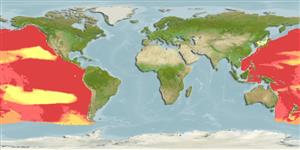
Pacific Ocean: Japan to Bering Sea, and south to Peru. Reported from the Philippines (Ref. 6956) and Taiwan (Ref. 5193). Highly migratory species.
Length at first maturity / Taille / Poids / Âge
Maturité: Lm 36.0, range 30 - 42 cm
Max length : 61.0 cm TL mâle / non sexé; (Ref. 2850); poids max. publié: 2.7 kg (Ref. 56527); âge max. reporté: 9 années (Ref. 56527)
Description synthétique
Clés d'identification | Morphologie | Morphométrie
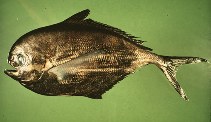
Épines dorsales (Total) : 0; Rayons mous dorsaux (Total) : 33 - 36; Épines anales: 0; Rayons mous anaux: 27 - 30. Dorsal and anal fins in adults with scales, without basal sheath of scales, and not fully depressible Interorbital space in adults strongly convex, the profile notably arched. Scales on caudal peduncle forming a graded size series with those on the bases of the midcaudal peduncle rays.
Body shape (shape guide): short and / or deep; Cross section: compressed.
Oceanic species which occurs near the surface (Ref. 2850). Feeds on crustaceans (amphipods and euphausiids), small fishes and squid (Ref. 4563). Rarely caught inshore (Ref. 2850). Good food fish (Ref. 6885).
Eschmeyer, W.N., E.S. Herald and H. Hammann, 1983. A field guide to Pacific coast fishes of North America. Boston (MA, USA): Houghton Mifflin Company. xii+336 p. (Ref. 2850)
Statut dans la liste rouge de l'IUCN (Ref. 130435: Version 2025-1)
Menace pour l'homme
Harmless
Utilisations par l'homme
Pêcheries: commercial; pêche sportive: oui
Outils
Articles particuliers
Télécharger en XML
Sources Internet
Estimates based on models
Preferred temperature (Réf.
123201): 3.2 - 13, mean 9.4 °C (based on 240 cells).
Phylogenetic diversity index (Réf.
82804): PD
50 = 0.5039 [Uniqueness, from 0.5 = low to 2.0 = high].
Bayesian length-weight: a=0.01738 (0.00907 - 0.03328), b=2.95 (2.77 - 3.13), in cm total length, based on LWR estimates for this species & (Sub)family-body (Ref.
93245).
Niveau trophique (Réf.
69278): 4.4 ±0.3 se; based on diet studies.
Generation time: 5.9 ( na - na) years. Estimated as median ln(3)/K based on 2
growth studies.
Résilience (Réf.
120179): Milieu, temps minimum de doublement de population : 1,4 à 4,4 années (tm=4).
Fishing Vulnerability (Ref.
59153): Moderate to high vulnerability (49 of 100).
🛈
Nutrients (Ref.
124155): Calcium = 21.1 [6.7, 81.1] mg/100g; Iron = 0.541 [0.212, 1.849] mg/100g; Protein = 20.2 [18.3, 21.9] %; Omega3 = 0.366 [0.209, 0.633] g/100g; Selenium = 31.9 [15.8, 62.6] μg/100g; VitaminA = 14.3 [3.9, 53.5] μg/100g; Zinc = 0.387 [0.210, 0.862] mg/100g (wet weight); based on
nutrient studies.