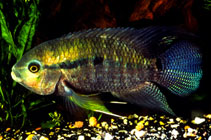
>
Cichliformes (Cichlids, convict blennies) >
Cichlidae (Cichlids) > Cichlasomatinae
Etymology: Cichlasoma: Greek, kichle = wrasse + Greek, soma = body (Ref. 45335).
More on author: Linnaeus.
Issue
Redescribed by Kullander (1983: 65), with bibliography, diagnosis, description, distribution and illustrations.
Environnement : milieu / zone climatique / profondeur / gamme de distribution
Écologie
; eau douce benthopélagique; pH range: 6.5 - 7.0; dH range: 3 - 10. Tropical; 16°C - 24°C (Ref. 13371); 12°N - 1°N
South America: Orinoco River basin, in the Caroni in River Venezuela; Guianas, from the Essequibo River to the Sinnamary River; Amazon River basin, in the upper Branco River basin.
Taille / Poids / Âge
Maturité: Lm ? range ? - ? cm
Max length : 12.3 cm SL mâle / non sexé; (Ref. 36377); 30.0 cm TL (female); common length : 12.0 cm TL mâle / non sexé; (Ref. 12193)
Occurs in canals and swamps (Ref. 7020). Tolerates low oxygen. Feeds on crustaceans and insects (Ref. 7020). Males are bigger than females which become mature at 7 to 9 cm (20-25 g). Spawning occurs at the start of the rainy season. About 700 eggs are spawned on open substrate and are cared for by the parents. Max length 35 cm TL (Ref. 35237).
Cycle de vie et comportement reproducteur
Maturité | Reproduction | Frai | Œufs | Fécondité | Larves
Kullander, S.O. and H. Nijssen, 1989. The cichlids of Surinam: Teleostei, Labroidei. E.J. Brill, Leiden, The Netherlands. 256 p. (Ref. 26372)
Statut dans la liste rouge de l'IUCN (Ref. 130435: Version 2025-2)
Menace pour l'homme
Harmless
Utilisations par l'homme
Pêcheries: sans intérêt; pêche sportive: oui; Aquarium: Commercial
Outils
Articles particuliers
Télécharger en XML
Sources Internet
Estimations basées sur des modèles
Indice de diversité phylogénétique (Réf.
82804): PD
50 = 0.5001 [Uniqueness, from 0.5 = low to 2.0 = high].
Bayesian length-weight: a=0.02291 (0.01064 - 0.04934), b=3.07 (2.89 - 3.25), in cm total length, based on LWR estimates for this (Sub)family-body shape (Ref.
93245).
Niveau trophique (Réf.
69278): 3.6 ±0.53 se; based on food items.
Résilience (Réf.
120179): Faible, temps minimum de doublement de population : 4,5 à 14 années (tmax=20).
Vulnérabilité de la pêche (Ref.
59153): Low vulnerability (20 of 100).
🛈