This website uses cookies to enhance your browsing experience and ensure the functionality of our site. For more detailed information about the types of cookies we use and how we protect your privacy, please visit our Privacy Information page.
×
Cookie Settings
This website uses different types of cookies to enhance your experience. Please select your preferences below:
> Ovalentaria/misc (Various families in series Ovalentaria) > Opistognathidae (Jawfishes)
Etymology: Opistognathus:Greek, opisthe = behind + Greek, gnathos = jaw (Ref. 45335); to the very elongate upper jaw of the type species of the genus, Opistognathus nigromarginatus (Ref. 128653). More on authors: Jordan & Thompson.
Environnement : milieu / zone climatique / profondeur / gamme de distribution Écologie
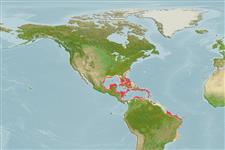
marin récifal; non migrateur (Ref. 52884); profondeur 3 - 40 m (Ref. 9710), usually 3 - 40 m (Ref. 27115). Tropical; 22°C - 28°C (Ref. 27115); 32°N - 23°S, 100°W - 29°W
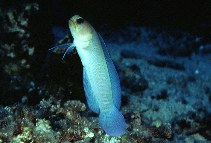
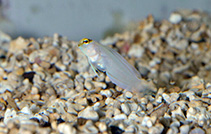
Épines dorsales (Total) : 11; Rayons mous dorsaux (Total) : 15 - 16; Épines anales: 3; Rayons mous anaux: 14 - 15. Body light bluish gray with numerous pale blue dots; head, nape and anterior part of dorsal fin yellow; a pair of black spots often present on chin (Ref. 13442). Body shape (shape guide): elongated.
Inhabit burrows made of crushed coral or sand. Hovers vertically, above or near its hole. The male courts the female by swimming in an arched position with his fins spread towards her (Ref. 9710). Male broods the eggs orally (Ref. 5521). Monogamous and always in home-ranging pairs, that is they do not defend an exclusive territory (Ref. 52884). Has been reared in captivity (Ref. 35427).
Cycle de vie et comportement reproducteur Maturité | Reproduction | Frai | Œufs | Fécondité | Larves
Mouthbrooders. Eggs which are clumped together in a sticky ball get incubated inside the male's mouth (Ref. 5521). Monogamous mating is observed irrespective of resource abundance (Ref. 52884).
Dynamique des populations Paramètres de croissance Âges / tailles maximales Longueur-poids rel. Rel. longueur-longueur. Fréquences de longueurs Conversion de masse Recrutement Abondance
Cycle de vie Reproduction Maturité Maturité/épines rel. Fécondité Frai Agrégats de frai Œufs Développement de l'œuf Larves Dynamique des populations larvaires
Physiologie Composition corporelle Nutriments Consommation d'oxygène Type de natation Vitesse de nage Pigments visuels Son de poisson Maladies et parasites Toxicité (CL50)
Température préférée (Réf. 123201): 24.7 - 28, mean 27 °C (based on 402 cells).
Indice de diversité phylogénétique (Réf. 82804): PD50 = 0.5000 [Uniqueness, from 0.5 = low to 2.0 = high].
Bayesian length-weight: a=0.00389 (0.00180 - 0.00842), b=3.12 (2.94 - 3.30), in cm total length, based on all LWR estimates for this body shape (Ref. 93245).
Niveau trophique (Réf. 69278): 3.0 ±0.1 se; based on diet studies.
Vulnérabilité de la pêche (Ref. 59153): Low vulnerability (10 of 100). 🛈