


Ajouter votre observation dans Fish Watcher
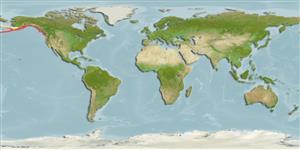
| Native range | All suitable habitat | Point map | Year 2050 |
|
| This map was computer-generated and has not yet been reviewed. |
| Sebastes proriger AquaMaps Data sources: GBIF OBIS |
Envoyez vos Photos et vidéos
Images | Images Google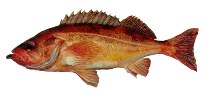 Sebastes proriger
Photo de Archipelago Marine Research Ltd.
Images | Images Google
Photo de Archipelago Marine Research Ltd.
Classification / Noms Noms communs | Synonymes | Catalog of Fishes(Genre, Espèce) | ITIS | CoL | WoRMS | Cloffa
> Perciformes/Scorpaenoidei (Scorpionfishes) > Sebastidae (Rockfishes, rockcods and thornyheads) > Sebastinae
Etymology: Sebastes: Greek, sebastes = august, venerable (Ref. 45335); proriger: From the Latin prora and gero, meaning 'bow' and 'to bear' (Ref. 27436).
More on authors: Jordan & Gilbert.
Etymology: Sebastes: Greek, sebastes = august, venerable (Ref. 45335); proriger: From the Latin prora and gero, meaning 'bow' and 'to bear' (Ref. 27436).
More on authors: Jordan & Gilbert.
Environnement : milieu / zone climatique / profondeur / gamme de distribution Écologie
marin bathydémersal; profondeur 12 - 425 m (Ref. 6793), usually 183 - 274 m (Ref. 27437). Deep-water; 66°N - 32°N, 177°E - 116°W
Distribution Territoires | Zones FAO | Écosystèmes | Occurrences | Carte par point | Introductions | Faunafri
North Pacific: Pribilof Canyon in the Bering Sea and Amchitka Island in the Aleutian chain to San Diego, California, USA.
Taille / Poids / Âge
Maturité: Lm ? range ? - ? cm
Max length : 61.0 cm TL mâle / non sexé; (Ref. 27437); âge max. reporté: 55 années (Ref. 39247)
Max length : 61.0 cm TL mâle / non sexé; (Ref. 27437); âge max. reporté: 55 années (Ref. 39247)
Description synthétique Clés d'identification | Morphologie | Morphométrie
Épines dorsales (Total) : 13; Rayons mous dorsaux (Total) : 13 - 15; Épines anales: 3; Rayons mous anaux: 6 - 7. Head spines weak - nasal, preocular, postocular, tympanic and parietal spines present, supraocular, coronal and nuchal spines absent (Ref. 27437). Notch on dorsal fin shallow; 2nd anal fin spine is of the same length or shorter than the 3rd (Ref. 27437). Caudal fin moderately indented (Ref. 6885). Light red and mottled with olive on back, lower sides flushed with yellow; light red stripe along lateral line; lips blackened; fins red with some light green or yellow (Ref. 27437).
Body shape (shape guide): fusiform / normal.
Body shape (shape guide): fusiform / normal.
Occur in areas where rocky reefs and steep silt-covered cliff faces meet gently sloping sand or mud bottoms (Ref. 27436). Found hovering just off the bottom or resting on a rocky perch (Ref. 27436). Viviparous (Ref. 34817). Sold as fresh or frozen fillets, together with other rockfish species (Ref. 27436). Not popular as a game fish (Ref. 27436).
Cycle de vie et comportement reproducteur Maturité | Reproduction | Frai | Œufs | Fécondité | Larves
Référence principale
Téléchargez vos références | Références | Coordinateur | Collaborateurs
Eschmeyer, W.N., E.S. Herald and H. Hammann, 1983. A field guide to Pacific coast fishes of North America. Boston (MA, USA): Houghton Mifflin Company. xii+336 p. (Ref. 2850)
CITES
Not Evaluated
Menace pour l'homme
Harmless
Utilisations par l'homme
Pêcheries: commercial; pêche sportive: oui
FAO - Publication: search | FishSource |
Plus d'informations
Écologie trophique
Aliments (proies)
Composition du régime alimentaire
Consommation alimentaire
Rations alimentaires
Prédateurs
Aliments (proies)
Composition du régime alimentaire
Consommation alimentaire
Rations alimentaires
Prédateurs
Dynamique des populations
Paramètres de croissance
Âges / tailles maximales
Longueur-poids rel.
Rel. longueur-longueur.
Fréquences de longueurs
Conversion de masse
Recrutement
Abondance
Paramètres de croissance
Âges / tailles maximales
Longueur-poids rel.
Rel. longueur-longueur.
Fréquences de longueurs
Conversion de masse
Recrutement
Abondance
Anatomie
Surface branchiale
Cerveau
Otolithe
Surface branchiale
Cerveau
Otolithe
Physiologie
Composition corporelle
Nutriments
Consommation d'oxygène
Type de natation
Vitesse de nage
Pigments visuels
Son de poisson
Maladies et parasites
Toxicité (CL50)
Composition corporelle
Nutriments
Consommation d'oxygène
Type de natation
Vitesse de nage
Pigments visuels
Son de poisson
Maladies et parasites
Toxicité (CL50)
Génétique
génôme
Génétique
Hétérozygotie
Héritabilité
Diversité génétique
génôme
Génétique
Hétérozygotie
Héritabilité
Diversité génétique
Liées à l'homme
Systèmes d'aquaculture
Profils d'aquaculture
Souches
Cas de ciguatera
Timbres, pièces de monnaie, divers
Systèmes d'aquaculture
Profils d'aquaculture
Souches
Cas de ciguatera
Timbres, pièces de monnaie, divers
Outils
E-book | Guide de terrain | Générateur de fréquences de longueur | Outil de dynamique de population | Carte par point |
Capture-MSY |
Articles particuliers
Télécharger en XML
Sources Internet
AFORO (otoliths) | Aquatic Commons | BHL | Cloffa | Websites from users | FishWatcher | CISTI | Catalog of Fishes: Genre, Espèce | DiscoverLife | ECOTOX | FAO - Publication: search | Faunafri | Fishipedia | Fishtrace | GloBI | Google Books | Google Scholar | Google | IGFA World Record | OceanAdapt | OneZoom | Open Tree of Life | Otolith Atlas of Taiwan Fishes | PubMed | Reef Life Survey | Identification RFE | Socotra Atlas | TreeBase | Arbre de Vie | Wikipedia: aller à, chercher | World Records Freshwater Fishing | Zoological Record
Estimations basées sur des modèles
Température préférée (Réf. 123201): 3.7 - 6.6, mean 5.4 °C (based on 51 cells).
Indice de diversité phylogénétique (Réf. 82804): PD50 = 0.5000 [Uniqueness, from 0.5 = low to 2.0 = high].
Bayesian length-weight: a=0.01000 (0.00490 - 0.02040), b=3.09 (2.92 - 3.26), in cm total length, based on LWR estimates for this Genus-body shape (Ref. 93245).
Niveau trophique (Réf. 69278): 3.8 ±0.5 se; based on size and trophs of closest relatives
Generation time: 7.4 ( na - na) years. Estimated as median ln(3)/K based on 2 growth studies.
Résilience (Réf. 120179): Faible, temps minimum de doublement de population : 4,5 à 14 années (K=0.15-0.18; tmax=55).