Issue
Date and spelling Smith-Vaniz, pers. comm.
Environment: milieu / climate zone / rango de profundidad / distribution range
Ecología
marino asociado a arrecife; rango de profundidad 0 - 150 m (Ref. 9710), usually 2 - 10 m (Ref. 40849). Subtropical; 44°N - 41°S, 180°W - 180°E
Western Atlantic: Massachusetts, USA and northern Gulf of Mexico to Rio de Janeiro, Brazil (Ref. 57756). Eastern Atlantic: off Genoa, Italy in the Mediterranean (Ref. 4233) and from Côte d'Ivoire to Angola (Ref. 7097). Throughout the Indo-Pacific (Ref. 37816), but rare or absent in the Persian Gulf (Ref. 3287). Eastern Pacific: mouth of Gulf of California to Ecuador; including the Galapagos Islands (Ref. 9283).
Length at first maturity / Tamaño / Peso / Age
Madurez: Lm 64.6 range ? - ? cm
Max length : 180 cm TL macho / no sexado; (Ref. 26340); common length : 90.0 cm TL macho / no sexado; (Ref. 5217); peso máximo publicado: 17.05 g (Ref. 40637); edad máxima reportada: 6 años (Ref. 96992)
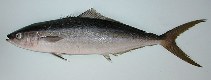
Espinas dorsales (total) : 7; Radios blandos dorsales (total) : 25 - 30; Espinas anales: 2; Radios blandos anales: 18 - 22; Vértebra: 24. This species is distinguished by the following characters: the upper jaw ending distinctly before eye (and to below anterior margin of eye in young); dorsal fin with a detached terminal 2-rayed finlet; anal fin with a slightly detached spine from the rest of fin and covered by skin in fish of larger sizes, then followed by a second spine continuous with the 18-22 soft rays, including a detached 2-rayed finlet. Colour dark olive-blue or green dorsally and on side, white ventrally with 2 narrow light blue or bluish white stripes along sides and a broader olive or yellowish stripe between them; fins olive or yellowish (Ref. 9894,90102).
Body shape (shape guide): fusiform / normal; Cross section: compressed.
Adults are found in oceanic and coastal waters, generally near the surface over reefs or sometimes far from the coast often around floating logs or other debris (Ref. 9283, 11230, 48635, 90102). May form large schools (Ref. 9283, 48635). They feed on invertebrates, mainly on larger crustaceans of the zooplankton, and small fishes (Ref. 9283, 26145). Eggs are pelagic (Ref. 4233). Good food fish (Ref. 9626) and a valued game fish (Ref. 26938); marketed fresh and salted or dried (Ref. 9283); also frozen and used for sashimi (Ref. 9987).
Smith-Vaniz, W.F., 1986. Carangidae. p. 638-661. In M.M. Smith and P.C. Heemstra (eds.) Smiths' sea fishes. Springer-Verlag, Berlin. (Ref. 3197)
IUCN Red List Status (Ref. 130435: Version 2025-1)
Threat to humans
Reports of ciguatera poisoning (Ref. 30911)
Human uses
Pesquerías: muy comercial; pesca deportiva: si
Herramientas
Special reports
Download XML
Fuentes de Internet
Estimates based on models
Preferred temperature (Referencia
123201): 22.8 - 28.8, mean 27.5 °C (based on 5152 cells).
Phylogenetic diversity index (Referencia
82804): PD
50 = 1.0000 [Uniqueness, from 0.5 = low to 2.0 = high].
Bayesian length-weight: a=0.01023 (0.00598 - 0.01751), b=2.85 (2.70 - 3.00), in cm total length, based on LWR estimates for this species & (Sub)family-body (Ref.
93245).
Nivel trófico (Referencia
69278): 4.3 ±0.0 se; based on diet studies.
Resiliencia (Referencia
120179): Medio, población duplicada en un tiempo mínimo de 1.4-4.4 años (tmax=6; K=0.6 is doubtful).
Prior r = 0.58, 95% CL = 0.39 - 0.88, Based on 2 data-limited stock assessments.
Fishing Vulnerability (Ref.
59153): Moderate to high vulnerability (51 of 100).
🛈
Climate Vulnerability (Ref.
125649): High to very high vulnerability (74 of 100).
🛈
Nutrients (Ref.
124155): Calcium = 16.7 [7.8, 29.9] mg/100g; Iron = 0.662 [0.361, 1.202] mg/100g; Protein = 20.8 [19.7, 21.8] %; Omega3 = 0.214 [0.129, 0.359] g/100g; Selenium = 26.7 [13.8, 50.7] μg/100g; VitaminA = 26 [9, 73] μg/100g; Zinc = 0.384 [0.262, 0.578] mg/100g (wet weight);