Пластиножаберные (акулы и скаты) (sharks and rays) >
Rajiformes (Skates and rays) >
Rajidae (Skates)
Etymology: Raja: Latin, raja, -ae = a sting ray (Raja sp.) (Ref. 45335).
Eponymy: Colonel George Montagu (1751–1815) was a soldier and natural history writer. [...] (Ref. 128868), visit book page.
More on author: Fowler.
Environment: milieu / climate zone / пределы глубины / distribution range
экология
морской демерсальный; пределы глубины 8 - 530 m (Ref. 88171). Temperate; 61°N - 16°N, 18°W - 25°E
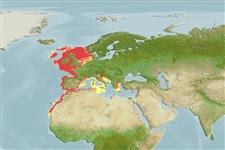
Eastern Atlantic: Shetlands, southern North Sea and the western Baltic to Mauritania, including the western part of the Mediterranean (to Tunisia and western Greece).
Length at first maturity / Size / Вес / Возраст
половая зрелость: Lm 61.0 range ? - ? cm
Max length : 102 cm TL самец/пол неопределен; (Ref. 6014); common length : 50.0 cm TL самец/пол неопределен; (Ref. 3261); наибольший возраст (опубликованны данные): 18 годы (Ref. 88187)
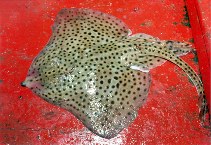
колючие лучи спинного плавника (общее число) : 0; колючие лучи анального плавника: 0. Sub-rhomboid in shape with a short rostrum and rounded wing-tips. Upper surface almost smooth in young, but prickly in large specimens, except for bare centers of pectoral fins and hind part of disc, underside nearly smooth; orbital thorns separate, a regular row of 20-50 usually persistent thorns from nape to first dorsal fin; with 1-2 thorns between dorsal fins; 2 equal-sized dorsal fins at end of tail. Brownish dorsally with numerous small dark spots which do not reach the margin of the disc, frequently with a concentration of dark spots forming a ring around a pale centre on hind part of each pectoral fin, underside white (Ref. 3167).
Body shape (shape guide): other; Cross section: flattened.
Found mainly along the continental shelf (Ref. 3167). Depth range from 8-283 m in the northeast Atlantic (Ref. 82399), in the southern part of its range it occurs down to 530 m (Ref. 78469, 89037), but most common between 20-120 m (Ref. 88187). Prefers habitats with sand or mud bottoms (Ref. 78469). Juveniles usually found in shallow sandy inshore areas, adults utilize more offshore sand or sand-gravel habitats (Ref. 82399, 89038). Species buries itself to avoid predation and ambush potential prey. Feeds mainly on crustaceans (Ref. 3167) with prey size increasing as it grows (Ref. 88171), also preys on benthic worms, cephalopods and small fishes (Ref. 41849, 58137). Most individuals attain a length of 40-60 cm (Ref. 3261). Oviparous. Young may tend to follow large objects, such as their mother (Ref. 205). Detects weak electric fields generated by other organisms and generate its own weak electric fields (Ref. 10311).
Oviparous. Distinct pairing with embrace. Paired eggs are laid during summer (Ref. 3167). Eggs are oblong capsules with stiff pointed horns at the corners deposited in sandy or muddy flats (Ref. 205). Egg capsules are 5.3-7.8 cm long and 3.0-5.0 cm wide (Ref. 41250). Fully formed pups hatch after about 5-6 months and are about 11-12 cm in length (Ref. 78469, 88187).
McEachran, J.D. and K.A. Dunn, 1998. Phylogenetic analysis of skates, a morphologically conservative clade of elasmobranchs (Chondrichthyes: Rajidae). Copeia 1998(2):271-290. (Ref. 27314)
Статус Красного Списка МСОП (Ref. 130435: Version 2025-1)
Угроза для людей
Harmless
Использование человеком
рыболовство: не имеет хозяйственного значения
дополнительная информация
инструменты
Специальные отчеты
Скачать в формате XML
ресурсы в Интернет
Estimates based on models
Preferred temperature (ссылка
123201): 7 - 16, mean 9.9 °C (based on 418 cells).
Phylogenetic diversity index (ссылка
82804): PD
50 = 0.5000 [Uniqueness, from 0.5 = low to 2.0 = high].
Bayesian length-weight: a=0.00240 (0.00193 - 0.00299), b=3.25 (3.21 - 3.29), in cm total length, based on LWR estimates for this species (Ref.
93245).
Trophic level (ссылка
69278): 3.9 ±0.2 se; based on diet studies.
устойчивость к внешним воздействиям (ссылка
120179): низкий, минимальное время удвоения популяции 4.5-14 лет (K=0.18-0.21; tm=8; tmax=14; Fec=24).
Prior r = 0.40, 95% CL = 0.27 - 0.61, Based on 1 full stock assessment.
Fishing Vulnerability (Ref.
59153): High vulnerability (58 of 100).
🛈
Climate Vulnerability (Ref.
125649): High to very high vulnerability (67 of 100).
🛈
Nutrients (Ref.
124155): Calcium = 5.91 [0.83, 102.85] mg/100g; Iron = 0.244 [0.023, 2.859] mg/100g; Protein = 16.8 [14.0, 19.1] %; Omega3 = 1 [0, 2] g/100g; Selenium = 14.6 [3.0, 72.2] μg/100g; VitaminA = 6.24 [0.46, 70.18] μg/100g; Zinc = 0.34 [0.02, 3.74] mg/100g (wet weight);