>
Eupercaria/misc (Various families in series Eupercaria) >
Sciaenidae (Drums or croakers)
Etymology: Pseudotolithus: Greek, pseudes = false + greek, otos = ear + Greek, lithos = stone (Ref. 45335).
More on author: Bleeker.
Environment: milieu / climate zone / profondeur / distribution range
Écologie
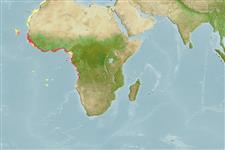
marin démersal; profondeur 0 - 150 m (Ref. 2683), usually ? - 60 m (Ref. 3593). Tropical; 35°N - 17°S, 25°W - 14°E
Eastern Atlantic: Mauritania (Ref. 5377) to Angola, becoming scarce north of Cape Verde. Often confused with Pseudotolithus senegalensis.
Length at first maturity / Taille / Poids / Âge
Maturité: Lm 48.3 range ? - ? cm
Max length : 140 cm TL mâle / non sexé; (Ref. 40637); common length : 50.0 cm SL mâle / non sexé; (Ref. 4780); poids max. publié: 15.0 kg (Ref. 40637)
Description synthétique
Clés d'identification | Morphologie | Morphométrie
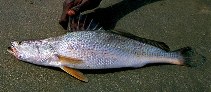
Épines dorsales (Total) : 10; Rayons mous dorsaux (Total) : 28 - 32. Diagnosis: dorsal fin with 9 spines in the 1st part and 1 spine and 28-32 in the second; second anal spine about half the length of the 1st anal fin soft ray; pectoral fins short, about 19-21% SL; gill rakers short, about as long as gill filament at angle between lower and upper part of gill arch; maxilla extending beyond posterior eye border, eyes small, 7.2-8.4 times in HL, but this character is difficult to use for identification because of allometry (Ref. 81656).
Body shape (shape guide): fusiform / normal.
Inhabits coastal waters from shoreline to about 150 m depth, over mud and sandy mud bottoms. Most abundant in waters less than 60 m at temperatures above 18°C. Juveniles and sub-adults enter estuaries and rivers. Feeds mainly on small fishes and crustaceans. Peak spawning season from late spring to early autumn in tropical West Africa (Ref. 4780).
Life cycle and mating behavior
Maturité | Reproduction | Frai | Œufs | Fécondité | Larves
Chao, L.N. and E. Trewavas, 1990. Sciaenidae. p. 813-826. In J.C. Quero, J.C. Hureau, C. Karrer, A. Post and L. Saldanha (eds.) Check-list of the fishes the eastern tropical Atlantic (CLOFETA). JNICT, Lisbon; SEI, Paris; and UNESCO, Paris. Vol. 2. (Ref. 3593)
Statut dans la liste rouge de l'IUCN (Ref. 130435: Version 2025-1)
Menace pour l'homme
Harmless
Utilisations par l'homme
Pêcheries: commercial
Outils
Articles particuliers
Télécharger en XML
Sources Internet
Estimates based on models
Preferred temperature (Réf.
123201): 19.2 - 27.9, mean 25.7 °C (based on 104 cells).
Phylogenetic diversity index (Réf.
82804): PD
50 = 0.5156 [Uniqueness, from 0.5 = low to 2.0 = high].
Bayesian length-weight: a=0.00661 (0.00358 - 0.01221), b=3.06 (2.91 - 3.21), in cm total length, based on LWR estimates for this species & (Sub)family-body (Ref.
93245).
Niveau trophique (Réf.
69278): 3.7 ±0.5 se; based on diet studies.
Résilience (Réf.
120179): Milieu, temps minimum de doublement de population : 1,4 à 4,4 années (K=0.22-0.29; tmax=7).
Fishing Vulnerability (Ref.
59153): Moderate to high vulnerability (49 of 100).
🛈
Nutrients (Ref.
124155): Calcium = 62.8 [36.3, 118.9] mg/100g; Iron = 0.842 [0.417, 1.457] mg/100g; Protein = 19.1 [17.9, 20.3] %; Omega3 = 0.198 [0.109, 0.333] g/100g; Selenium = 88.4 [48.5, 173.3] μg/100g; VitaminA = 10.3 [3.8, 29.3] μg/100g; Zinc = 0.763 [0.547, 1.103] mg/100g (wet weight);