


Masukkan pemerhatian anda di Fish Watcher
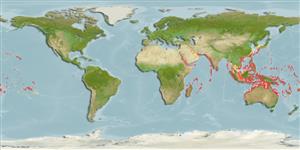
| Native range | All suitable habitat | Point map | Year 2050 |
|
| This map was computer-generated and has not yet been reviewed. |
| Siganus argenteus AquaMaps Data sources: GBIF OBIS |
muatnaik fotos/gambar dan video
Gambar | video | imej Google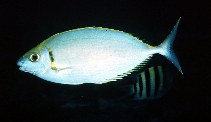 Siganus argenteus
foto/gambar oleh Randall, J.E.
Gambar | video | imej Google
foto/gambar oleh Randall, J.E.
klasifikasi / Nama Nama-nama umum | Sinonim (persamaan) | Catalog of Fishes(Marga, Jenis) | ITIS | CoL | WoRMS | Cloffa
> Acanthuriformes (Surgeonfishes) > Siganidae (Rabbitfishes)
Etymology: Siganus: Latin, siganus = a fish, rabbit fish; by the similarity of the nose (Ref. 45335).
More on authors: Quoy & Gaimard.
Etymology: Siganus: Latin, siganus = a fish, rabbit fish; by the similarity of the nose (Ref. 45335).
More on authors: Quoy & Gaimard.
Lingkungan: lingkungan / zona iklim / kisaran kedalaman / jangkauan distribusi Ekologi
laut berasosiasi dengan karang; kisaran kedalaman 0 - 40 m (Ref. 9813), usually 1 - 30 m (Ref. 27115). Tropical; 25°C - 29°C (Ref. 27115); 30°N - 30°S, 32°E - 128°W
Penyebaran Wilayah | Daerah-daerah FAO | Ekosistem | Kemunculan | peta titik | Introduksi | Faunafri
Indo-Pacific: Red Sea and East Africa to Pitcairn. Often the only siganid present on remote islands like Pitcairn, Rapa and Line.
Panjang pada saat jatuh tempo pertama / Ukuran / Berat / umur
Kematangan: Lm ?, range 20 - ? cm
Max length : 40.0 cm TL jantan/; (Ref. 9813); common length : 25.0 cm TL jantan/; (Ref. 9813)
Max length : 40.0 cm TL jantan/; (Ref. 9813); common length : 25.0 cm TL jantan/; (Ref. 9813)
deskripsi pendek Kunci identifiaksi (pengenalan) | Morfologi | Morfometrik
Duri punggung (Keseluruhan (total)) : 13; duri punggung lunak (Keseluruhan (total)) : 10; Duri dubur: 7; Sirip dubur lunak: 9; vertebrata, bertulang belakang: 13. This species is distinguished by the following characters: juveniles and adults with body oval and compressed, slender, fusiform, greatest body depth 2.4-3 in SL; anterior nostril with a long flap reaching to or past posterior nostril; last dorsal-fin spine very short, 2.6-3.5 times in longest dorsal-fin spine; last anal-fin spine shortest, 2.1-3.1 times in longest (second or third) anal-fin spine; caudal fin deeply forked. Colour of body blue or greyish above, silvery below; variations in markings (spots, curved lines); head and trunk usually covered with small yellow spots, bars, and commas, much larger than interspaces and quarter to 1/2 size of pupil; spots usually joining to form horizontal wavy lines, particularly on lower sides; yellow pectoral-fin axil, usually yellow stripes along base of dorsal fin and a dark brown bar immediately posterior to the upper opercular margin; colours fade rapidly at death so that head and trunk may be solid brown (Ref. 9813, 90102).
Body shape (shape guide): fusiform / normal; Cross section: compressed.
Body shape (shape guide): fusiform / normal; Cross section: compressed.
Inhabits coastal and inner reef slopes and lagoons. Usually occurs in large schools that swim fast and well above the substrate, occasionally all diving down to the bottom to feed (Ref. 48637). Juveniles and adults occur in small schools (2-100) around coral reefs, typically in surge zone at reef edge. Juveniles live near the surface in dense aggregations up to several km offshore, migrating to reef flats just prior to metamorphosis. Feeds on algae (Ref. 30573). Juveniles and adults not frequently found in markets; but prejuveniles form a brief but important fishery when migrating on to the reef flat, e.g. combined catch (with Siganus spinus of 16 tonnes in one season in Guam. Prejuveniles eaten fresh, pickled in brine or made into fish paste (Ref. 9813). Consumed as food although it is known to be occasionally poisonous (Ref. 4537). Used in Chinese medicine (Ref. 12166).
Siklus hidup dan perilaku kawin Kematangan | Reproduksi, perkembang biakan | Pemijahan | telur-telur | Fekunditas | Larva
Spawn in group (Ref. 240).
rujukan utama
Unggah referensi Anda | Acuan | Koordinator : Woodland, David J. | mitra
Woodland, D.J., 1990. Revision of the fish family Siganidae with descriptions of two new species and comments on distribution and biology. Indo-Pac. Fish. (19):136 p. (Ref. 1419)
Status IUCN Red List (Ref. 130435: Version 2025-2 (Global))
kurang bimbang (LC) ; Date assessed: 10 March 2015
CITES
Not Evaluated
ancaman kepada manusia
Venomous (Ref. 4537)
penggunaan manusia
Perikanan: komersial; Akuarium: Komersial
FAO - Publication: search | FishSource | Laut di Sekitar Kita
informasi lanjut
Dinamika populasi
Parameter pertumbuhan
Maks. usia / ukuran
Panjang-berat rel.
Panjang-panjang rel.
ukuran frekuensi
Konversi massa
pemulihan
Kelimpahan
Parameter pertumbuhan
Maks. usia / ukuran
Panjang-berat rel.
Panjang-panjang rel.
ukuran frekuensi
Konversi massa
pemulihan
Kelimpahan
Siklus hidup
Reproduksi, perkembang biakan
Kematangan
Kedewasaan / insang rel.
Fekunditas
Pemijahan
Agregasi pemijahan
telur-telur
pekembangan telor
Larva
Dinamika larva
Reproduksi, perkembang biakan
Kematangan
Kedewasaan / insang rel.
Fekunditas
Pemijahan
Agregasi pemijahan
telur-telur
pekembangan telor
Larva
Dinamika larva
Fisiologi
Komposisi tubuh
Nutrisi
Konsumsi oksigen
Jenis renang
Kecepatan berenang
Pigmen visual
Suara ikan
Penyakit & Parasit
Toksisitas (LC50)
Komposisi tubuh
Nutrisi
Konsumsi oksigen
Jenis renang
Kecepatan berenang
Pigmen visual
Suara ikan
Penyakit & Parasit
Toksisitas (LC50)
Yang berhubungan dengan manusia
Sistem akuakultur
profil budidaya air
Strain
Kasus Ciguatera
Perangko, koin, dll.
Sistem akuakultur
profil budidaya air
Strain
Kasus Ciguatera
Perangko, koin, dll.
Alat, peralatan
Kuis organik | E-book | Penuntun lapangan | Kunci identifiaksi (pengenalan) | tanda freqkuenci panjang | peringkat sejarah hidup | peta titik |
Tangkap-MSY |
laporan khas
muat turun XML
Sumber internet
AFORO (otoliths) | Aquatic Commons | BHL | Cloffa | Websites from users | semak peneliti ikan | CISTI | Catalog of Fishes: Marga, Jenis | DiscoverLife | ECOTOX | FAO - Publication: search | Faunafri | Fishipedia | Fishtrace | GloBI | Google Books | Google Scholar | Google | IGFA World Record | Pangkalan data nasional | OneZoom | Open Tree of Life | Otolith Atlas of Taiwan Fishes | PubMed | Reef Life Survey | Socotra Atlas | TreeBase | Tree of Life | Wikipedia: pergi, Cari | World Records Freshwater Fishing | Catatan Zoologi
Estimasi berdasarkan model
Suhu yang disukai (Acuan 123201): 24.6 - 29, mean 27.8 °C (based on 1374 cells).
Indeks keanekaragaman filogenetik (Acuan 82804): PD50 = 0.5000 [Uniqueness, from 0.5 = low to 2.0 = high].
Bayesian length-weight: a=0.01349 (0.01090 - 0.01670), b=3.00 (2.95 - 3.05), in cm total length, based on LWR estimates for this species (Ref. 93245).
Tingkat Trofik (Acuan 69278): 2.0 ±0.0 se; based on diet studies.
Daya lenting (Acuan 120179): Tinggi, Waktu penggandaan populasi minimum kurang dari 15 bulan (K=0.75; tm=1).
Nutrisi (Ref. 124155): Calcium = 36.5 [18.7, 87.0] mg/100g; Iron = 0.714 [0.345, 1.487] mg/100g; Protein = 19 [18, 20] %; Omega3 = 0.132 [0.075, 0.234] g/100g; Selenium = 24.1 [10.7, 52.0] μg/100g; VitaminA = 37.9 [11.4, 131.2] μg/100g; Zinc = 1.51 [0.60, 2.86] mg/100g (wet weight); based on nutrient studies.