>
Blenniiformes (Blennies) >
Tripterygiidae (Triplefin blennies) > Tripterygiinae
Etymology: Ruanoho: A vernacular name in maori, New Zealand.
Environment: milieu / climate zone / ระดับความลึก / distribution range
นิเวศวิทยา
เกี่ยวกับทะเล,น้ำเค็ม สัตว์น้ำหน้าดิน; ระดับความลึก 0 - 6 m (Ref. 84086). Temperate
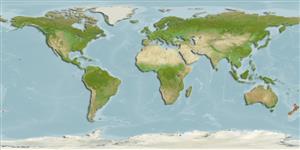
Southwest Pacific: around mainland New Zealand.
ขนาด / น้ำหนัก / Age
วัยเจริญพันธุ์: Lm ? range ? - ? cm
Max length : 12.0 cm TL เพศผู้/กระเทย; (Ref. 84086)
Short description
เครื่องมือที่ใช้ในการแยกชนิดสัตว์,สิ่งมีชีวิตออกจากกัน | สัณฐานวิทยา | ความยาวต่างๆ
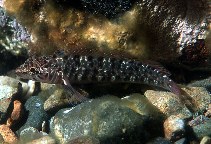
เงี่ยงครีบหลัง (รวม) : 20 - 23; ก้านครีบอ่อนที่หาง (รวม) : 14 - 16; เงี่ยงครีบก้น: 2; ก้านครีบอ่อนที่ก้น: 24 - 27. Males uniform grey to black with red fins and a bluish white margin to the anal fin during the breeding season. Females mottled greenish grey with an indistinct broken dark band along the base of the dorsal fins. Distinguished from other triplefins by the flattened pointed head and snout, the short, square caudal peduncle, and by having three spines in the first dorsal fin and 14-16 spines in the second.
Body shape (shape guide): elongated.
Adults are commonly found in sheltered areas shallower than 5 m. Typical in shallow habitats in coastal mainland areas and seldom on offshore islands. Mainly found under rocks. They feed on a range of benthic invertebrates including ophiuroids, archaeogastropods, trichoptera and errant polychaetes (Ref. 84084). Eggs are hemispherical and covered with numerous sticky threads that anchor them in the algae on the nesting sites (Ref. 240). Larvae are planktonic which occur primarily in shallow, nearshore waters (Ref. 94114). They are caught by slurp guns and handnets (Ref. 84086).
Fricke, R., 1994. Tripterygiid fishes of Australia, New Zealand and the southwest Pacific Ocean (Teleostei). Theses Zool. 24:1-585. (Ref. 13227)
IUCN Red List Status (Ref. 130435: Version 2025-1)
Threat to humans
Harmless
Human uses
การประมง: ไม่มีผลประโยชน์
เครื่องมือ
Special reports
Download XML
แหล่งที่มาจากอินเตอร์เน็ต
Estimates based on models
Preferred temperature (อ้างอิง
123201): 10.6 - 21.2, mean 15.9 °C (based on 162 cells).
Phylogenetic diversity index (อ้างอิง
82804): PD
50 = 0.7500 [Uniqueness, from 0.5 = low to 2.0 = high].
Bayesian length-weight: a=0.00708 (0.00399 - 0.01256), b=3.06 (2.90 - 3.22), in cm total length, based on LWR estimates for this species & (Sub)family-body (Ref.
93245).
ระดับชั้นอาหาร (อ้างอิง
69278): 3.3 ±0.4 se; based on size and trophs of closest relatives
ความสามารถในการกลับคืนสู่ปกติ (อ้างอิง
120179): ความสูง, เวลาต่ำสุดที่จะทำให้ประชากรเพิ่มขึ้นเป็น 2 เท่าใช้เวลาน้อยกว่า 15 เดือน (Preliminary K or Fecundity.).
Fishing Vulnerability (Ref.
59153): Low vulnerability (10 of 100).
🛈