Cobitis trichonica

You can sponsor this page

Cobitis trichonica Stephanidis, 1974

Upload your photos and videos
Google image
Image of Cobitis trichonica
No image available for this species;
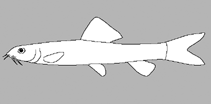
drawing shows typical species in Cobitidae.

Classification / Names Nombres comunes | Sinónimos | Catalog of Fishes(Género, Especie) | ITIS | CoL | WoRMS | Cloffa

> Cypriniformes (Carps) > Cobitidae (Spined loaches)
Etymology: Cobitis: Greek, kobitis, -idos = a kind of sardine; also related with the voice Greek, kobios, Latin gobius = gudgeon (Ref. 45335).

Environment: milieu / climate zone / rango de profundidad / distribution range Ecología

; agua dulce bentopelágico. Subtropical

Distribución Países | Áreas FAO | Ecosistemas | Ocurrencias, apariciones | Mapa de puntos | Introducciones | Faunafri

Europe: Endemic to Acheloos drainage in Greece.

Tamaño / Peso / Age

Madurez: Lm ?  range ? - ? cm
Max length : 10.2 cm TL macho / no sexado; (Ref. 125981)

Short description Claves de identificación | Morfología | Morfometría

Pigmentation (Gambetta's longitudinal zone of pigmentation): zone Z4 with 9-14 large blotches, those on caudal peduncle mostly vertically elongated, sometimes fused into a midlateral stripe in males; axial streak conspicuous along upper margin of blotches of zone Z4. Two laminae circularis.
Body shape (shape guide): elongated.

Biología     Glosario (por ej. epibenthic)

A short-lived species. Adults occur in lakes and lowland water courses with little current. Spawn from April to June (Ref. 13696). A multiple spawner (Ref. 59043). Oviparous, possibly with distinct pairing during breeding similar to congeners (Ref. 205). Is threatened due to water abstraction (Ref. 26100).

Life cycle and mating behavior Madurez | Reproducción | Puesta | Huevos | Fecundidad | Larva

During courtship, 'the male follows the female and, after both enter dense vegetation (e.g. filamentous algae), the male forms a complete ring around the female's body behind the dorsal as the female releases the eggs' (Ref. 59043).

Main reference Upload your references | Referencias | Coordinador | Colaboradores

Kottelat, M. and J. Freyhof, 2007. Handbook of European freshwater fishes. Publications Kottelat, Cornol and Freyhof, Berlin. 646 pp. (Ref. 59043)

IUCN Red List Status (Ref. 130435: Version 2025-1)

  Near Threatened (NT) (B1b(iii)); Date assessed: 10 September 2023

CITES

Not Evaluated

CMS (Ref. 116361)

Not Evaluated

Threat to humans

  Harmless


Human uses

Pesquerías: sin interés
FAO - Publication: search | FishSource |

Más información

Ecología Trófica
Food items (preys)
Composición de la dieta
consumo de alimento
Food rations
Despredadores
Ecología
Ecología
Home ranges
Population dynamics
Coeficiente del crecimiento para
Max. ages / sizes
Length-weight rel.
Length-length rel.
Length-frequencies
Mass conversion
Reclutamiento
Abundancia
Life cycle
Reproducción
Madurez
Maturity/Gills rel.
Fecundidad
Puesta
Spawning aggregations
Huevos
Egg development
Larva
Dinámica larvaria
Distribución
Países
Áreas FAO
Ecosistemas
Ocurrencias, apariciones
Introducciones
BRUVS - Videos
Anatomy
Superficie branquial
Brain
Otolith
Physiology
Body composition
Nutrients
Consumo del oxígeno
Tipo de natación
Velocidad de natación
Visual pigments
Fish sound
Diseases & Parasites
Toxicity (LC50s)
Genética
Genome
Genética
Heterozygosity
heritabilidad
Human related
Aquaculture systems
Perfiles de acuicultura
Razas
Ciguatera cases
Stamps, coins, misc.
Outreach
Colaboradores
Referencias
Referencias

Herramientas

Special reports

Download XML

Fuentes de Internet

AFORO (otoliths) | Aquatic Commons | BHL | Cloffa | Websites from users | Check FishWatcher | CISTI | Catalog of Fishes: Género, Especie | DiscoverLife | ECOTOX | FAO - Publication: search | Faunafri | Fishipedia | Fishtrace | GloBI | Google Books | Google Scholar | Google | IGFA World Record | OneZoom | Open Tree of Life | Otolith Atlas of Taiwan Fishes | PubMed | Reef Life Survey | Socotra Atlas | TreeBase | Árbol de la vida | Wikipedia: Go, búsqueda | World Records Freshwater Fishing | Zoobank | Expediente Zoológico

Estimates based on models

Phylogenetic diversity index (Referencia 82804):  PD50 = 0.5000   [Uniqueness, from 0.5 = low to 2.0 = high].
Bayesian length-weight: a=0.00490 (0.00282 - 0.00849), b=3.10 (2.96 - 3.24), in cm total length, based on LWR estimates for this species & Genus-body shape (Ref. 93245).
Nivel trófico (Referencia 69278):  3.2   ±0.4 se; based on size and trophs of closest relatives
Resiliencia (Referencia 120179):  Medio, población duplicada en un tiempo mínimo de 1.4-4.4 años (Assumed Fec < 10,000).
Fishing Vulnerability (Ref. 59153):  Low vulnerability (10 of 100). 🛈