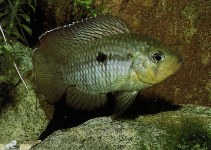
>
Cichliformes (Cichlids, convict blennies) >
Cichlidae (Cichlids) > Cichlinae
Eponymy: Marshall Cândido Mariano da Silva Rondon (1865–1958) was a Brazilian army officer (1881–1955) engineer and explorer, whose Rondon Commission was responsible for installing telegraph poles from Mato Grosso to Amazonas. [...] (Ref. 128868), visit book page.
Entorno: milieu / zona climática / rango de profundidad / gama de distribución
Ecología
; agua dulce bentopelágico; dH range: ? - 20. Tropical; 18°C - 30°C (Ref. 13614)
South America: Amazon River basin, in the Araguaia River drainage.
Tamaño / Peso / Edad
Madurez: Lm ? range ? - ? cm
Max length : 7.2 cm SL macho / no sexado; (Ref. 101427)
Descripción breve
Claves de identificación | Morfología | Morfometría
Espinas dorsales (total) : 13 - 14; Radios blandos dorsales (total) : 9 - 11; Espinas anales: 3; Radios blandos anales: 9 - 10. Rondonacara hoehnei is distinguished by having only four pores on the dentary (vs. five in other tribes of the Cichlidae, except Heroini) and three anal-fin spines (vs. more in Heroini). It differs from all members of Cichlasomatini by presence of transversal streaks originated at the insertion of spines and softs rays of dorsal fin in live specimens, preserved ones retains just the proximal portion of the transversal streaks (vs. absence). Furthermore, it can be diagnosed from species of Acaronia (Myers, 1940), Bujurquina, Krobia, Andinoacara and Tahuantinsuyoa by having the longitudinal stripe of the flank horizontally oriented, ending directed to caudal-fin base (vs. dorsally displaced, ending directed to the end of dorsal-fin base); from 'Aequidens' paloemeuensis Kullander & Nijssen, 1989, 'A'. potaroensis, Cichlasoma and Aequidens by having the caudal-fin base spot on the middle of the fin (vs. dorsally displaced with major part of spot occurring above lower lateral line); from species of Cichlasoma and Aequidens by presence of a conspicuous suborbital bar (vs. suborbital bar transformed into a spot located below orbits [cheek spot sensu Kullander (1983)], and caudal-fin base spot not ocellated (vs. ocellated); from species of Ivanacara Römer & Hahn 2007, Laetacara Kullander, 1986, Nannacara Regan, 1905 and Cleithracara Kullander & Nijssen 1989 by the lack of scales on preopercle (vs. with scales); from species of Cleithracara, Ivanacara, and Nannacara by having two supraneuralia (vs. 1), and from members of Laetacara by the possession of uniserial predorsal squamation (vs. triserial) (Ref. 101427).
Body shape (shape guide): fusiform / normal.
Inhabits rivers (Ref. 12965). Adults exhibit biparental care (Ref. 40602).
Ciclo vital y comportamiento de apareamiento
Madurez | Reproducción | Puesta | Huevos | Fecundidad | Larva
Both parents guard the eggs and young (Ref. 40602).
Ottoni, F.P. and J.L.O. Mattos, 2015. Phylogenetic position and re-description of the endangered cichlid Nannacara hoehnei, and description of a new genus from Brazilian Cerrado (Teleostei, Cichlidae, Cichlasomatini). Vert. Zool. 65(1):65-79. (Ref. 101427)
Situación en la Lista Roja de la UICN (Ref. 130435: Version 2025-2)
Amenaza para el ser humano
Harmless
Usos humanos
Herramientas
Informes especiales
Descargar XML
Fuentes de Internet
Estimaciones basadas en modelos
Índice de diversidad filogenética (Referencia
82804): PD
50 = 1.0000 [Uniqueness, from 0.5 = low to 2.0 = high].
Bayesian length-weight: a=0.01380 (0.00659 - 0.02894), b=3.07 (2.89 - 3.25), in cm total length, based on LWR estimates for this (Sub)family-body shape (Ref.
93245).
Nivel trófico (Referencia
69278): 3.2 ±0.5 se; based on size and trophs of closest relatives
Resiliencia (Referencia
120179): Medio, población duplicada en un tiempo mínimo de 1.4-4.4 años (Assuming Fec<1000).
Vulnerabilidad pesquera (Ref.
59153): Low vulnerability (10 of 100).
🛈