Klassifizierung / Names
Namen | Synonyme | Catalog of Fishes(Gattung, Arten) | ITIS | CoL | WoRMS | Cloffa
>
Cypriniformes (Carps) >
Cyprinidae (Minnows or carps) > Smiliogastrinae
Etymology: Barbodes: Latin, barbus = barbel + Greek, oides = similar to (Ref. 45335).
More on author: Günther.
Environment: milieu / climate zone / Tiefenbereich / distribution range
Ökologie
; süßwasser benthopelagisch; pH range: 6.0 - 8.0; dH range: 5 - 19; tiefenbereich 0 - 5 m (Ref. 6898). Subtropical; 18°C - 24°C (Ref. 1672); 24°N - 20°N, 102°E - 108°E
Asia: Red River basin, southwestern China, including Hainan (Ref. 43281). Widely transported around the world (Ref. 1739).
Size / Gewicht / Alter
Geschlechtsreife: Lm ? range ? - ? cm
Max length : 7.6 cm TL Männchen/unbestimmt; (Ref. 132332); common length : 3.5 cm SL Männchen/unbestimmt; (Ref. 35840); max. veröff. Gewicht: 11.90 g (Ref. 124724)
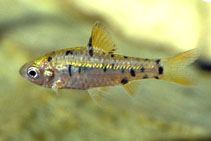
Body with 4-7 narrow bars, more or less complete or dissociated into series of spots; complete lateral line; last simple dorsal ray serrated posteriorly; yellowish in color (Ref. 43281).
Body shape (shape guide): fusiform / normal.
Adults feed on worms, crustaceans, insects, plant matter (Ref. 7020) and detritus (Ref. 5258). Aquarium keeping: in groups of 5 or more individuals; minimum aquarium size 60 cm (Ref. 51539).
Life cycle and mating behavior
Geschlechtsreife | Fortpflanzung | Ablaichen | Eier | Fecundity | Larven
Spawns during early morning hours.
Chen, X., J.-H. Pan, Z. Liu and D. Liang, 1991. Barbinae. p. 136-167. In J.-H. Pan, L. Zhong, C.-Y. Zheng, H.-L. Wu and J.-H. Liu (eds.) The freshwater fishes of Guangdong Province. Guangdong Science and Technology Press, Guangzhou. 589 p. (Ref. 33326)
IUCN Rote Liste Status (Ref. 130435: Version 2025-1)
Bedrohung für Menschen
Harmless
Nutzung durch Menschen
Fischereien: hoch kommerziell; Aquarium: hoch kommerziell
Tools
Zusatzinformationen
Download XML
Internet Quellen
Estimates based on models
Phylogenetic diversity index (Ref.
82804): PD
50 = 0.5000 [Uniqueness, from 0.5 = low to 2.0 = high].
Bayesian length-weight: a=0.01349 (0.00803 - 0.02267), b=3.08 (2.94 - 3.22), in cm total length, based on LWR estimates for this species & Genus-body shape (Ref.
93245).
Trophic level (Ref.
69278): 2.8 ±0.28 se; based on food items.
Widerstandsfähigkeit (Ref.
120179): hoch, Verdopplung der Population dauert weniger als 15 Monate. (tm<1; multiple spawning per year; Fec=300).
Fishing Vulnerability (Ref.
59153): Low vulnerability (10 of 100).
🛈