>
Cichliformes (Cichlids, convict blennies) >
Cichlidae (Cichlids) > Geophaginae
Etymology: Apistogramma: Greek, apisto = uncertain + Greek, gramma = graphic signal (Ref. 45335); diplotaenia: Named for its colour pattern, Greek 'diploos' for double and 'taenia' for stripe; noun in apposition (Ref. 86447).
More on author: Kullander.
Environnement : milieu / zone climatique / profondeur / gamme de distribution
Écologie
; eau douce benthopélagique; pH range: 6.0 - 6.5; dH range: 6 - 20. Tropical; 24°C - 29°C (Ref. 13614)
South America: Amazon River basin, in the middle Negro River from San Carlos to the Arirará River.
Taille / Poids / Âge
Maturité: Lm ? range ? - ? cm
Max length : 2.9 cm SL mâle / non sexé; (Ref. 36377); 4.5 cm TL (female)
Description synthétique
Clés d'identification | Morphologie | Morphométrie
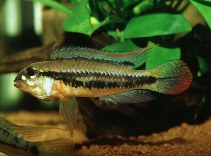
Vertèbres: 24 - 25. This elongate (depth 25.1-27.8% of SL), relatively small (<30 mm SL) species is distinguished by the following set of characters: presence of anguloarticular lateralis canal; four lateralis canal foramina on dentary; two infraorbital bones, second with three foramina; serrated posttemporal, supracleithrum and preoperculum; bi- or tri-serial jaw dentition; no scales on anterior chest region; males with low dorsal fin, caudal fin elongately rounded, soft dorsal, anal and pelvic fins with prolonged tips; a unique colour pattern with two horizontal bands on side, converging posteriorly and anteriorly, a ventrally widened suborbital stripe continued across branchiostegal membrane and 3 spots associated with pectoral fin base (2 on medial side of axilla, 1 on lateral side on bases of rays) (Ref. 86447).
Body shape (shape guide): fusiform / normal.
Eggs are deposited on the ceiling of caves and are tendered by the female parent (Ref. 47893). Attains a maximum length 2.92 cm SL (Ref. 98797).
Cycle de vie et comportement reproducteur
Maturité | Reproduction | Frai | Œufs | Fécondité | Larves
Eggs are attached to the roof of caves, female cares for eggs and larvae (Ref. 47893).
Kullander, S.O., 2003. Cichlidae (Cichlids). p. 605-654. In R.E. Reis, S.O. Kullander and C.J. Ferraris, Jr. (eds.) Checklist of the Freshwater Fishes of South and Central America. Porto Alegre: EDIPUCRS, Brasil. (Ref. 36377)
Statut dans la liste rouge de l'IUCN (Ref. 130435: Version 2025-2)
Menace pour l'homme
Harmless
Utilisations par l'homme
Outils
Articles particuliers
Télécharger en XML
Sources Internet
Estimations basées sur des modèles
Indice de diversité phylogénétique (Réf.
82804): PD
50 = 0.5000 [Uniqueness, from 0.5 = low to 2.0 = high].
Bayesian length-weight: a=0.01820 (0.00845 - 0.03919), b=2.99 (2.82 - 3.16), in cm total length, based on LWR estimates for this Genus-body shape (Ref.
93245).
Niveau trophique (Réf.
69278): 3.2 ±0.4 se; based on size and trophs of closest relatives
Résilience (Réf.
120179): Milieu, temps minimum de doublement de population : 1,4 à 4,4 années (Assuming Fec<1000).
Vulnérabilité de la pêche (Ref.
59153): Low vulnerability (10 of 100).
🛈