This website uses cookies to enhance your browsing experience and ensure the functionality of our site. For more detailed information about the types of cookies we use and how we protect your privacy, please visit our Privacy Information page..
×
Cookie Settings
This website uses different types of cookies to enhance your experience. Please select your preferences below:
Perccottus glenii, Chinese sleeper : fisheries, aquarium
分類 / Names 俗名 | 同種異名 | Catalog of Fishes(屬, 種) | ITIS | CoL | WoRMS | Cloffa
Teleostei > Gobiiformes (Gobies) 鱸形目 (Gobies) > Odontobutidae (Freshwater sleepers) 沙塘鱧科 (Freshwater sleepers)
Etymology: Perccottus:Greek, perke = perch + Gr, kottos = a fish (Ref. 45335). Eponymy: Colonel Nikolay Alexandrovich Glen was honoured because of his efforts that improved the well-being of the Ussuri River area (Ussuriland) of Russia, the type locality. (Ref. 128868), visit book page. More on author: Dybowski.
Environment: milieu / climate zone / 深度上下限 / distribution range 生態學
Asia: Tugur (Sea of Okhotsk) and Amur southward to Yangtze and Fujian. In Amur, historically known from the middle and lower Amur (from Tygda Rive down to the estuary) with tributaries Zeya, Sungari, Ussuri and the Khanka Lake basin. Reported from Shilka in the upper Amur where it is introduced (Ref. 82587). Introduced in Europe (Ref. 59043). At least one country reports adverse ecological impact after introduction (Ref. 2058). 歐洲與亞洲: 俄國,中國, 東北方的韓國與阿穆爾河流域。 至少一個國家報告引入後的不利的生態衝擊。
Length at first maturity / 大小 / 重量 / 年齡
成熟度: Lm7.0, range 6 - 8 cm Max length : 25.0 cm TL 雄魚/尚未辨別雌雄; (Ref. 2059); 最大體重: 250.00 g (Ref. 80031); 最大年齡: 7 年 (Ref. 56557)
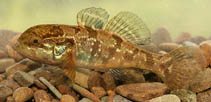
背棘 (總數) : 6 - 8; 背的軟條 (總數) : 9 - 11; 臀棘: 1 - 3; 臀鰭軟條: 7 - 10. Distinguished from other European freshwater species by the following characters: 2 dorsals with the first with 6-8 simple rays, and the second with 2-3 simple and 8-12 branched rays; no spines on first dorsal; no barbels; pelvics not fused into a disc; no lateral line canals; males during spawning period, develop a hump on nape and become black with bright green spots on body and unpaired fins (Ref. 59043). Body shape (shape guide): fusiform / normal.
Occurs in lentic waters, lakes, ponds, backwaters and marshes with dense underwater vegetation and avoids river stretches with fast and even slow current (Ref. 59043). Prefers stagnant rivers and bogs (Ref. 80031). Can tolerate poorly oxygenated water and able to survive in dried out or completely frozen water bodies by digging itself into mud where it hibernates. A voracious predatory fish (wide variety of invertebrates, tadpoles and fish) constituting a most serious threat to aquatic fauna wherever it occurs. In small water bodies; known to extirpate almost all other fish species and amphibian larvae. Spawns for the first time at 1-3 years and about 6.0 cm SL. Spawns several potions of eggs in May to June at 15-20°C. Elongated eggs (3.8 x 1.3 mm) with sticky filaments usually deposited in one row close to water surface on underwater structures such as roots, leaves and others. Males guard the eggs and pelagic larvae (Ref. 59043).
Berg, L.S., 1965. Freshwater fishes of the U.S.S.R. and adjacent countries. volume 3, 4th edition. Israel Program for Scientific Translations Ltd, Jerusalem. (Russian version published 1949). (Ref. 2058)
Phylogenetic diversity index (參考文獻 82804): PD50 = 1.0000 [Uniqueness, from 0.5 = low to 2.0 = high].
Bayesian length-weight: a=0.01072 (0.00629 - 0.01825), b=3.09 (2.94 - 3.24), in cm total length, based on LWR estimates for this species & (Sub)family-body (Ref. 93245).
營養階層 (參考文獻 69278): 3.6 ±0.54 se; based on food items.
Generation time: 8.5 ( na - na) years. Estimated as median ln(3)/K based on 1 growth studies.
回復力 (參考文獻 120179): 低的, 最小族群倍增時間4.5 - 14 年 (Preliminary K or Fecundity.).
Fishing Vulnerability (Ref. 59153): Moderate to high vulnerability (51 of 100). 🛈