>
Blenniiformes (Blennies) >
Tripterygiidae (Triplefin blennies) > Tripterygiinae
Etymology: Enneapterygius: Greek, ennea = nine times + Greek, pterygion = little fin (Ref. 45335).
Eponymy: Dr Helen K Larson was Curator of Fishes, Museum and Art Gallery of the Northern Territory, Darwin, Australia (1981–2009), retiring as Emeritus Curator, and is now a Research Associate at the Museum of Tropical Queensland, Townsville. [...] (Ref. 128868), visit book page.
More on author: Fricke.
Environment: milieu / climate zone / пределы глубины / distribution range
экология
морской демерсальный; немигрирующий; пределы глубины 0 - 12 m (Ref. 13227). Tropical
Southwest Pacific: Papua New Guinea and Australia.
Size / Вес / Возраст
половая зрелость: Lm ? range ? - ? cm
Max length : 3.5 cm SL самец/пол неопределен; (Ref. 13227)
Краткое описание
определительные ключи | морфология | морфометрия
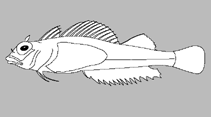
колючие лучи спинного плавника (общее число) : 14 - 17; членистые (мягкие) лучи спинного плавника (общее число) : 8 - 12; колючие лучи анального плавника: 1; членистые (мягкие) лучи анального плавника: 14 - 20. Male dusky red with black "mask" covering most of head, chest, and pectoral-fin base, about 5 whitish saddles/bars on back (a few extending on lower side), and white bar on pectoral-fin base (immediately posterior to black area). Female mainly brownish or greenish with white bars. Dorsal rays III + XI-XIV + 8-12; anal rays I,14-20; pectoral rays 14-18; pelvic rays I,2; lateral line interrupted, 14-20 + 13-20; head, chest, and pectoral-fin base scaleless; lobate orbital tentacle; mandibular pores 3-4 + 1-2 +3-4. Maximum size to 4.4 cm TL (Ref. 90102).
Body shape (shape guide): elongated; Cross section: oval.
Adults occur at shallow depths, often seen associated with coralline rocks, seagrass or algae (Ref. 13227). Eggs are hemispherical and covered with numerous sticky threads that anchor them in the algae on the nesting sites (Ref. 240). Larvae are planktonic which occur primarily in shallow, nearshore waters (Ref. 94114).
Life cycle and mating behavior
половая зрелость | размножение | нерест | икра | Fecundity | личинки
Fricke, R., 1994. Tripterygiid fishes of Australia, New Zealand and the southwest Pacific Ocean (Teleostei). Theses Zool. 24:1-585. (Ref. 13227)
Статус Красного Списка МСОП (Ref. 130435: Version 2025-1)
Угроза для людей
Harmless
Использование человеком
рыболовство: интереса не представляет
дополнительная информация
инструменты
Специальные отчеты
Скачать в формате XML
ресурсы в Интернет
Estimates based on models
Preferred temperature (ссылка
123201): 23.3 - 29.3, mean 27.9 °C (based on 1065 cells).
Phylogenetic diversity index (ссылка
82804): PD
50 = 0.5000 [Uniqueness, from 0.5 = low to 2.0 = high].
Bayesian length-weight: a=0.00617 (0.00288 - 0.01322), b=3.04 (2.86 - 3.22), in cm total length, based on LWR estimates for this (Sub)family-body shape (Ref.
93245).
Trophic level (ссылка
69278): 3.1 ±0.3 se; based on size and trophs of closest relatives
устойчивость к внешним воздействиям (ссылка
120179): высокий, минимальное время удвоения популяции до 15 месяцев (Preliminary K or Fecundity.).
Fishing Vulnerability (Ref.
59153): Low vulnerability (10 of 100).
🛈
Nutrients (Ref.
124155): Calcium = 1370 [560, 6,275] mg/100g; Iron = 4.37 [1.63, 10.78] mg/100g; Protein = 17.4 [15.7, 19.0] %; Omega3 = 0.157 [0.038, 0.675] g/100g; Selenium = 93 [17, 373] μg/100g; VitaminA = 12 [2, 84] μg/100g; Zinc = 5.75 [2.55, 10.70] mg/100g (wet weight);