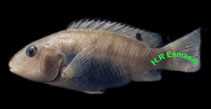
Environnement : milieu / zone climatique / profondeur / gamme de distribution
Écologie
; eau douce; saumâtre benthopélagique. Tropical; 32°N - 27°N
Asia: Southern Iran above the Straits of Hormuz.
Taille / Poids / Âge
Maturité: Lm ? range ? - ? cm
Max length : 9.7 cm SL mâle / non sexé; (Ref. 36597)
Description synthétique
Clés d'identification | Morphologie | Morphométrie
Épines dorsales (Total) : 14 - 16; Rayons mous dorsaux (Total) : 9 - 11; Rayons mous anaux: 6 - 9; Vertèbres: 28 - 30. Diagnosis: dental field on lower pharyngeal bone nearly circular; teeth of lower pharyngeal bone of uniform size, not enlarged medially; cheek, operculum, belly, isthmus and area between pectortal and pelvic fin bases naked or poorly scaled; anal and dorsal fins rounded posteriorly; pectoral fins short, not reaching vent; scales cycloid, with granular posterior circuli bearing rounded or irregular protuberances; inferior apophysis for support of swimbladder centred around 4th vertebra; mesethmoid not meeting vomer; median length of lower pharyngeal bone 31.8-40.9% length of head; pharyngeal blade/median length toothed area 0.6-1.0 (Ref. 36597).
Body shape (shape guide): fusiform / normal.
Restricted to salty streams (Ref. 12251, 36597), rarely in freshwaters (Ref. 36597), which are constantly warm, unshaded, usually with muddy bottoms, with little vegetation other than encrusting algae, and are subject to massive flooding during winter rains (Ref. 12251, 36597). Stomach contents consist of various algae (including diatoms) and detritus, indicating that it feeds on bottom deposits (Ref. 36597) and by scraping aufwuchs (Ref. 12251, 36597). This maternal mouthbrooder can brood up to 38 large eggs; females carry eggs in March (Ref. 12251, 36597). Because of the restricted range of this fish and the continual warfare and oil pollution in the area, this fish may be well on its way to extinction (Ref. 12251).
Cycle de vie et comportement reproducteur
Maturité | Reproduction | Frai | Œufs | Fécondité | Larves
Female mouth brooder with up to 38 eggs (Ref. 36597).
Coad, B.W., 1982. A new genus and species of cichlid endemic to southern Iran. Copeia 1982(1):28-37. (Ref. 36597)
Statut dans la liste rouge de l'IUCN (Ref. 130435: Version 2025-2)
Menace pour l'homme
Harmless
Utilisations par l'homme
Outils
Articles particuliers
Télécharger en XML
Sources Internet
Estimations basées sur des modèles
Indice de diversité phylogénétique (Réf.
82804): PD
50 = 0.7500 [Uniqueness, from 0.5 = low to 2.0 = high].
Bayesian length-weight: a=0.01288 (0.00694 - 0.02391), b=2.98 (2.82 - 3.14), in cm total length, based on LWR estimates for this species & (Sub)family-body (Ref.
93245).
Niveau trophique (Réf.
69278): 2.0 ±0.00 se; based on food items.
Résilience (Réf.
120179): Milieu, temps minimum de doublement de population : 1,4 à 4,4 années (Assuming Fec<1000 per year).
Vulnérabilité de la pêche (Ref.
59153): Low vulnerability (10 of 100).
🛈