>
Perciformes/Notothenioidei (Icefishes) >
Channichthyidae (Crocodile icefishes)
Etymology: Chaenodraco: Greek, chaeno = to yawn + Greek, drako = dragon (Ref. 45335).
Eponymy: Dr Edward Adrian Wilson (1872–1912) was an English physician, polar explorer, painter and natural historian. [...] (Ref. 128868), visit book page.
More on author: Regan.
Environment: milieu / climate zone / kisaran kedalaman / distribution range
Ekologi
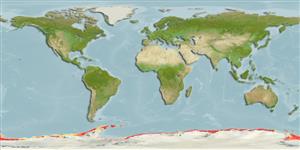
laut bentopelagis; kisaran kedalaman 200 - 800 m (Ref. 5200). Polar; 60°S - 78°S, 180°W - 180°E (Ref. 5200)
Southern Ocean: Circum-Antarctic on Antarctic continental shelf. Northernmost records from vicinity of South Orkney Islands and Antarctic Peninsula.
Length at first maturity / Size / Weight / umur
Kematangan: Lm ?, range 23 - ? cm
Max length : 43.0 cm TL jantan/; (Ref. 5200); common length : 30.0 cm TL jantan/; (Ref. 2805)
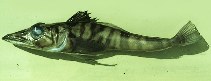
Duri punggung (Keseluruhan (total)) : 5 - 8; duri punggung lunak (Keseluruhan (total)) : 38 - 42; Duri dubur: 0; Sirip dubur lunak: 32 - 36. Supraorbital ridge not crenulated. Middle lateral line restricted to caudal peduncle; lower lateral line originating from in front of anal-fin origin to above sixth anal ray. Maxilla extending to below anterior third of eye. Opercular bones with 2 upper and 3 lower spines. Preopercular-mandibular canal not joined to temporal canal. Pelvic fins extending beyond anal-fin origin. In life, pale grey, whitish ventrally. Differentiated by the dorsoventrally oval shape; the prominent distally rounded rostrum, pseudo-rostrum and pseudo-antirostrum; the clearly defined excisura ostii and pseudo-excisura ostii; the acutely constricted collum; and the well developed colliculli.
Ontogeny: The excisura ostii and the pseudo-excisura ostii become deeper and the crista inferior becomes less distinct with an increase in the fish size.
Body shape (shape guide): elongated; Cross section: oval.
Common in shallower waters of the continental shelf, especially on banks less than 250 m deep in areas where local upwelling increase food supply (Ref. 6390). Postlarvae and pelagic juveniles are also found in the upper 100 m (Ref. 5200). Food consists of fishes and krill. Spawn in winter (Ref. 6390). Larval pelagic phase is long (Ref. 28915). Prey to penguins and seals (Ref. 6390). Utilized as a food fish (Ref. 5200).
Iwami, T. and K.-H. Kock, 1990. Channichthyidae. p. 381-389. In O. Gon and P.C. Heemstra (eds.) Fishes of the Southern Ocean. J.L.B. Smith Institute of Ichthyology, Grahamstown, South Africa. 462 p. (Ref. 5200)
Status IUCN Red List (Ref. 130435: Version 2025-1)
ancaman kepada manusia
Harmless
penggunaan manusia
Perikanan: nilai komersial kecil
Alat, peralatan
laporan khas
muat turun XML
Sumber internet
Estimates based on models
Preferred temperature (Acuan
123201): -1.8 - 1.4, mean -0.8 °C (based on 825 cells).
Phylogenetic diversity index (Acuan
82804): PD
50 = 1.0000 [Uniqueness, from 0.5 = low to 2.0 = high].
Bayesian length-weight: a=0.00098 (0.00057 - 0.00167), b=3.53 (3.38 - 3.68), in cm total length, based on LWR estimates for this species & (Sub)family-body (Ref.
93245).
Trophic level (Acuan
69278): 3.2 ±0.2 se; based on diet studies.
Daya lenting (Acuan
120179): sedang, Waktu penggandaan populasi minimum 1.4 - 4.4 tahun (Fec = 393-862).
Fishing Vulnerability (Ref.
59153): Low to moderate vulnerability (33 of 100).
🛈
Climate Vulnerability (Ref.
125649): High vulnerability (64 of 100).
🛈
Nutrients (Ref.
124155): Calcium = 24.1 [13.1, 52.5] mg/100g; Iron = 0.394 [0.164, 0.807] mg/100g; Protein = 16.6 [14.9, 18.4] %; Omega3 = 0.238 [0.110, 0.509] g/100g; Selenium = 23 [8, 56] μg/100g; VitaminA = 20.2 [4.2, 101.6] μg/100g; Zinc = 0.466 [0.301, 0.712] mg/100g (wet weight);