Issue
Generic placement is tentative. This species lacks several osteological characters diagnostic for the genus and preliminary molecular data place it close to Petroleuciscus (Ref. 59043).
Environment: milieu / climate zone / rango de profundidad / distribution range
Ecología
; agua dulce bentopelágico. Temperate
Europe: Kuban drainage from Adagum to Laba systems.
Tamaño / Peso / Age
Madurez: Lm ? range ? - ? cm
Max length : 16.0 cm SL macho / no sexado; (Ref. 59043)
Short description
Claves de identificación | Morfología | Morfometría
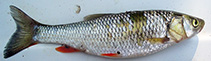
Diagnosed from its congeners in Black Sea basin by having the following characters: anal fin with 9½ branched rays; 36-41 + 3 scales on lateral line; interorbital distance 32-35% HL; postorbital distance 45-47% HL; eye diameter 22-26% HL, 1.3-1.5 times in snout length; body depth 21-27% SL; a row of black pigment along free margin of each flank scale, forming a regular reticulate pattern; anal and pelvic fins orange to red (Ref. 59043).
Body shape (shape guide): fusiform / normal.
Inhabits piedmont and mountain streams with Mediterranean water regime, strong to moderate current, rock or gravel bottom. Abundant along shores and may be restricted to very small pools during summer. Feeds predominantly on terrestrial insects, benthic invertebrates and algae. Breeds in shallow riffle habitats, with strong current and stone or pebble bottom, at 10-20 cm water depth. Moves downstream in winter to deeper pools and to uppermost stretches of streams in summer (Ref. 59043).
Life cycle and mating behavior
Madurez | Reproducción | Puesta | Huevos | Fecundidad | Larva
Spawns in shallow riffles, with strong current and stone or pebble bottom, at 10-20 cm water depth. Females deposit eggs in 2-3 portions throughout the spawning period. Eggs are 1.9 in diameter, orange, adhere to pebbles and hatch in 3 days. Larvae do not possess adhesive glands, are negatively phototactic and hide under stones. They drift to shallow areas after active feeding activity commences (Ref. 59043).
Kottelat, M. and J. Freyhof, 2007. Handbook of European freshwater fishes. Publications Kottelat, Cornol and Freyhof, Berlin. 646 pp. (Ref. 59043)
IUCN Red List Status (Ref. 130435: Version 2025-1)
Threat to humans
Harmless
Human uses
Pesquerías: sin interés
Herramientas
Special reports
Download XML
Fuentes de Internet
Estimates based on models
Phylogenetic diversity index (Referencia
82804): PD
50 = 0.5000 [Uniqueness, from 0.5 = low to 2.0 = high].
Bayesian length-weight: a=0.00813 (0.00411 - 0.01607), b=3.13 (2.97 - 3.29), in cm total length, based on LWR estimates for this Genus-body shape (Ref.
93245).
Nivel trófico (Referencia
69278): 3.3 ±0.4 se; based on size and trophs of closest relatives
Resiliencia (Referencia
120179): Medio, población duplicada en un tiempo mínimo de 1.4-4.4 años (Preliminary K or Fecundity.).
Fishing Vulnerability (Ref.
59153): Low vulnerability (10 of 100).
🛈