>
Siluriformes (Catfishes) >
Heptapteridae (Three-barbeled catfishes)
Etymology: Pimelodella: Diminutive latinized of greek, pimele = fat + Greek, odous, odella = little teeth (Ref. 45335).
Eponymy: Dr Jacques Géry (1917– 2007) was a French physician and ichthyologist. [...] (Ref. 128868), visit book page.
Environment: milieu / climate zone / rango de profundidad / distribution range
Ecología
; agua dulce demersal. Tropical
South America: Maroni/Marowijne River basin.
Tamaño / Peso / Age
Madurez: Lm ? range ? - ? cm
Max length : 10.8 cm SL macho / no sexado; (Ref. 101566)
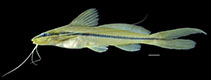
Appears to be smaller than P. cristata. P. geryi and P. cristata share the same biotope. Inhabits the high and middle parts of rivers, in zones with more or less fast flowing water and a rocky substrate (rock clusters consisting of pre-Cambrian pebbles, shales). Lies hidden under rocks, letting its barbel out to auscultate the exterior world. Emits growling sounds regularly (alarm signals?) and goes stalk-hunting frequently scouting around its hiding place. The population is organized in a hierarchical structure based on size, with markedly aggressive behavior. The juveniles are found mostly in seasonal little tributaries. Diet changes according to size: small crustaceans, insect larvae and adult, and fish. This slow-growing species can live for more than 10 years in the wild (Ref. 35381).
Life cycle and mating behavior
Madurez | Reproducción | Puesta | Huevos | Fecundidad | Larva
Reproductive mode and guild assumed to be the same as congeners (Ref. 56810).
Bockmann, F.A. and G.M. Guazzelli, 2003. Heptapteridae (Heptapterids). p. 406-431. In R.E. Reis, S.O. Kullander and C.J. Ferraris, Jr. (eds.) Checklist of the Freshwater Fishes of South and Central America. Porto Alegre: EDIPUCRS, Brasil. (Ref. 36914)
IUCN Red List Status (Ref. 130435: Version 2025-1)
Threat to humans
Harmless
Human uses
Herramientas
Special reports
Download XML
Fuentes de Internet
Estimates based on models
Phylogenetic diversity index (Referencia
82804): PD
50 = 0.5000 [Uniqueness, from 0.5 = low to 2.0 = high].
Bayesian length-weight: a=0.00891 (0.00519 - 0.01532), b=2.97 (2.82 - 3.12), in cm total length, based on LWR estimates for this species & Genus-body shape (Ref.
93245).
Nivel trófico (Referencia
69278): 3.6 ±0.55 se; based on food items.
Fishing Vulnerability (Ref.
59153): Low vulnerability (10 of 100).
🛈